Weight on the Moon Converter
Type in your Earth weight and instantly see what you would weigh on the Moon and thirteen other worlds. Your mass in kilograms never changes, but your weight scales with each body's surface gravity using the simple rule weight on body = Earth weight times the gravity ratio.
🚀Popular Weight Presets
⚖Your Weight Details
Enter the number shown on your bathroom scale.
All results are shown back in this same unit.
Choose whether your entered value is measured on Earth or on the body.
Card two reports your weight on this body.
Controls rounding on the weight cards.
Standard Earth gravity, used to find your mass in kg.
🔢Conversion Snapshot
🌎Gravity Ratio and Surface g by Body
| Space Body | Gravity Ratio vs Earth | Surface g (m/s2) | Type |
|---|---|---|---|
| Earth | 1.000 | 9.807 | Home planet |
| Moon | 0.1655 | 1.623 | Our moon |
| Mercury | 0.378 | 3.707 | Rocky planet |
| Venus | 0.907 | 8.895 | Rocky planet |
| Mars | 0.377 | 3.697 | Rocky planet |
| Jupiter | 2.360 | 23.14 | Gas giant |
| Saturn | 0.916 | 8.983 | Gas giant |
| Uranus | 0.889 | 8.718 | Ice giant |
| Neptune | 1.120 | 10.98 | Ice giant |
| Pluto | 0.0635 | 0.623 | Dwarf planet |
| Sun | 27.03 | 265.1 | Our star |
🧍What a 150 lb Person Weighs Everywhere
| Body | Gravity Ratio | 150 lb Person | 68 kg Person |
|---|---|---|---|
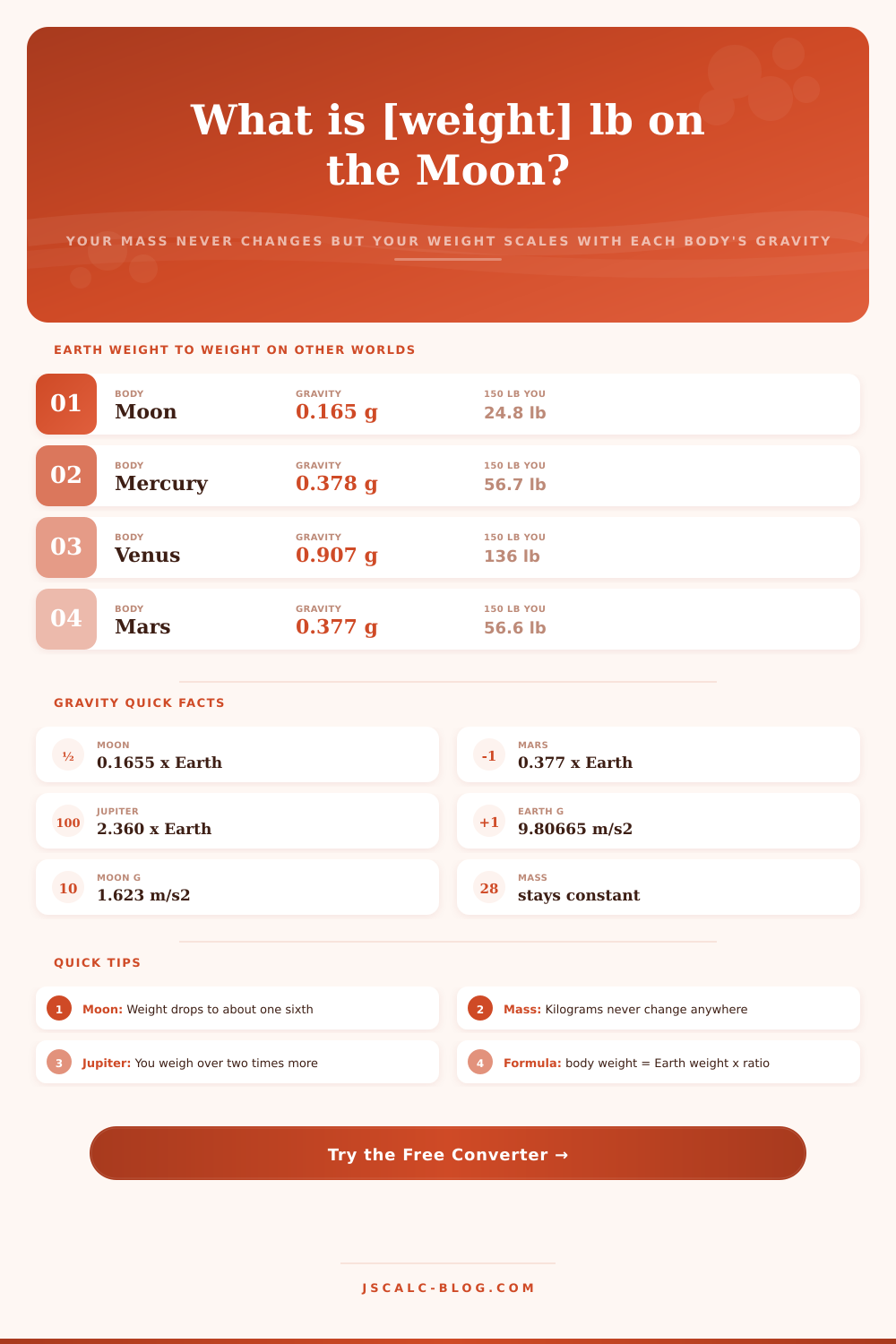
| Moon | 0.1655 | 24.8 lb | 11.3 kg-f |
| Mercury | 0.378 | 56.7 lb | 25.7 kg-f |
| Venus | 0.907 | 136.1 lb | 61.7 kg-f |
| Mars | 0.377 | 56.6 lb | 25.6 kg-f |
| Jupiter | 2.360 | 354.0 lb | 160.5 kg-f |
| Saturn | 0.916 | 137.4 lb | 62.3 kg-f |
| Neptune | 1.120 | 168.0 lb | 76.2 kg-f |
| Pluto | 0.0635 | 9.5 lb | 4.3 kg-f |
| Titan | 0.138 | 20.7 lb | 9.4 kg-f |
| Sun | 27.03 | 4054.5 lb | 1838 kg-f |
📏Weight Unit Conversions
| Unit | Equals | In Kilogram-Force | Note |
|---|---|---|---|
| 1 lb | 0.4536 kg-f | 0.4536 | Pound force |
| 1 kg | 1 kg-f | 1.0000 | Kilogram force |
| 1 stone | 14 lb | 6.3503 | British stone |
| 1 N | 0.1020 kg-f | 0.1020 | Newton, SI force |
| 1 kg-f | 9.80665 N | 1.0000 | Weight of 1 kg on Earth |
| 1 kg-f | 2.2046 lb | 1.0000 | Same as 2.2046 pounds |
🗃Full Body Comparison Grid
| Body | Surface g (m/s2) | Ratio vs Earth | 150 lb Weighs | Jump Height Factor | Note |
|---|---|---|---|---|---|
| Moon | 1.623 | 0.1655 | 24.8 lb | 6.04x higher | Apollo landings |
| Mercury | 3.707 | 0.378 | 56.7 lb | 2.65x higher | Smallest planet |
| Venus | 8.895 | 0.907 | 136.1 lb | 1.10x higher | Earth twin size |
| Mars | 3.697 | 0.377 | 56.6 lb | 2.65x higher | Red planet |
| Jupiter | 23.14 | 2.360 | 354.0 lb | 0.42x lower | Largest planet |
| Saturn | 8.983 | 0.916 | 137.4 lb | 1.09x higher | Ringed giant |
| Uranus | 8.718 | 0.889 | 133.4 lb | 1.12x higher | Tilted ice giant |
| Neptune | 10.98 | 1.120 | 168.0 lb | 0.89x lower | Windiest planet |
| Pluto | 0.623 | 0.0635 | 9.5 lb | 15.7x higher | Dwarf planet |
| Io | 1.796 | 0.183 | 27.5 lb | 5.46x higher | Volcanic moon |
| Europa | 1.314 | 0.134 | 20.1 lb | 7.46x higher | Icy ocean moon |
| Titan | 1.353 | 0.138 | 20.7 lb | 7.25x higher | Saturn moon |
⚙Formula Breakdown
💡Space Weight Insights
The Moon converter lets you calculate what you would weigh on other celestial objects. Type in how much you currently weigh and where you want to go. Then it spits out your new weight there. It also shows your mass in kilogram and the surface gravity of the place.
That’s because based on a simple law of physics, mass is constant wherever you may be, while weight is not. In everyday speech, it’s common for people to use pounds and kilograms interchangeably as if they’re both measurements of the same thing. But they are not. Mass is an amount of matter, like how much your body weighs. And the mass doesn’t change. You have 68 kilograms of you. Of tissue, and muscle, and bone, and water. It is on Earth. You are in orbit. It is on Mars. Your mass remains your mass no matter where you are.
How to Use the Moon Weight Converter
Weight is a force: the force of gravity on your mass. Different worlds has different amounts of gravity. So your weight can (and will) change depending on where you are, while your mass never changes. The converter makes that distinction clear.
Calculating interplanetary weight is simple math. Every planet have a surface gravity ratio relative to Earth. That’s how strong its gravity is relative to ours. On the Moon, it’s 0.1655. That’s just under one-sixth of Earth’s gravity. On Mars, it’s 0.377. Jupiter’s gravity is 2.360 and the Sun is 27.03. If you know your weight here on Earth, multiply that number by the ratio of that planet or body. A 150 pound person would weigh 24.8 pounds on the Moon (150 times 0.1655 = 24.8). They’d be down around 354 poundss on Jupiter. Our tool will calculate that in an instant.
Want to go the other way? Know your weight somewhere else and want to know what you’d weigh here on Earth? Divided your weight by the ratio and you’ve got it. Whatever you enter gets converted to kilogram-force and reported back as your mass in kilograms. Divide it by 2.2046 for pounds, multiply it by 6.35029 for stone, or divide it by 9.80665 for newtons. And the tool notes that mass doesn’t change, it stays the same. No matter what body you select, that number isn’t going to alter. As you watch the weight value bounce around and the mass value remain constant, you can see the distinction between the two ideas.
For example, in the fourth result, it displays surface gravity in meters per second squared. That means the normal gravity on Earth is 9.80665. Then, multiply the planet’s ratio by that number to find its surface gravity. For example, moon’s gravity is 1.623. Mars is 3.697. Neptune’s gravity is 10.98, just a bit more than Earth’s gravity. That means it will affect both your jumping ability and the way objects fall. The gravity is so much less on the moon. If you jumped up a little bit on Earth, you’d have a lot farther to go there. That is why we saw the Apollo astronauts sort of bouncing around when they was walking on the moon.
Other than the Moon, there are lots of other things you can choose from in the drop-down menu. It’ll tell you how much you’d weigh on Mercury, Venus, Mars, Jupiter, Saturn, Uranus, Neptune, Pluto and Ceres. There is a bunch of big moons too like Titan, Europa and Io. And you can even try out the Sun. If you’re 150 pounds on Earth, you’d be more than 4,000 pounds on the Sun. You wouldn’t be able to stand there because of gravity. But it does illustrate just how strong gravity is on the Sun. It tells you the gravity ratio for each one so you can easily see where you’d be lightest and heaviest.
This will let you load up common scenarios with just ten presets. How much does a 150-pound human weigh on the Moon? What about a 200-pound human on Mars? What about an 80-pound child on lunar surface? They also have metric variants, such as how much a 70-kilogram human weighs on the Moon. It even supports odd units like stone. The nice thing is that each preset automatically populates the fields and runs the conversion right away. Before you’ve finished reading the button text, you have your answer. Then you can modify one or more of the fields and run other variations.
There are a couple extra tables under the calculator that give more information: One lists all the bodies with their corresponding surface gravity and gravity ratio. Another table shows how much 68 kilograms and 150 pounds weigh on each world so that you can plug in your own numbers and compare. There’s also a unit conversion table showing how pounds, kilograms, stone, and newtons relates to kilogram-force.
The information is combined into a broad comparison grid. This grid includes surface gravity, ratio, sample weight, jump height factor, and notes for multiple destinations so you can easily compare worlds without running separate calculations.
It’s a good physics demo. It shows kids the difference between weight and mass at play. The bodies change and only the weights respond. For space nerds, it answers the question of what it would be like to stand on the Sun or Titan. And for teachers, there’s a chance to have some examples on hand that work well in class.
The converter shows your weight, your mass, and the surface gravity of each world. A kid can ask what they always wanted to know… How much do you weigh? And they get a real answer for the 14 worlds in our solar system.