Wire Size Voltage Drop Calculator
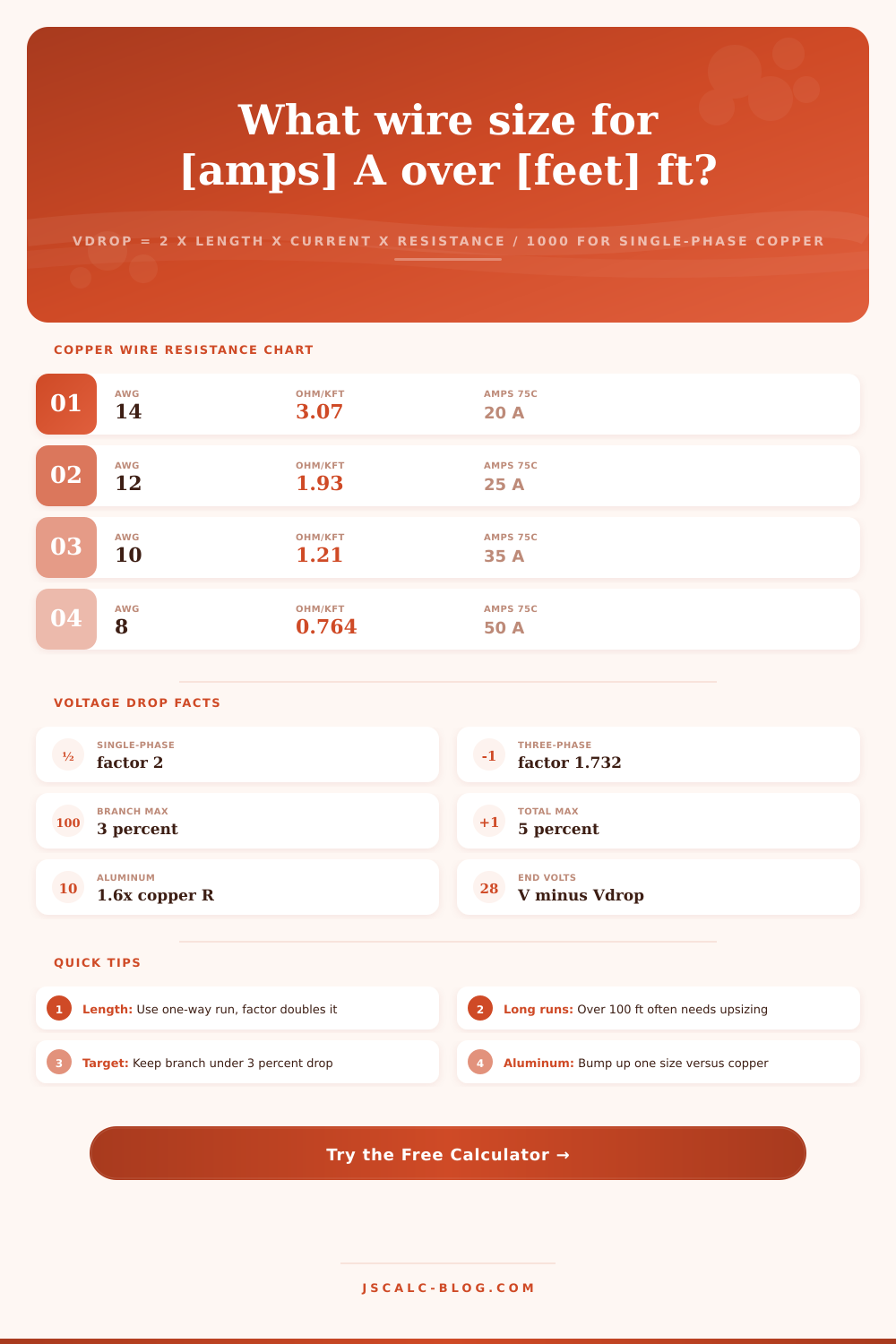
Estimate conductor voltage drop with Vdrop = 2 x length x current x resistance / 1000 for single-phase, or the 1.732 factor for three-phase. Check the percent drop against NEC targets of 3 percent for a branch and 5 percent overall, see the voltage at the load end, and find the smallest AWG copper or aluminum conductor that keeps you inside your target.
🎯Real Circuit Presets
🔌Circuit and Conductor Inputs
Nominal supply voltage, for example 120, 208, 240, or 480.
Single-phase doubles the run; three-phase uses 1.732.
Aluminum has roughly 1.6 times the resistance of copper.
Resistance per 1000 ft is pulled from the NEC-style table.
Distance from source to load, one direction only.
Meters are converted to feet internally (1 m = 3.281 ft).
Continuous or design current the circuit carries.
NEC recommends 3 percent branch and 5 percent total.
Used only when the target above is set to Custom.
🔢Formula Snapshot
📋Conductor Resistance (Ohm per 1000 ft)
| Wire Size | Copper Ohm/kft | Aluminum Ohm/kft | Notes |
|---|---|---|---|
| 14 AWG | 3.07 | 4.91 | Small branch |
| 12 AWG | 1.93 | 3.09 | Common outlet |
| 10 AWG | 1.21 | 1.94 | Dryer, small AC |
| 8 AWG | 0.764 | 1.22 | Range, welder |
| 6 AWG | 0.491 | 0.786 | Sub-feed 55A |
| 4 AWG | 0.308 | 0.493 | Feeder 70A |
| 2 AWG | 0.194 | 0.310 | Feeder 95A |
| 1/0 AWG | 0.122 | 0.195 | Service 125A |
| 2/0 AWG | 0.0967 | 0.155 | Service 145A |
| 4/0 AWG | 0.0608 | 0.0973 | Service 195A |
⚡Copper Ampacity by Temperature Rating
| Wire Size | Amps at 60C | Amps at 75C | Typical Breaker |
|---|---|---|---|
| 14 AWG | 15 A | 20 A | 15 A |
| 12 AWG | 20 A | 25 A | 20 A |
| 10 AWG | 30 A | 35 A | 30 A |
| 8 AWG | 40 A | 50 A | 40 A |
| 6 AWG | 55 A | 65 A | 50 A |
| 4 AWG | 70 A | 85 A | 70 A |
| 2 AWG | 95 A | 115 A | 100 A |
| 1/0 AWG | 125 A | 150 A | 125 A |
| 3/0 AWG | 165 A | 200 A | 200 A |
| 4/0 AWG | 195 A | 230 A | 200 A |
📏NEC Recommended Maximum Voltage Drop
| Circuit Part | Recommended Max | On 120 V | On 240 V |
|---|---|---|---|
| Branch circuit | 3 percent | 3.6 V | 7.2 V |
| Feeder only | 3 percent | 3.6 V | 7.2 V |
| Feeder plus branch | 5 percent | 6.0 V | 12.0 V |
| Sensitive electronics | 2 percent | 2.4 V | 4.8 V |
| Motor at start | Under 10 percent | 12.0 V | 24.0 V |
| Long outdoor run | 3 percent | 3.6 V | 7.2 V |
🗃Wire Size Comparison Grid
| Wire Size | Area kcmil | Area mm2 | Copper Ohm/kft | Ampacity 75C | Typical Use |
|---|---|---|---|---|---|
| 14 AWG | 4.11 | 2.08 | 3.07 | 20 A | Lighting circuits |
| 12 AWG | 6.53 | 3.31 | 1.93 | 25 A | Receptacles |
| 10 AWG | 10.4 | 5.26 | 1.21 | 35 A | Water heater |
| 8 AWG | 16.5 | 8.37 | 0.764 | 50 A | Range, dryer |
| 6 AWG | 26.2 | 13.3 | 0.491 | 65 A | Sub-panel feed |
| 4 AWG | 41.7 | 21.2 | 0.308 | 85 A | Small feeder |
| 2 AWG | 66.4 | 33.6 | 0.194 | 115 A | Service feeder |
| 1/0 AWG | 105.6 | 53.5 | 0.122 | 150 A | Main service |
| 2/0 AWG | 133.1 | 67.4 | 0.0967 | 175 A | Large service |
| 4/0 AWG | 211.6 | 107.2 | 0.0608 | 230 A | 200A service |
⚙Formula Breakdown
💡Wiring Design Tips
Now maybe you’ve been noticing how dim the lights are these days, or how the air conditioner drops voltage on the whole house. You’re experiencing voltage drop in action. It’s annoying, it’s invisible, and thankfully, we can plan for it and make it go away.
The wire size voltage drop calculator does all the hard work for us here. It makes complex math easy and gives a simple pass/fail decision at the end.
How to Use a Voltage Drop Calculator
All wires has some amount of resistance. Resistance uses voltage before it gets to the item you want it powering. At short runs, you hardly even notice. Stretch the run to a subpanel or a shed, though, and those missing volts becomes very important. It’s simple, just Physics at work. While both copper and aluminum wires does conduct electricity well, they’re not perfect. There’s a specific rating for how much each size of wire resists electricity, measured in ohms per thousand feet. The thinner the wire, the greater amount of resistance; the higher the resistance, the more voltage that’s wasted along the way as heat. This means that a large six AWG cable will drop less voltage then a small skinny twelve AWG cable carrying equal current.
The calculator simply takes that into account with standard formula automatically, no need to remember the coefficients. On single-phase circuits, the current travels out and then returns, so length is doubled. For three-phase, it multiplies by 1.732. Just select type of phase you want to calculate, and let the tool do the math.
Basically what we’re looking at here are our two main targets from the National Electrical Code… Three percent for branch circuits and five percent for the entire path (service to load). While it’s not a hard law everywhere, it is a strong recommendation for a good reason. Motors running low on voltage will pull more current as compensation, overheating their windings in the process. Sensitive electronics may simply stop working altogether. By keeping the drop below three percent you’ll ensure your equipment runs efficiently and has a longer life.
The tool tells you instantly whether or not the wire size you have chosen will realy work with your specific set-up. This is where folks get hung up. They choose their wire solely by current capacity. Yep, that twelve AWG wire can handle twenty amps without melting. So what? That run is two hundred feet long. There’ll be a ton of voltage drop. Your lights will dim but the wire won’t melt. To meet requirements of both safety and performance you have to check voltage drop in addition to ampacity. When ampacity looks good but the voltage drop calculator shows a fail, time to upsize the conductor. Sometimes just jumping from twelve AWG to ten AWG will pull those percentages into an acceptable range.
Material also matters. For the same size, copper has roughly 60 percent lower resistance than aluminum. (Aluminum is also less expensive and lighter.) You won’t be able to replace them one-for-one without accounting for that fact. If you choose aluminum from the dropdown, the calculator will do this automatically for you. It’s a simple toggle, but it would of saved you some costly mistakes out in the field.
Keep in mind that heat ratings are not the same as voltage drop. Your wire needs to be large enough to transport current safely, and then large enough to reduce loss even more. Whichever is the greater requirement dictate your wire size. This is meant to be used in conjunction with a good engineer, NOT AS A replacement for one! Local amendments, temperature corrections, and conduit fill factors affects real-world installs. However, this is a great starting point for most residential or light commercial applications.
This will show you why larger wire should of been used for longer runs. It helps you avoid those red-faced “I’ve got a new piece of equipment, but it’s not performing well” situations caused by insufficient power at the start of the install. You’ll save yourself some headaches down the road by doing it right up front.