Thrust to Weight Ratio Calculator
Calculate TWR, net acceleration, hover throttle, and thrust margin for launches, landings, hovering craft, and test stands.
Formula Breakdown
| Body | Gravity (m/s^2) | Earth g | Hover force for 1,000 kg |
|---|---|---|---|
| Earth | 9.80665 | 1.000 g | 9.81 kN |
| Moon | 1.620 | 0.165 g | 1.62 kN |
| Mars | 3.711 | 0.379 g | 3.71 kN |
| Venus | 8.870 | 0.905 g | 8.87 kN |
| Titan | 1.352 | 0.138 g | 1.35 kN |
| Europa | 1.315 | 0.134 g | 1.32 kN |
| Use case | Typical TWR | Net acceleration on Earth | Practical reading |
|---|---|---|---|
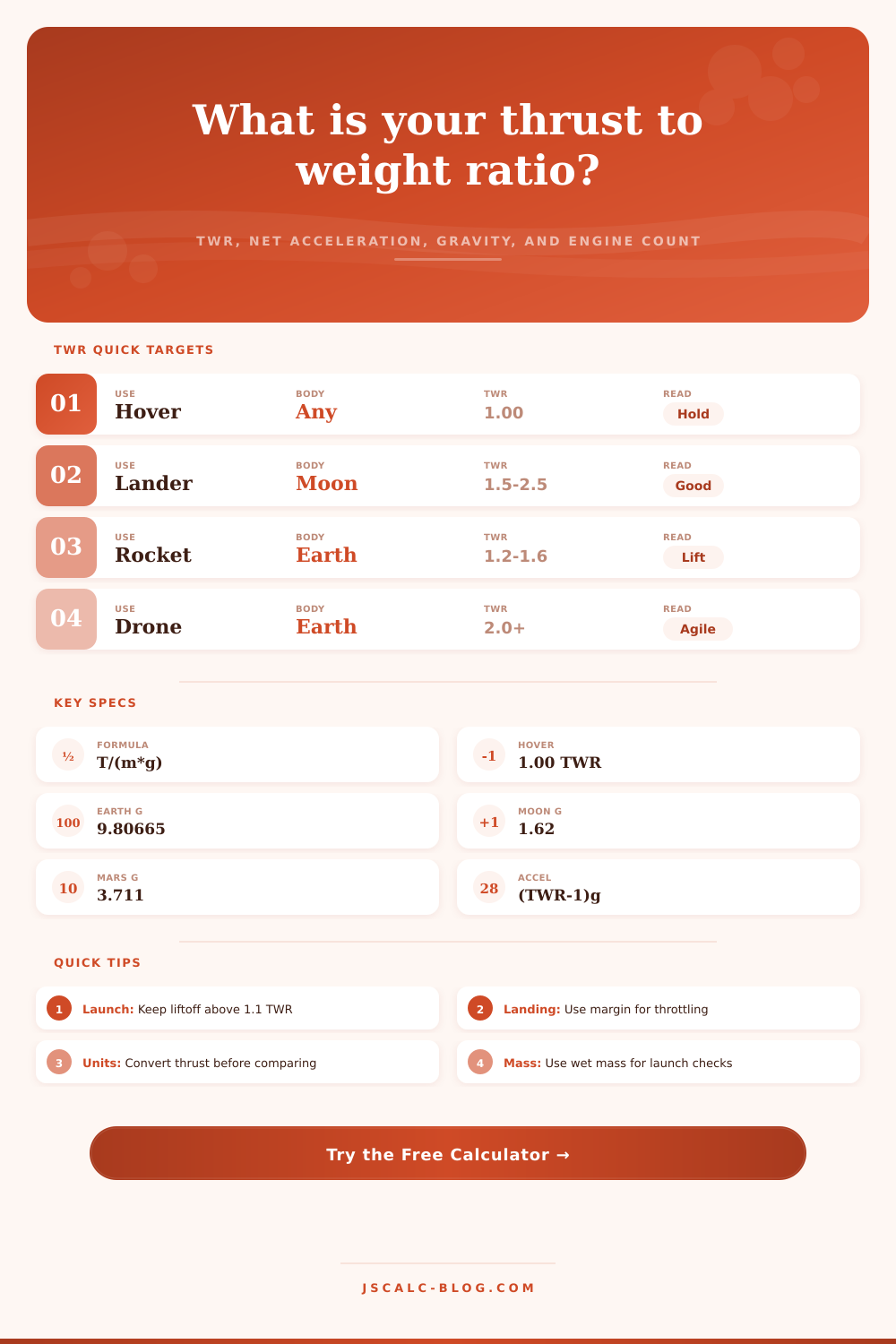
| Exact hover | 1.00 | 0.00 m/s^2 | Balances weight with no climb margin. |
| Gentle lander | 1.20 to 1.50 | 1.96 to 4.90 m/s^2 | Usable if throttle control is precise. |
| Earth rocket liftoff | 1.20 to 1.60 | 1.96 to 5.88 m/s^2 | Common launch pad range before drag and guidance losses. |
| High-performance drone | 2.00 to 4.00 | 9.81 to 29.42 m/s^2 | Fast climb and recovery authority. |
| Static test below lift | 0.20 to 0.95 | negative | Cannot lift vertically in the chosen gravity. |
| Aggressive launch vehicle | 1.60 to 2.00 | 5.88 to 9.81 m/s^2 | High initial acceleration; structural loads matter. |
| Quantity | Input unit | SI conversion | When to use |
|---|---|---|---|
| Thrust | 1 N | 1 N | Small test rigs, lab data, exact SI values. |
| Thrust | 1 kN | 1,000 N | Rocket engines, landers, larger motors. |
| Thrust | 1 MN | 1,000,000 N | Large launch vehicles and clustered engines. |
| Thrust | 1 lbf | 4.44822 N | US engine specs and hobby rocket motors. |
| Mass | 1 metric ton | 1,000 kg | Launch vehicles and spacecraft wet mass. |
| Mass | 1 lbm | 0.453592 kg | US payloads, drones, and airframes. |
| Phase | What TWR answers | Mass to enter | Watch item |
|---|---|---|---|
| Launch pad | Can it leave the pad? | Wet mass | Drag and gravity losses need margin above 1.00. |
| Upper stage | How hard can it accelerate? | Current stage mass | High TWR can raise loads late in burn. |
| Powered landing | Can it arrest descent? | Landing mass | Hover throttle must sit within engine throttle range. |
| Hover vehicle | Can it hold altitude? | Flight-ready mass | Useful control authority usually needs TWR above 1.2. |
| Static test | What force margin exists? | Held-down mass | Fixtures must carry full thrust and side loads. |
Launch Vehicle
Use sea-level thrust for pad liftoff. A value around 1.2 to 1.6 is often practical because it clears the pad while leaving room for guidance and structural limits.
Lunar Lander
Lower lunar gravity makes hover possible with less thrust, but landing still needs margin. Check hover throttle so the engine can modulate descent.
Mars Ascent
Mars gravity is about 38% of Earth gravity, so the same thrust produces a much higher TWR than it would at the launch pad on Earth.
Drone Hover
Multirotors usually need more than hover thrust. A TWR near 2.0 gives climb, gust, and maneuver margin without running every motor at full output.
VTOL Test
For lift fans or jet lift, TWR below 1.0 means a tethered or rolling test only. Vertical climb starts once total vertical thrust exceeds weight.
Static Stand
Static tests can show TWR below or above 1.0, but the vehicle is restrained. The number still reveals lift potential for the same mass and gravity.
For rockets, the point of take-off is most important part of a launch. Up until then, everything has been sitting there still, and when it finally launches into the air, everything hinges upon one thing: the thrust-to-weight ratio. Does it have enough force to lift off? And if not, how close did it come?
Thrust-to-weight is a dimensionless figure; it’s sneaky. You’d think more power would make for better rocket. But power isn’t what counts here; mass do. Triple the weight of the rocket and double its thrust, and you’re still behind.
Why Thrust-to-Weight Ratio Matters for Rockets
Once you plug in the specs of your engines, your vehicle mass, and the gravity at your location, this calculator will do math for you. No need to memorise slug-pounds-newton conversions.
So how do we make this simple? Simple: Divide total thrust by weight. What’s the weight? That’s force due to local gravitational pull times some mass. When weight equals the thrust, the ratio is exactly one. You’ll stay put. You’re neither rising nor falling. Instead, you’re burning fuel but not climbing.
So, all launch vehicles requires a ratio greater than one to get off the ground. The amount by which you exceed one determines your rate of climb (acceleration). It also specifies the stress your airframe has to withstands.
And then there’s gravity. It makes all difference. There is presets for Earth, the Moon, Mars and more moons. What doesn’t work so well here may have plenty of margin up there. Lunar gravity is about a sixth of Earth’s, which means an engine with a thrust-to-weight ratio of 0.2 would hover in perfect balance on the moon. That’s why mission designers keep it in mind. You can’t plan out a landing profile without considering how much gravity pulls you where you’re going. Depending on which planet or moon you choose, the tool will adjust accordingly to help make sure the ratio reflects real-world physical forces.
Throttle authority is more important than many admit; a high thrust-to-weight ratio does you no good if you can’t control the engines. 80% of full thrust might be needed for hover, and you only have throttles that go down to 90%. Oops, now you’re crashed. Hover throttle % is shown on the calculator. Is it within your engine operating range? That tells you if you’ll have enough control while descending.
Landing is a precise operation when powered. You want enough thrust to overcome gravity, and enough control to decelerate your descent without crashing. If your hover throttle percentage doesn’t fall within your engine operating range, you need less mass or more thrust.
There is one common point of confusion: mass units. In regular engineering conversations, people tend to swap these terms interchangeably. The calculator does not allow that. You input a value in pounds, tons, or kilograms for mass. Then it will convert everything into standard units and apply the gravitational constant. That way you don’t end up mixing mass in pounds with thrust in newtons which aren’t converted back and forth. Any little error there mess up the whole ratio. It can lead you to believe you’re about to liftoff when in reality your rocket won’t budge from the pad.
The thrust-to-weight ratio only accounts for one thing, static thrust. That’s not factoring in guidance loss nor drag. And it doesn’t account for gravity losses while you try to point the vehicle. In practice, actual ratio will be less than theoretical number. That’s why rockets typically target a launch ratio between 1.2 and 1.6. They are adding a bit extra to account for drag and the slow start as they climb.
For drones, there needs to be even more room. A drone with a camera might have a ratio of say two or three to accommodate aggressive moves and gusty winds. That is why understanding that ratio makes what was once just pieces of paper and glue come together into something with a design. That number will let you know if you have the right size motor to move your payload. It also lets you know if you’re overbuilding for your budget or under building for your mission.
Whether you’re sizing motors for a drone or creating a rocket model, numbers all need to add up. And when you put them in the calculator, it clears things up. It takes away the guesswork and shows you what actualy happens. Either you have lift or you don’t.