Propellant Mass Calculator
Estimate rocket propellant from wet and dry mass, or solve final mass from delta-v and specific impulse using the rocket equation on JSCalc-Blog.com.
🚀 Mission-stage presets
⚙ Stage inputs
Propellant Mass Results
🧪 Propellant family reference grid
📐 Formula breakdown
📊 Mission comparison grid
| Mission stage | Common delta-v band | Typical Isp band | Usual propellant fraction | Calculator preset use |
|---|---|---|---|---|
| CubeSat kick stage | 120 to 700 m/s | 220 to 320 s | 0.35 to 0.65 | Small trim, deployment, orbit raise |
| SmallSat apogee stage | 900 to 1800 m/s | 285 to 330 s | 0.55 to 0.78 | Transfer orbit circularization |
| Lander descent stage | 1500 to 2300 m/s | 310 to 340 s | 0.55 to 0.75 | Throttleable terminal descent |
| Lunar ascent stage | 1700 to 2100 m/s | 315 to 330 s | 0.45 to 0.65 | Depart low gravity surface |
| LEO second stage | 3000 to 5200 m/s | 330 to 465 s | 0.80 to 0.92 | Near-orbital insertion burn |
| GTO upper stage | 1800 to 2600 m/s | 320 to 455 s | 0.58 to 0.78 | Transfer orbit injection |
| Interplanetary injection | 2200 to 3800 m/s | 320 to 462 s | 0.65 to 0.86 | Escape or departure burn |
| Reusable booster burn | 1600 to 2600 m/s | 280 to 345 s | 0.70 to 0.88 | Ascent plus reserve estimate |
📚 Reference tables
| Propulsion type | Typical Isp | Notes |
|---|---|---|
| Cold gas | 45 to 75 s | Simple attitude or tiny impulse systems |
| Monopropellant | 220 to 235 s | Hydrazine-class spacecraft thrusters |
| Solid motor | 240 to 290 s | High thrust, fixed propellant load |
| Storable bipropellant | 300 to 335 s | Common upper stages and deep-space craft |
| KeroLOX vacuum | 330 to 360 s | Dense propellant, compact tanks |
| HydroLOX vacuum | 430 to 465 s | High Isp, large low-density tanks |
| Mass term | Meaning | Check |
|---|---|---|
| m0 | Initial wet mass | Must be largest mass |
| mf | Final mass after burn | Includes dry and payload |
| mp | Propellant mass | m0 minus mf |
| ve | Effective exhaust velocity | Isp times g0 |
| MR | Mass ratio | m0 divided by mf |
| PF | Propellant fraction | mp divided by m0 |
🔍 Mass fraction interpretation
| Propellant fraction | What it often indicates | Design pressure | Margin cue |
|---|---|---|---|
| Below 0.35 | Small correction or low delta-v burn | Tankage less dominant | Check minimum impulse and residuals |
| 0.35 to 0.60 | Spacecraft maneuver or ascent in low gravity | Payload and dry mass both matter | Dry plus payload should fit mf comfortably |
| 0.60 to 0.80 | Upper-stage or transfer-stage work | Mass ratio becomes sensitive | Small Isp changes move propellant strongly |
| 0.80 to 0.92 | Launch vehicle stage territory | Structure fraction is critical | Use conservative dry mass and residuals |
| Above 0.92 | Very aggressive single-stage assumption | Often impractical with real tanks | Consider staging or lower delta-v demand |
🧭 Practical mass notes
When propellant is factored in to the math, rocket design goes from being an abstraction to something practical. You realize that each kilo of fuel also weigh down your vehicle, and then you have to get all of that weight up into space. And the result is a self-reinforcing spiral: the more fuel you load on to provide thrust, the heavier the vehicle become, which means you have more mass to accelerate.
The rocket equation feels like it’s a law of physics, one that isn’t negotiable. Leave it to the calculator to do the exponential math, but know what those figures represent if you want to create a stage that gets to orbit as opposed to one that crumbles under its own inertia.
Understanding Rocket Math
Specific Impulse is how efficiently a thruster turn its propellant into thrust. It doesn’t indicate how much space propellant will take up. Density is how much space a tank need for a certain amount of fuel.
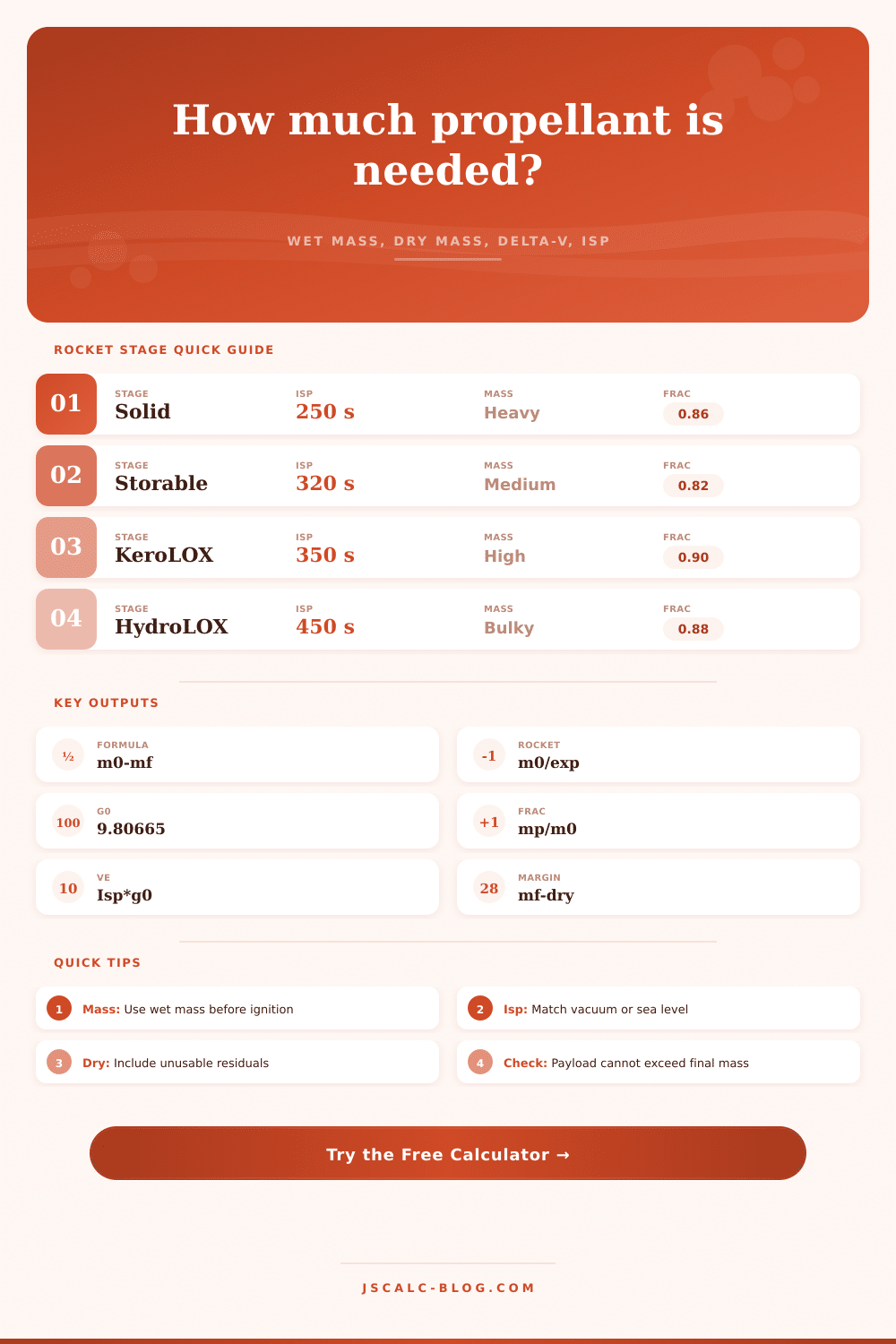
If you have more efficient engine (higher specific impulse) but they run on a low-density fuel like liquid hydrogen, then you’ll require larger tanks and end up sacrificing payload margin with all that extra dry mass. Conversely, if you run kerosene, then you’re less efficient, but since it’s denser, you don’t need as large tank. Different propellants lie somewhere along this spectrum, as the reference table shows, and it comes down to choosing your poison.
If you’re entering both your final dry mass and wet mass, congratulations, you’re betting on structure efficiency. That’s everything that isn’t propellant, like avionics, engines, tanks and the unusable residual left in the tank post-burn. Since most designer think all of their fuel will be burned, they fail to account for these residuals. You can’t pump out the last liter of sloshing fuel, so it adds mass; and goes against you. The calculator show that an overly optimistic dry mass budget commonly result in a negative payload margin.
The other side of the equation is delta-v requirements. To get into any given orbit you need sufficient change in velocity, but each additional hundred meters per second cost exponentially increasing amounts of propellant. At this point the mass ratio come back into play.
High mass ratios is great for performance (most of your vehicle is fuel!), but bad for stability. Too high a propellant fraction make the structure too delicate to sustain launch loads. As we’ll see on the mission comparison grid, second stages used in LEO launches has much higher propellant fractions than small satellite kick motors. Because the kick motor’s job is lightweight, it can afford to be robust, but the second stage need to be light and sleek.
Frequently, when people attempt to solve large scale problems like this they pick an engine with a higher specific impulse to get the job done. However, there are limitations on that approach. If your vehicle geometry won’t accommodate larger tanks, then you can’t switch from a kerosene engine to a hydrogen engine. The entire system trade off, not just the engine. Reducing your avionics rack by fifty kilograms might provide you with more delta-v than swapping engines will. Typicaly it’s the dry mass that holds the margin, not the propulsion system.
Building rockets is always a game of subtraction. If you begin with your mission need then subtract out the mass until it works out. It’s your job to ask the right questions and the calculator will give you the answer. To recognize when optimization should of cease and physics take over. Each gram of dry mass is one more gram you have to lift into space. And when you realize this, things fall into place. No longer do you chase after ideal efficiencies, instead you’re building something that can actualy survive the climb.