Burn Time Calculator
Estimate rocket motor burn duration from propellant mass, thrust, specific impulse, mass flow, total impulse, and average acceleration context.
Burn Time Results
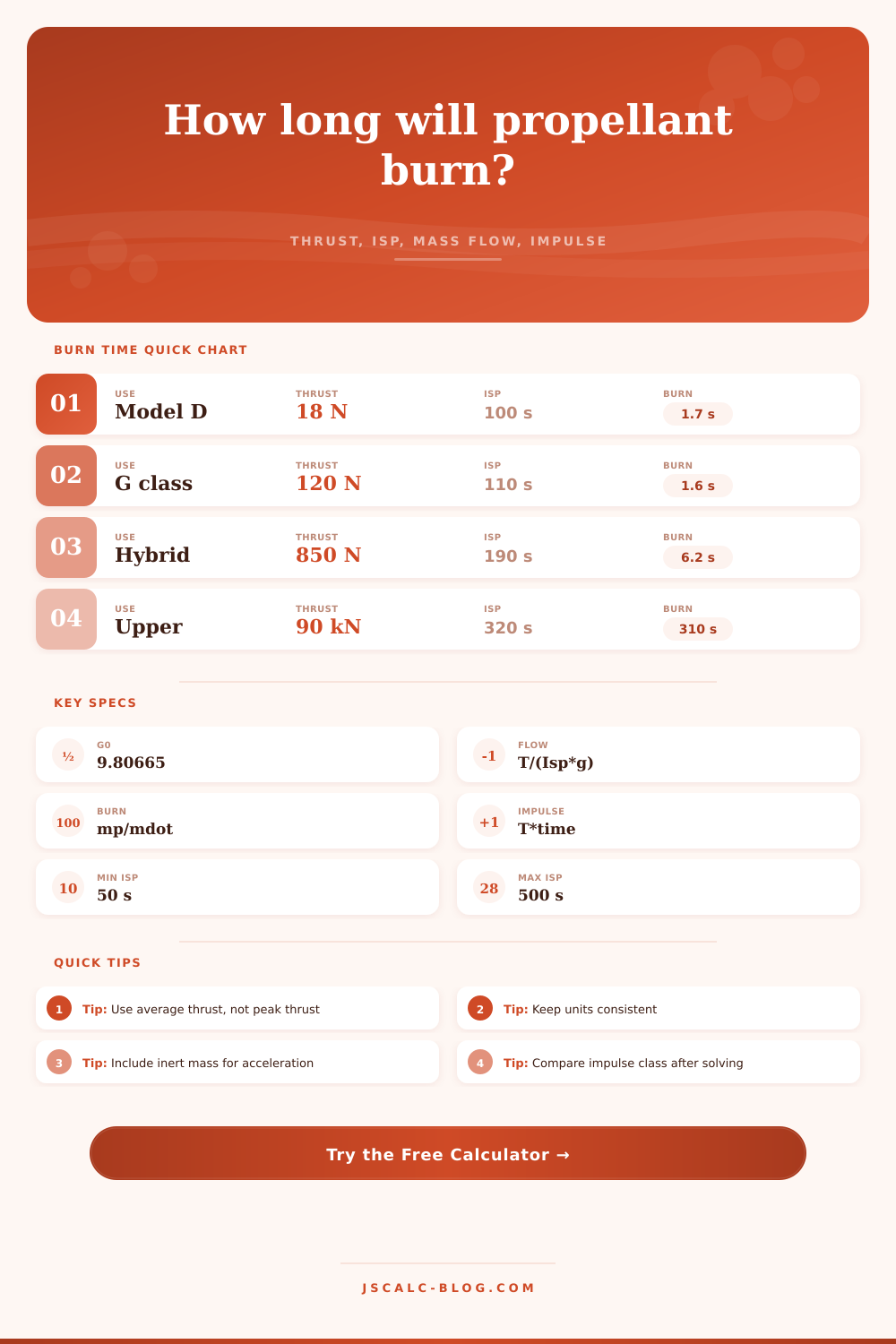
mass flow rate = thrust / (Isp × g0). Use average thrust in newtons, specific impulse in seconds, and standard gravity g0 = 9.80665 m/s².
burn time = usable propellant mass / mass flow rate. The calculator reduces usable propellant by the reserve allowance before dividing by mass flow.
total impulse = average thrust × burn time. This gives newton-seconds in metric mode and pound-force seconds in imperial display mode.
average acceleration context = thrust / average vehicle mass - local gravity. Average mass is dry mass plus half of usable propellant, so it is a context estimate rather than a full trajectory model.
| Motor or Thruster Type | Typical Isp Range | Usual Burn Style | Calculator Note |
|---|---|---|---|
| Model black powder solid | 70 to 100 s | Short fixed burn | Use certified average thrust where available. |
| Composite hobby solid | 90 to 180 s | Short to medium fixed burn | Average thrust smooths the thrust curve spike. |
| Hybrid test motor | 160 to 260 s | Valve-controlled burn | Measured mass flow can be better than nominal Isp. |
| Cold gas thruster | 40 to 80 s | Pulsed or pressure-decay burn | Use direct measured flow for tank blowdown tests. |
| Monopropellant thruster | 180 to 240 s | Pulsed or steady | Total impulse is often the planning metric. |
| Pressure-fed liquid engine | 220 to 330 s | Throttleable steady burn | Average thrust should include throttle schedule. |
| Pump-fed liquid booster | 260 to 360 s | High-flow steady burn | Acceleration changes quickly as propellant drains. |
| Vacuum upper stage | 300 to 465 s | Longer vacuum burn | Use vacuum thrust and vacuum Isp together. |
Short Solid
0.05 to 2 seconds is common for small model-class motors.
Burn time is normally taken from certified thrust data.
Test Stand
Direct mass flow is useful when thrust and tank data are logged.
Compare computed impulse with load-cell integration.
Upper Stage
Long burns often use vacuum thrust and vacuum Isp values.
Acceleration increases as propellant mass decreases.
Pulsed Thruster
Duty cycle reduces average thrust and flow over clock time.
Use a profile factor or measured average flow.
| Class | Total Impulse Range | Example Average Thrust | Approximate Burn Time |
|---|---|---|---|
| D | 20.01 to 40 N·s | 18 N | 1.1 to 2.2 s |
| F | 80.01 to 160 N·s | 50 N | 1.6 to 3.2 s |
| G | 160.01 to 320 N·s | 120 N | 1.3 to 2.7 s |
| H | 320.01 to 640 N·s | 220 N | 1.5 to 2.9 s |
| I | 640.01 to 1280 N·s | 450 N | 1.4 to 2.8 s |
| J | 1280.01 to 2560 N·s | 850 N | 1.5 to 3.0 s |
| K | 2560.01 to 5120 N·s | 1200 N | 2.1 to 4.3 s |
| L | 5120.01 to 10240 N·s | 2200 N | 2.3 to 4.7 s |
| Quantity | Metric Unit | Imperial Unit | Conversion |
|---|---|---|---|
| Thrust | newton (N) | pound-force (lbf) | 1 lbf = 4.44822 N |
| Mass | kilogram (kg) | pound-mass (lbm) | 1 lbm = 0.453592 kg |
| Mass flow | kg/s | lbm/s | 1 lbm/s = 0.453592 kg/s |
| Acceleration | m/s² | ft/s² | 1 m/s² = 3.28084 ft/s² |
| Total impulse | N·s | lbf·s | 1 lbf·s = 4.44822 N·s |
| Specific impulse | seconds | seconds | Same value in both systems |
| Context | Expression | Meaning | Use in Calculator |
|---|---|---|---|
| Initial mass | dry mass + propellant | Mass at ignition | Shows the low end of acceleration. |
| Final mass | dry mass | Mass after burnout | Shows the high end of acceleration. |
| Average mass | dry mass + propellant/2 | Simple midpoint estimate | Used for the result card. |
| Gross acceleration | thrust / mass | Thrust-only acceleration | Helpful for horizontal test context. |
| Net acceleration | thrust / mass - gravity | Vertical upward context | Shown in the result card by default. |
| g multiple | net accel / g0 | Acceleration relative to Earth gravity | Included in the breakdown row. |
It’s launch day. You’re standing at the launch pad with a rocket strapped into place. The engine fires up, the ground drops from beneath you, and you hope for the best, that there’s enough gas in the tank to get you to apogee rather than running out of power halfway to space.
Burn time is what separates you from knowing for sure. It is not some spec sheet number, but the lifeblood of whether you’ll end up with a functional spacecraft, or have a very expensive pile of scrap metal. When you understand exactly how long your motor burns, you know how to build a vehicle capable of surviving its own launch.
How to Calculate Rocket Burn Time
Above is a little calculator that does all this mass conservation/thermodynamic work for you. Put in your propellant mass, thrust and specific impulse (Isp) and out comes duration. But the inputs are where the real engineering happens.
Specific impulse (often written simply as “Isp”) is a way to measure how efficient rockets are at producing thrust. It’s the miles per gallon of spaceflight. A high Isp means you’re getting more thrust per kilogram of fuel carried. Liquid engines typically reach very high Isp numbers; solid motors is usually lower.
If you input a low Isp for an engine with high performance, then your burn time will appear longer than what it truly is. This results in overconfidence in terms of your range.
The secret variable that links fuel consumption to thrust is mass flow rate, which is essentially how fast your engine consumes fuel. Your thrust rating and standard gravity will calculate it for you. No need to figure it out yourself. It’s simple math, just be careful with your units. Mixing metric and imperial units is the fastest way to lose a rocket. Stick with one and have the converter handle everything else.
Another handy little addition is the reserve allowance. Never in real life do you actualy burn all the propellant. Some gets wedged in the grain or left in the tank. A five percent buffer ensures you don’t plan a burn you’ll never actually experience.
Now what about acceleration? Acceleration varies continuously during the flight. Because the aircraft is lighter due to fuel consumption, the same amount of thrust produce more acceleration at the end of the burn than at the beginning. Most calculations of acceleration assume only the beginning value (ignition) but neglect updating it for the rest of the burn. The midpoint of your mass are used as an average context here.
Acceleration is an estimate (not a trajectory simulation). What does it tell you? Does your design hold up under that stress? If your rocket cannot withstand three Gs, and your average acceleration hits four, you have a design problem. If your average acceleration is 4, then you have a design problem. This matters for performance or structural integrity.
Motors also vary. Some are fixed. It is like model rocket motors; you get a Class G motor. That thing’s gonna burn for roughly one and a half seconds. And you can’t do anything about it.
Others throttle. They’re hybrid or liquid engines that let you adjust their thrust on the fly. The tool accounts for this change when adjusting the profile. Some have regressive profiles, meaning they start hard and taper off. Some are progressive, meaning their thrust goes up as they burn longer. If you don’t take that into account, you end up with bad burn times. Average thrust smooths the valleys and the peaks. It gives you a single number to work with.
The other wrinkle is pulsed thrusters. These fire in bursts. How much thrust do they generate? On average that depends on their duty cycle. A ten percent duty cycle means the engine is off ninety percent of the time. With a profile factor you can adjust the tool for this fact. It scales back the thrust to account for reality. This is useful for cold gas thrusters or attitude control systems. In these cases, you need to know not only how hard it pushes while active but also how long the tank last.
Performance varies with altitude. Sea level versus vacuum The upper stage burns in a vacuum. Specific Impulse is higher, and it can burn longer. If you use sea level data for an upper stage, your performance will look lower then it actually is. You’re able to toggle contexts in the tool. You’ll be planning for when the engine will actualy be operating. It assists in planning for that context.
Gravity losses matter too. The longer you burn, the harder you are fighting gravity. A shorter, high-thrust burn will perform better than a long, low-thrust burn. That’s the tyranny of the rocket equation. Seconds count.
A couple of quick benchmarks are provided in the reference tables on the page. These are average ranges for various classes of motors. Use this to compare your design with what is normal. Identify mistakes before they cost you. For instance, if you calculate that a small motor will burn for ten seconds, there’s something amiss here. The table indicates that these typically burn for under two seconds. It’s a sanity check.
In short: Burn time is all about balance. Too little fuel; and you don’t make it to your destination. Too much fuel, and you’re too heavy to get off the ground.
It takes the abstractions of physics and makes them concrete. Concrete numbers. It provides a clear picture of the trade-offs. If you want more thrust, you’ll have shorter burns and achieve a greater acceleration. If you want to increase your fuel, you’ll have longer burns with a higher total impulse.
What’s right for your mission? The rocket takes off. Or it sits on the pad. It’s the math that decides.