Rocket Thrust Calculator
Calculate nozzle thrust from propellant mass flow, effective exhaust velocity or Isp, pressure thrust, ambient pressure, burn time, and vehicle mass.
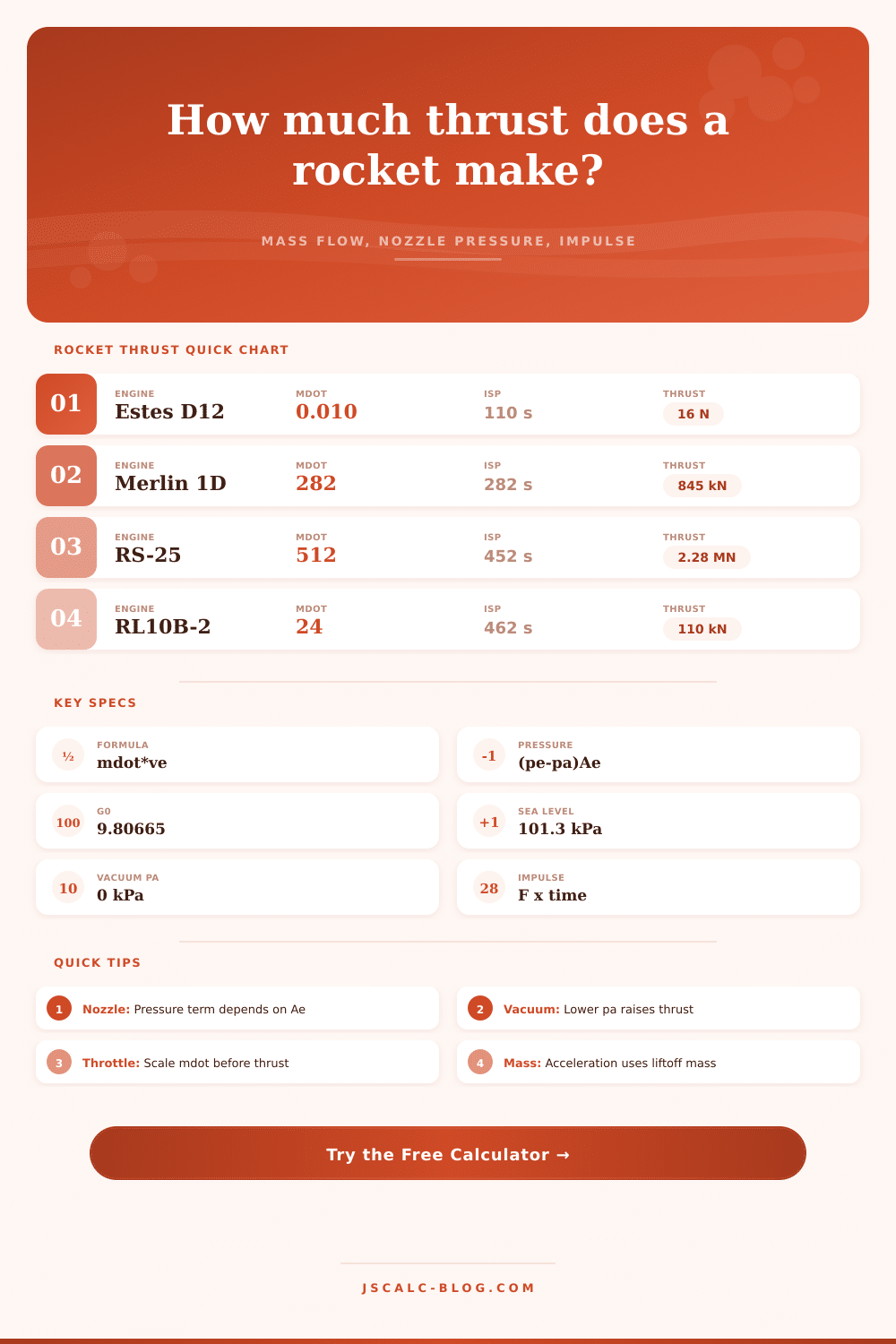
| Preset | Typical role | mdot | Isp or ve | Exit area |
|---|---|---|---|---|
| Estes D12 | Model rocket motor | 0.010 kg/s | 110 s | 0.00003 m2 |
| H180 hobby motor | High-power model motor | 0.065 kg/s | 210 s | 0.00020 m2 |
| SuperDraco | Storable abort engine | 30 kg/s | 235 s | 0.070 m2 |
| Rutherford Vac | Small vacuum engine | 9.5 kg/s | 343 s | 0.210 m2 |
| RL10B-2 | Hydrogen upper stage | 24 kg/s | 462 s | 1.510 m2 |
| Merlin 1D SL | Kerosene booster | 282 kg/s | 282 s | 0.660 m2 |
| RS-25 Vacuum | Hydrogen sustainer | 512 kg/s | 452 s | 4.600 m2 |
| Saturn V F-1 | Kerosene booster | 2578 kg/s | 263 s | 4.300 m2 |
| Raptor 2 SL | Methane booster | 650 kg/s | 330 s | 1.330 m2 |
Preset numbers are rounded engineering examples for calculator exploration; enter measured test data for design work.
| Condition | Altitude | Ambient pressure | Effect on thrust |
|---|---|---|---|
| Sea level standard | 0 m | 101.325 kPa | Largest back pressure |
| Low mountain | 1500 m | 84.6 kPa | Small thrust gain |
| High mountain | 3000 m | 70.1 kPa | Moderate thrust gain |
| Jet altitude | 10000 m | 26.4 kPa | Large pressure gain |
| Upper stratosphere | 20000 m | 5.5 kPa | Near vacuum term |
| Vacuum | Space | 0 kPa | Maximum correction |
| Symbol | Meaning | Calculator input | Formula use |
|---|---|---|---|
| F | Net nozzle thrust | Output | F = mdot*ve + (pe-pa)*Ae |
| mdot | Mass flow rate | Propellant flow | Momentum term mdot ve |
| ve | Effective exhaust velocity | Isp x g0 or direct | Velocity in m/s |
| pe | Nozzle exit pressure | Exit pressure field | Pressure correction |
| pa | Ambient pressure | Sea level, altitude, vacuum, custom | Back pressure term |
| Ae | Nozzle exit area | Exit area field | Multiplies pressure difference |
| It | Total impulse | Burn time | It = F x burn time |
| a | Acceleration | Vehicle mass | a = Ftotal / mass, or minus g0 |
Pressure units are converted to pascals before multiplying by square meters, so 1 kPa x 1 m2 equals 1000 N.
| Class | Approx thrust | Typical use | Acceleration note |
|---|---|---|---|
| Model motor | 10 N to 250 N | Small hobby rockets | Mass measured in grams or kg |
| High-power hobby | 250 N to 5 kN | Certification launches | Short burn, high peak loads |
| Small orbital | 10 kN to 50 kN | Upper stages, small launchers | Vacuum pressure gain matters |
| Medium booster | 500 kN to 1 MN | Reusable first stages | Clustered engines common |
| Heavy booster | 1 MN to 10 MN | Large first stages | TWR drives liftoff margin |
A Rocket thrust calculator takes data from geometry of nozzle and the rate at which propellant flows through it to produce a quantifiable amount of force. It allows you to turn abstract figures into something you can feel the difference of, even if you are just staring at a screen. By seeing how your design pushes against air, you can tell if it is close to what you want or if it need more work.
There are two primary parts of thrust and it’s important to know both if you want anything closer to a good estimate. Momentum thrust occur because a huge amount of hot exhaust rushes out of the nozzle at high speed. Pressure thrust: Because the exiting nozzle pressure is higher than the atmosphere around it, this create a difference in pressure that provides thrust to engine. You will often hear people talking about exhaust velocity as the key factor, but I find that’s often where they get tripped up, if there isn’t enough difference in pressure (nozzle vs. Ambient), your rocket won’t take off. This tool splits those numbers apart so that you’ll be able to identify the source of its lift: Is it primarily due to pressure or momentum?
How to Use the Rocket Thrust Calculator
These figures also depend on altitude, but in an unintuitive manner. Since rockets rise into less-dense air, the pressure of the surrounding atmosphere decrease, changing the pressure thrust term. An optimum-sea-level nozzle might become underexpanded in a vacuum, wasting available thrust. A nozzle designed for optimal performance in a vacuum might instead be overexpanded at sea level, leading to separation and possible loss of structure. By default, the calculator runs from sea level to vacuum. Toggle it back down to sea level or any other desired altitude. Compare the resulting change in engine performance with increasing altitude. You might discover that your sea-level thrust is sufficient but your vacuum thrust isn’t which suggests your nozzle expansion ratio is too small.
Newcomers frequently mistake the difference between raw power and efficiency (specific impulse). Specific impulse is defined in terms of time: how much time can I generate a pound of thrust from a pound of propellant? So an engine with high specific impulse like a liquid hydrogen engine burn its fuel more efficienty, but requires large tanks to contain the low density propellant. An engine like a kerosene one isn’t as efficient, but it is denser so it can fit in simple and small tanks. To make the input process easier, the calculator also calculates effective exhaust velocity automaticly from specific impulse. There is no need to remember the standard gravity constant to arrive at the correct solution. The fixed standard gravity value used for the conversion guarantees that all of your comparisons will be consistent, even if you aren’t standing on the same spot on Earth.
In real world engineering, you make tradeoffs instead of getting every number possible from a theoretical perspective. For example, a larger and more moddern nozzle is usually heavier, meaning your vehicle will have more mass. More mass slow down the acceleration which makes the gravity losses worse as the rocket climbs up into space. The acceleration figure in the results section can help you work out the equation here. You want enough thrust to go against drag and gravity but not so much that you use too much propellant or stress the airframe. The way to balance this is with the thrust-to-weight ratio. If this value is less than 1 then the rocket won’t get off the ground. If it’s way more than one, you might just be carrying around a lot of mass that you don’t really need for the engine.
To use it, there are preset buttons for engines like the RS-25 or Merlin 1D so you have some basis off comparison for your designs. The numbers for those engines will tell you how the pressure terms relates to the exit area, how mass flow relates to thrust, etc. It serves as a sort of check on whether your inputs make sense or not. You put in your numbers and if the thrust comes out higher or lower than you were expecting, then you can look at the input values compared to a known engine and spot where yours might differ. That makes the calculator useful not only as a way to predict results but as a way to find problems.
This enables designing in confidence, knowing what forces you have working for/against you. You can see exactly how much lift you’re getting and where it’s coming from. As you go up, and/or throttle back down this changes some of the numbers, but not the underlying physics. Letting the tool do the math and units-conversion stuff lets you think about the engineering issues instead. It lets you see what path your design would of take if built before you build it. Rocketry lives and dies by small margins. Knowing that stuff is half the battle towards orbital flight.