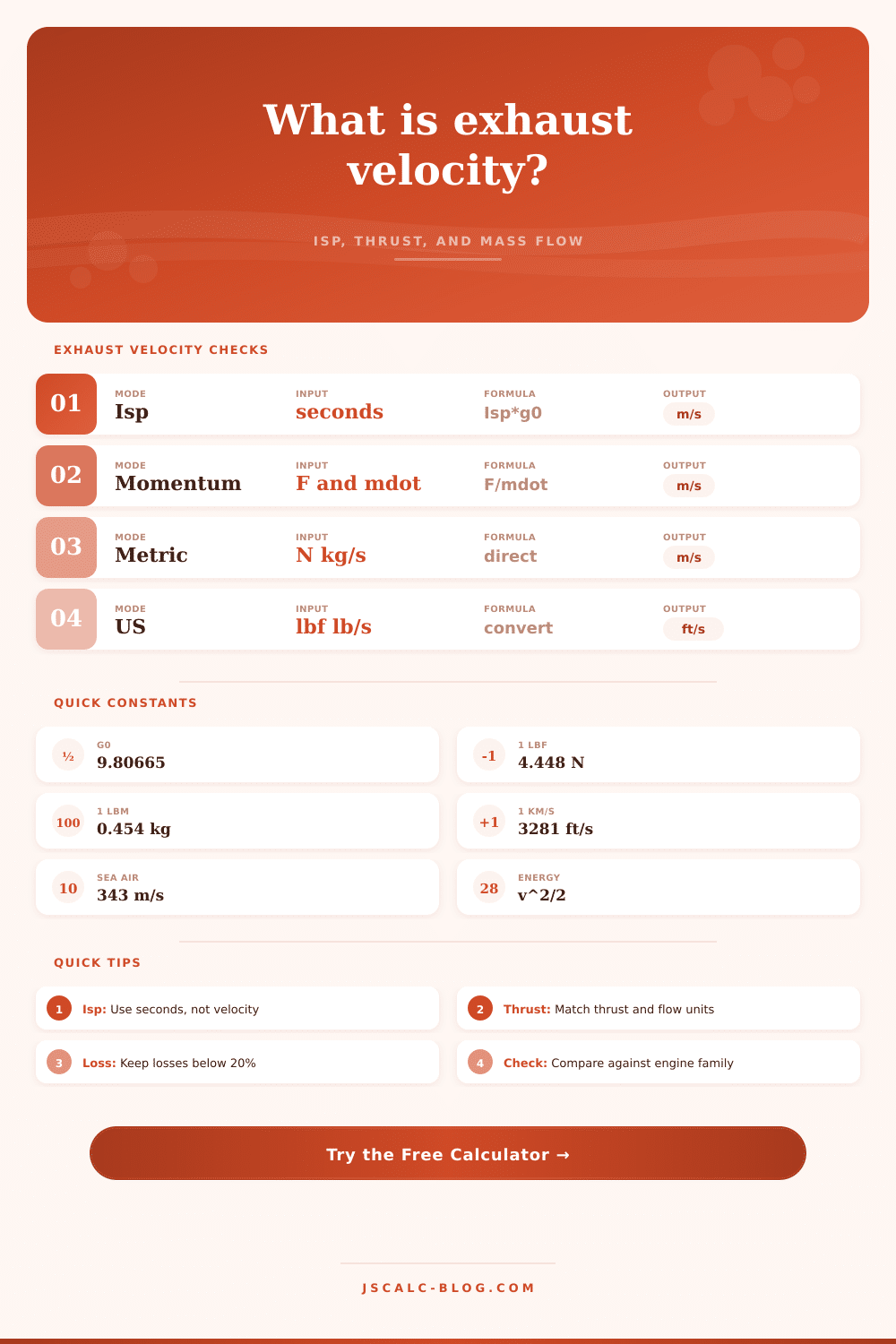
Exhaust Velocity Calculator
Calculate rocket exhaust velocity from specific impulse or from ideal momentum thrust, with metric and US unit conversion for JSCalc-Blog.com.
Exhaust Velocity Results
| Quantity | Formula | Use When | Notes |
|---|---|---|---|
| Ideal exhaust velocity | ve = Isp × g0 | Specific impulse is known | Isp is in seconds and g0 is 9.80665 m/s². |
| Momentum exhaust velocity | ve = F / mdot | Thrust and mass flow are known | This is the ideal momentum-thrust velocity term. |
| Specific impulse equivalent | Isp = ve / g0 | Velocity result needs seconds | Useful for comparing electric and chemical propulsion. |
| Energy proxy | E = ve² / 2 | Comparing jet kinetic energy | Reported as MJ/kg; not a complete engine energy balance. |
| Propulsion Type | Common Propellant | Typical Isp | Approx ve | Typical Role |
|---|---|---|---|---|
| Cold gas | Nitrogen or helium | 45-75 s | 0.44-0.74 km/s | Simple attitude control |
| Solid booster | Composite solid | 240-295 s | 2.35-2.89 km/s | High thrust launch assist |
| Kerolox sea level | LOX/RP-1 | 255-312 s | 2.50-3.06 km/s | Dense first stages |
| Hypergolic | NTO/MMH or UDMH | 290-330 s | 2.84-3.24 km/s | Restartable spacecraft stages |
| Methalox vacuum | LOX/methane | 350-380 s | 3.43-3.73 km/s | Reusable upper stages |
| Hydrolox upper | LOX/hydrogen | 430-465 s | 4.22-4.56 km/s | High-energy upper stages |
| Hall thruster | Xenon or krypton | 1200-2200 s | 11.8-21.6 km/s | Electric orbit raising |
| Ion thruster | Xenon | 2500-4200 s | 24.5-41.2 km/s | Deep-space electric cruise |
| Item | Metric Value | US Value | Calculator Use |
|---|---|---|---|
| Standard gravity | 9.80665 m/s² | 32.174 ft/s² | Converts Isp seconds to velocity. |
| Force conversion | 1 lbf = 4.448221615 N | 1 N = 0.224809 lbf | Converts thrust before F / mdot. |
| Mass-flow conversion | 1 lbm/s = 0.45359237 kg/s | 1 kg/s = 2.204623 lbm/s | Keeps momentum calculation in SI. |
| Velocity conversion | 1 m/s = 3.28084 ft/s | 1 ft/s = 0.3048 m/s | Displays the selected output unit. |
| Sea-level sound speed | 343 m/s near 20°C | 1125 ft/s near 68°F | Creates a rough Mach comparison. |
| Known Data | Choose Mode | Required Inputs | Best Check |
|---|---|---|---|
| Published engine Isp | Specific impulse | Isp in seconds | Compare ve to the family range. |
| Test stand thrust and flow | Momentum thrust | Thrust and propellant mass flow | Equivalent Isp should be plausible. |
| Electric thruster data sheet | Specific impulse | High Isp, usually low thrust | Velocity may exceed 10 km/s. |
| Rough design target | Specific impulse | Family preset plus adjustment | Use conservative loss assumptions. |
| Measured impulse stand data | Momentum thrust | Average thrust and average mdot | Use steady burn interval only. |
The calculator reports effective exhaust velocity for comparison and preliminary checks. Detailed nozzle design also depends on pressure ratio, expansion area, chemistry, two-phase losses, and flight environment.
The currency of spaceflight is exhaust velocity. It show up on the data sheet as just a number, but it’s a measure of how much you can get for a pound of rocket fuel. Every bit more exhaust velocity means every bit less fuel needed for the same increase of spacecraft velocity, aka mission delta-v. That’s why an upper stage is delicate, while a brute force booster isn’t.
Once you know the fuel-flow rate and thrust, the rest of calculation comes out of the exhaust. Enter those values in calculator above and let it do the heavy lifting (no pun intended). That’s pretty simple for the core relationship: effective exhaust speed in meters per second equals the product of standard gravity (meters per second squared) and specific impulse (seconds). Why does this matter? Because specific impulse is an abstract measure of time, whereas velocity is a measure of real-world physical performance.
What Is Exhaust Velocity?
A rocket engine is, after all, something that takes chemical energy and converts it to directed motion. How fast do those gases exits the engine? That depends on combustion temperature and nozzle shape. Gases moves faster, producing more thrust for the same amount of mass flow through the engine. This also results in more delta-v for a given amount of mass fraction.
This is as fast as chemical propulsion can go. The exhaust velocity from burning hydrogen with oxygen is roughly three to four kilometers per second. Because hydrogen is light, it goes fast when you heat it up. It’s at the high end of that bracket. Heavier fuels like kerosene produce slower exhaust; they burn more quicky and create a denser plume. Ease of storage and thrust density comes with sacrificing specific impulse. For example, solid boosters tend to be down on that end of the spectrum, at maybe two point five kilometers per second. While effective at getting something off the pad, they aren’t efficient in terms of velocity. You use solid boosters to get off the pad, not to finesse your orbit.
Chemical propulsion has its limitations. Electric propulsion does not. Electricity can propels plasma or ions at velocities that would make a chemical rocket seem sluggish. Ion engines and Hall effect thrusters regularly reach speeds in excess of twenty kilometers per second. The catch is thrust. Because you’re pushing out such little mass, acceleration is low. An ion drive won’t get you off the ground, but it will let you coast through the solar system for years with tiny amounts of propellant.
The table of references on this page shows the jump in velocity you experience when transitioning from chemical to electric systems. And it demonstrates why there is no such thing as one “best” engine, just the appropriate tool for each stage of flight.
The most frequent error people make with this calculation involves mixing up their units. Engineers copy information from other countries and frequently use a mixture of both imperial and metric units. A “pound” might mean “pound mass” or it might refer to “pound force. Likewise, pound mass is distinct than kilogram mass. The tool handles the unit conversion for you, but that doesn’t help if you give it the wrong units in the first place. For example, if you’re entering thrust as Newtons and mass flow as pounds/second, you’ll get the wrong answer. Double check your units before pressing calculate.
The practical speed changes based off operating condition. At sea level, an engine has to work through air pressure that limits how much gas can expand out of the nozzle. In a vacuum, the engine’s full expansion will pull more power out of the fuel. This explains why high-specific-impulse and big-nozzle vacuum rated engines exist. Without accounting for this you can’t fairly compare sea-level versus vacuum performance. In the equations it’s a slight tweak but it is what shapes the design of all the multi-stage rockets.
Imperfect nozzle expansion and efficiency losses elsewhere (plumbing) will reduce theoretical gains. No engine is perfect in real life. There’s friction, incomplete combustion, and heat transfer to the walls. These factors cut into actual velocity, making it less than what is calculated theoreticaly. To take this into account, the calculator lets you enter an efficiency factor. That number should of been kept realistic so as not to design something that looks good on paper, but doesn’t fly.
The exhaust velocity relates to how fast the propellant leaves the engine, and thus how it will carry vehicle through space. This is the connection between the fire in the chamber and the path of the vehicle. The exhaust velocity number is what tells you what your engine can realy do. It doesn’t matter whether you’re building a deep-space probe or a heavy lifter, you begin from either power source or the chemistry, but you conclude with the velocity. If you don’t have that last number, you won’t make orbit.