Specific Impulse Calculator
Calculate Isp, exhaust velocity, total impulse, and propellant flow with unit conversion and engine benchmarks from JSCalc-Blog.com.
Specific Impulse Results
Isp = thrust / (mass flow rate × g0)
ve = Isp × g0
total impulse = thrust × burn time
propellant mass = mass flow rate × burn time
Use thrust in newtons, mass flow in kg/s, burn time in seconds, and standard gravity g0 = 9.80665 m/s². The calculator converts lbf, kN, g/s, lb/s, minutes, and hours before applying the equations.
Booster chemistry
Sea-level chemical engines often sit near 250 to 330 seconds because ambient pressure reduces nozzle expansion benefit.
Vacuum upper stages
Vacuum nozzles and hydrogen propellant can push Isp above 440 seconds, with lower thrust density than dense propellants.
Electric propulsion
Ion and Hall thrusters can exceed 1500 seconds, but thrust is measured in millinewtons to newtons rather than kilonewtons.
| Class | Propellant or system | Typical Isp | Where it is used |
|---|---|---|---|
| Solid booster | Composite solid propellant | 250-315 s | Liftoff thrust, strap-on stages |
| Kerolox sea level | Liquid oxygen and RP-1 | 260-315 s | Dense booster engines |
| Kerolox vacuum | Liquid oxygen and RP-1 | 330-360 s | Upper stages with larger nozzles |
| Methalox sea level | Liquid oxygen and methane | 320-335 s | Reusable booster engines |
| Hydrolox vacuum | Liquid oxygen and hydrogen | 440-465 s | High-energy upper stages |
| Ion electric | Xenon or similar propellant | 1500-4000 s | Long-duration spacecraft thrusting |
| Engine or thruster | Approx thrust | Approx mass flow | Isp check | Context |
|---|---|---|---|---|
| Merlin 1D sea level | 845 kN | 305 kg/s | 282 s | Dense first-stage kerolox engine |
| Merlin Vacuum | 981 kN | 287 kg/s | 348 s | Vacuum-optimized kerolox upper stage |
| Raptor sea level | 2300 kN | 719 kg/s | 326 s | Full-flow staged combustion methalox |
| RS-25 vacuum | 1860 kN | 420 kg/s | 452 s | Reusable hydrolox main engine |
| RL10B-2 | 110 kN | 24.3 kg/s | 462 s | Hydrolox upper-stage engine |
| Saturn V F-1 | 6770 kN | 2630 kg/s | 263 s | Large kerolox booster engine |
| Space Shuttle SRB | 12500 kN | 4860 kg/s | 262 s | Segmented solid rocket booster |
| NSTAR ion thruster | 0.092 N | 0.0000031 kg/s | 3027 s | Deep-space electric propulsion |
| Quantity | Input unit | SI conversion | Calculator use |
|---|---|---|---|
| Thrust | 1 kN | 1000 N | Converted before Isp and impulse |
| Thrust | 1 lbf | 4.448221615 N | Imperial thrust entry |
| Mass flow | 1 g/s | 0.001 kg/s | Small thruster entry |
| Mass flow | 1 lb/s | 0.45359237 kg/s | Imperial flow entry |
| Velocity | 1 m/s | 3.28084 ft/s | Alternative exhaust velocity display |
| Impulse | 1 N·s | 0.224809 lbf·s | Alternative total impulse display |
| Result | Formula | Required SI units | Meaning |
|---|---|---|---|
| Specific impulse | Isp = F / (mdot × g0) | N, kg/s, m/s² | Thrust produced per unit propellant weight flow |
| Exhaust velocity | ve = Isp × g0 | s and m/s² | Effective jet velocity implied by Isp |
| Total impulse | It = F × t | N and s | Integrated push over the burn |
| Propellant mass | m = mdot × t | kg/s and s | Total propellant consumed during the burn |
There’s one number that matters most in rocketry: specific impulse. It’s the efficiency metric for converting fuel into movement. A bigger number mean more thrust is generated per kg of fuel, which allows you to use fewer kilogram on a particular mission. The calculator does this math for you. It takes raw flow rates and thrust and shows you in clear terms what your rocket will do.
But looking at the raw numbers dont tell you what they mean. What are the tradeoffs in designing engines? Why does an engine optimized for vacuum has such a much higher specific impulse when compared to the same engine at sea level? Even burning the same fuel? The reason is nozzle expansion. Exhaust gases can fully expand in the thin expanse of space, taking out as much energy as possible. But at sea level, atmosphere acts like a wall against which those gases expands, which chokes off that expansion and wastes potential energy. It is a little thing, sure. But it is enormously important for how a mission is built.
What Specific Impulse Tells You About Rocket Engines
When you’re talking about first stages, you need brute force and density to combat gravity. That’s why kerolox engines tends to be in the 250 to 315 second range. They are dense and powerful but they are also inefficient. Upper stages, however, must battle enemy of weight. Hydrogen engine strive for 450 seconds or better because they give up thrust density for pure efficiency.
This all changes with electric propulsion. Ion thrusters has specific impulses greater than 3000 seconds. That’s like orders of magnitude more efficient then a chemical rocket. But there’s a tradeoff for efficiency. The amount of thrust produced is measured in millinewtons; barely enough to lift a sheet of paper. With an ion drive, you can’t launch off planet Earth, but you can coast gently into the asteroid belt without much fuel at all.
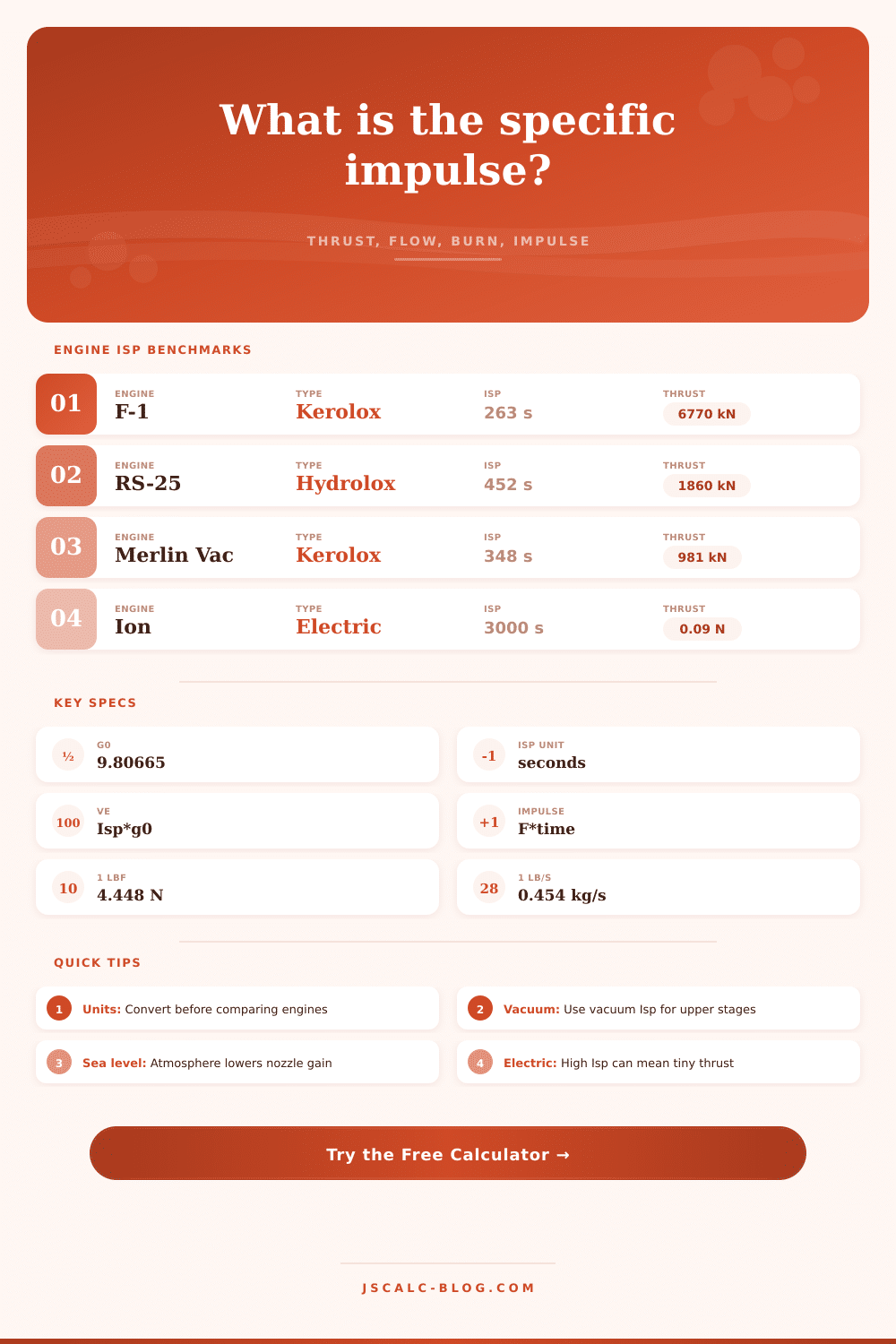
The little calculator on that page puts these two extremes in perspective, letting you plug in the ridiculously low mass flow rate of electric thrusters as well as gigantic flow of a Saturn V booster. When they’re placed side-by-side, it becomes clear: specific impulse isn’t about power; its about economy.
As a consequence, increasing the throttle setting changes both mass flow and thrust at the same time; they always maintains constant specific impulse. That is important information for mission planner who wants to be sure that an engine loses no efficiency while operating at reduced power. The basic assumption is a steady state, and some engines will indeed show reduced efficiency at low throttle; it’s good practice to add a planning margin. No real launch goes exactly as planned, so reserve 5 to 10 percent of your computed impulse just in case. You should of prepared for that.
This is how it breaks down by engine chemical class, based off the page’s reference table. Hydrolox engines are bulky but highly efficient. They also need big tanks which add structural mass to the vehicle. Methalox engines provides good efficiency with smaller, denser propellants which reduces the vehicle’s footprint. Solid boosters has low fuel efficiency, but are simple and reliable. That means they’re great for getting off the ground, but not so hot for precision maneuvering.
You never pick the biggest number when choosing between these options. You select the one whose character matches your mission constraints.
To conclude, Specific impulse measures the care (or lack thereof) with which an engine delivers its fuel supply. A high value indicates that you’re wringing the last joule from the reaction. Usually at the cost of some kind of complexity or perhaps even thrust. A low value indicates you’re sacrificing fuel for the sake of simplicity and speed. The calculator does the math and converts units for you so you can spend more time thinking about strategy.
Whether you are planning lunar landings or a satellite’s station-keeping maneuver, remember that power and efficiency tend to be opposites. Keeping this in mind helps you stay grounded in reality when designing your missions. Know exactly what you’re willing to sacrifice to reach the heights above you.