Rocket Mass Ratio Calculator
Estimate ideal mass ratio, propellant fraction, wet mass, and propellant mass from delta-v, specific impulse, or effective exhaust velocity.
Rocket Mass Ratio Results
This is the ideal rocket equation. It does not automatically include gravity loss, drag loss, steering loss, boiloff, residual propellant, mixture-ratio limits, engine throttling, or structural sizing. Use the practical margin and usable-propellant fields when you want a planning-level estimate.
| Propulsion type | Typical Isp | Approx ve | Best use in this calculator |
|---|---|---|---|
| Small black-powder solid | 70 to 90 s | 690 to 880 m/s | Model rocket and classroom estimates |
| Composite solid motor | 230 to 285 s | 2255 to 2795 m/s | Sounding rockets and boosters |
| Kerolox sea level | 260 to 310 s | 2550 to 3040 m/s | Launch vehicle lower stages |
| Kerolox vacuum | 320 to 350 s | 3138 to 3432 m/s | Vacuum upper stages and boosters after ascent |
| Storable hypergolic | 300 to 330 s | 2942 to 3236 m/s | Spacecraft maneuvers and landers |
| Methalox vacuum | 360 to 385 s | 3530 to 3775 m/s | Reusable upper stages and landers |
| Hydrolox vacuum | 430 to 465 s | 4217 to 4559 m/s | High-energy upper-stage burns |
| Electric propulsion | 1200 to 4000 s | 11768 to 39227 m/s | Long-duration low-thrust transfers |
| Maneuver or mission segment | Typical delta-v | Notes | Suggested margin |
|---|---|---|---|
| Small model rocket powered coast | 0.15 to 0.40 km/s | Motor impulse and drag dominate the real path | 10% to 25% |
| Suborbital sounding rocket stage | 1.5 to 3.0 km/s | Often split across several stages | 15% to 25% |
| LEO circularization burn | 1.5 to 3.5 km/s | Depends on booster cutoff velocity and trajectory | 5% to 15% |
| Total surface to LEO estimate | 9.0 to 9.7 km/s | Includes orbital speed plus ascent losses | Already includes losses |
| Trans-lunar injection from LEO | 3.1 to 3.3 km/s | Impulsive high-energy departure | 5% to 10% |
| Lunar landing from low lunar orbit | 1.6 to 2.0 km/s | Throttle and hover margin matter | 10% to 20% |
| Mars orbit insertion sample case | 1.0 to 1.8 km/s | Aerobraking can reduce propulsive need | 10% to 15% |
| Station keeping per year | 0.01 to 0.10 km/s | Depends strongly on orbit and disturbance forces | 10% to 20% |
| Delta-v / ve | Mass ratio | Propellant fraction | What it means |
|---|---|---|---|
| 0.25 | 1.28 | 22.1% | Light maneuver, comfortable margin |
| 0.50 | 1.65 | 39.3% | Moderate spacecraft burn |
| 0.75 | 2.12 | 52.8% | Propellant now exceeds final mass |
| 1.00 | 2.72 | 63.2% | Classic one-e-fold mass increase |
| 1.50 | 4.48 | 77.7% | Demanding for one stage |
| 2.00 | 7.39 | 86.5% | Usually needs excellent structure or staging |
| 2.50 | 12.18 | 91.8% | Very hard as a single chemical stage |
| 3.00 | 20.09 | 95.0% | Staging or high ve becomes essential |
| Example | Inputs | Ideal mass ratio | Ideal propellant fraction |
|---|---|---|---|
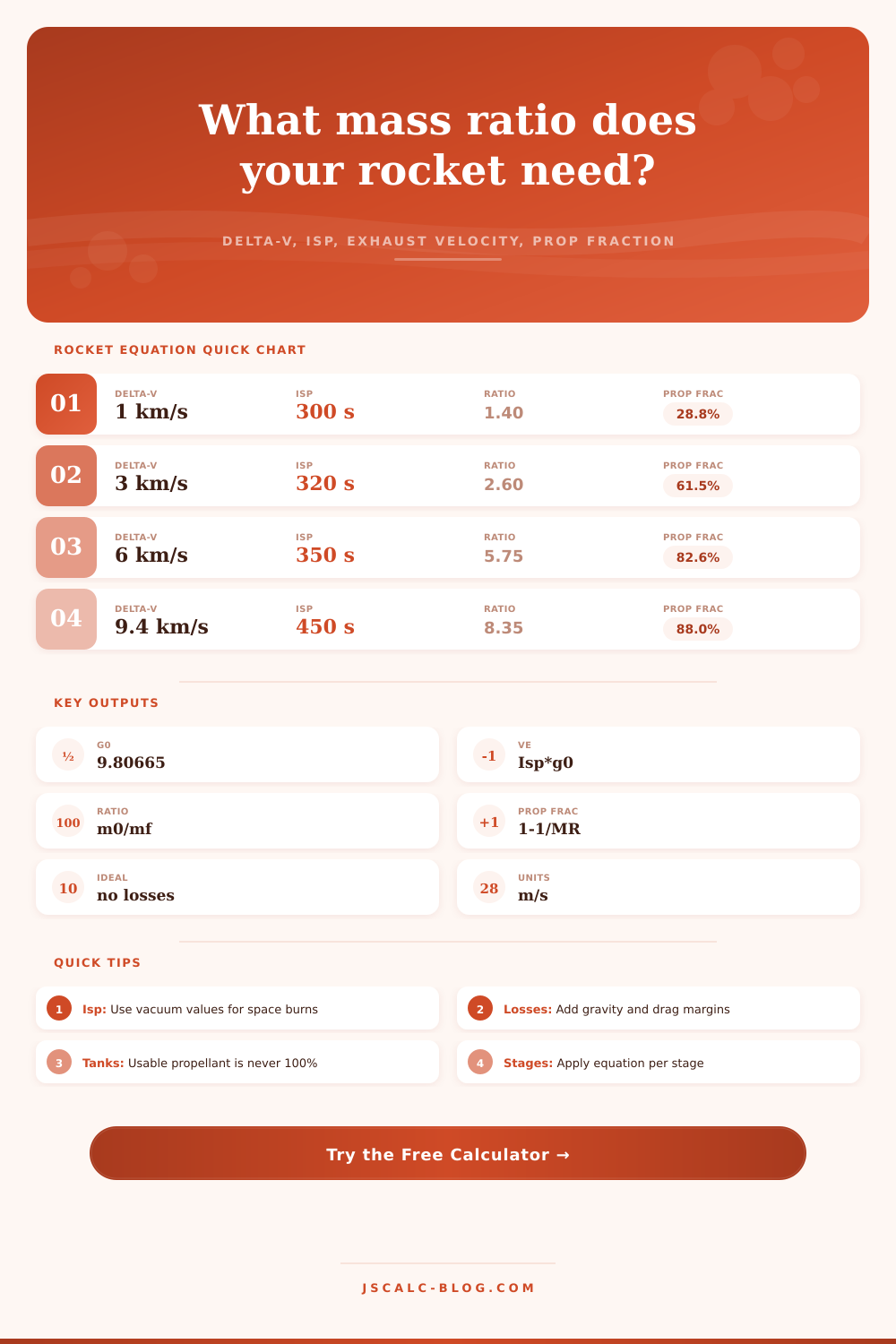
| 1 km/s maneuver, 300 s Isp | dv = 1000 m/s, ve = 2942 m/s | 1.40 | 28.8% |
| 3 km/s upper-stage burn, 320 s Isp | dv = 3000 m/s, ve = 3138 m/s | 2.60 | 61.5% |
| 3.2 km/s lunar injection, 450 s Isp | dv = 3200 m/s, ve = 4413 m/s | 2.07 | 51.6% |
| 6 km/s electric transfer, 1800 s Isp | dv = 6000 m/s, ve = 17652 m/s | 1.40 | 28.8% |
| 9.4 km/s idealized launch, 450 s Isp | dv = 9400 m/s, ve = 4413 m/s | 8.42 | 88.1% |
| 9.4 km/s idealized launch, 330 s Isp | dv = 9400 m/s, ve = 3236 m/s | 18.25 | 94.5% |
Rocketry is hard: You can’t get anywhere without carrying enough fuel to get there. And then you’ve got a spacecraft design on the screen, all sleek lines and perfect aerodynamics, but no fuel to carry.
Rocketry’s a tax collector. It’s not just a formula, it’s called the “rocket equation.” Every meter per second of speed cost mass. Pay up, or don’t fly.
Understanding the Cost of Rocket Fuel
This calculator will do the math for you; the point is learning what that math mean about your design choices. The key variable here are the mass ratio: the weight of your full rocket divided by the weight of your empty rocket. That’s just a number. When that number is two, half of what you’re launching is fuel; at ten, nine-tenths of your rocket is propellant. Because the equation is exponential, tiny increases in necessary velocity require huge increase in your fuel requirement.
Why do engineers care so much about efficiency? The answer is that they want their rocket engines to have high specific impulse, which is how efficiently an engine turns fuel into thrust. Think of it as rocket equivalent of miles per gallon. The higher your impulse, the less fuel you’ll require to accomplish same task. And that’s lighter dry mass. Lighter dry mass lets you carry more payload. Get it right and you’ve got yourself a virtuous cycle. Get it wrong and you get a vicious cycle.
As you fill in mission parameters, you’ll see fields for drag margins and gravity margins. In an ideal world, there’s no gravity loss and there’s nothing but perfect vacuum. But life gets messy. To fight against gravity while you’re hovering or accelerating at a slow pace? That takes propellant. Trying to fly through the atmosphere without fighting drag? That also take propellant. You can add a percentage margin into the tool here for those losses. For ascent profiles, most mission planners adds ten to fifteen percent. For complex maneuvers, sometimes more.
The worst thing a beginner can do is ignore these losses. They calculate how much delta-v their rocket need to get into orbit. They design it for precisely that amount. Then they watch as it falls short because they neglected to pay the atmosphere tax.
The other half of the solution are staging. When your mass ratio is too high for a single stage to work, you have no choice but to drop dead engines and empty tanks. Carrying dead weight isnt good. The calculator allow you to determine if a single stage can work, and just as importantly, when you’re trying too hard. When you get over an eighty-five-percent propellant fraction, you’d better be working with some kind of very high-energy fuel (liquid hydrogen), or some strange material, because otherwise, you’re just dreaming.
Liquid hydrogen’s got some fantastic specific impulse but terrible density, which translates into huge tanks. Kerosene’s less efficient but denser. You gotta go for volume or you gotta go for performance and vice versa.
The page has some of the usual reference tables that lay out normal values for various kinds of engine. Simple engines are solid motors which are simple but inefficient. More complex liquid engines can performs better and throttle, but have extra mechanics involved. Electric propulsion is super efficient but provides tiny amounts of thrust so will take you months to change velocities.
Spaceflight isn’t free, there’s always a price tag somewhere. The tool removes all the marketing hype and gives you the cold hard numbers. How much propellant do I need to get where? If that’s too large, then you either need more stages or lighter structure or better engines.
That’s the point of the equation, it’s not for calculating the mass ratio as much as understanding the tradeoff it embodies. It’s for understanding the tyranny of the rocket equation… Something you should of learn to respect.
You’ll be able to see how increasing your payload by even a kilogram can increase the amount of fuel needed to carry it by 10 kilograms. That’s where folks go astray; they look only at the payload, not the cost of getting it up there. When you accept this cost, you come to design things in a way that better suits reality. You stop struggling against math and you work with it. The calculator doesn’t create the number; it reflects the difficult costs of being in orbit back to you.