Rocket Equation Calculator
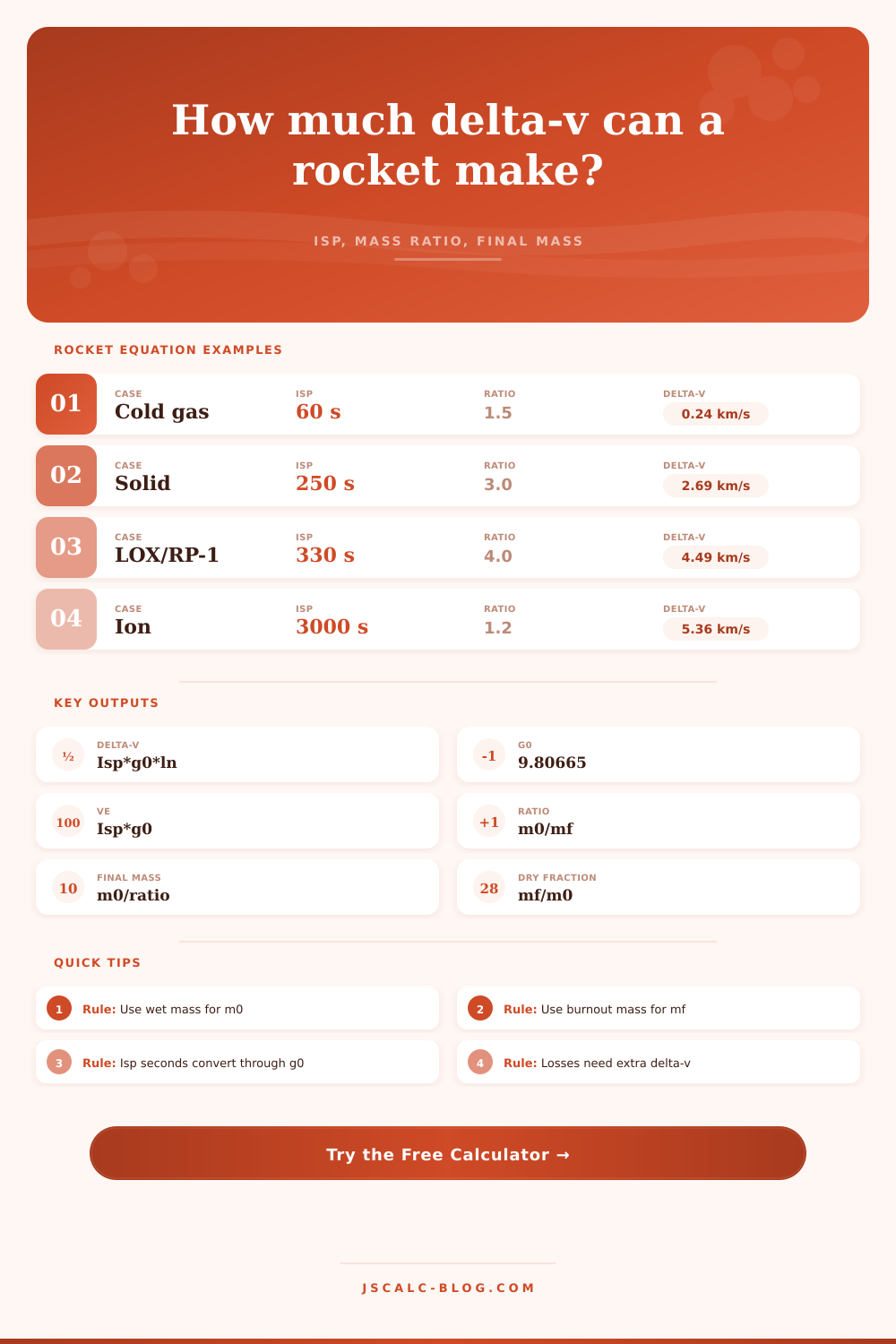
Calculate ideal delta-v, exhaust velocity, mass ratio, final mass, initial mass, or required specific impulse using delta-v = Isp * g0 * ln(m0 / mf).
| Propulsion type | Typical Isp | Exhaust velocity | Useful note |
|---|---|---|---|
| Cold gas thruster | 40 to 80 s | 0.39 to 0.78 km/s | Simple attitude control or tiny spacecraft maneuvers. |
| Monopropellant hydrazine | 220 to 235 s | 2.16 to 2.30 km/s | Common for spacecraft reaction control and small orbit changes. |
| Solid rocket motor | 230 to 290 s | 2.26 to 2.84 km/s | High thrust with limited throttling and restart flexibility. |
| LOX/RP-1 vacuum stage | 310 to 350 s | 3.04 to 3.43 km/s | Dense propellant chemical stage with strong thrust. |
| LOX/LH2 vacuum stage | 430 to 465 s | 4.22 to 4.56 km/s | High chemical Isp with bulky low-density hydrogen. |
| Nuclear thermal concept | 800 to 950 s | 7.85 to 9.32 km/s | High thermal exhaust velocity estimate for mission trades. |
| Hall effect thruster | 1200 to 2200 s | 11.77 to 21.57 km/s | Efficient electric propulsion with low thrust. |
| Ion thruster | 2500 to 4500 s | 24.52 to 44.13 km/s | Very high Isp for long-duration low-thrust missions. |
| Mass ratio m0/mf | ln(ratio) | Delta-v at 320 s Isp | Propellant fraction |
|---|---|---|---|
| 1.25 | 0.223 | 0.70 km/s | 20.0% |
| 1.50 | 0.405 | 1.27 km/s | 33.3% |
| 2.00 | 0.693 | 2.17 km/s | 50.0% |
| 3.00 | 1.099 | 3.45 km/s | 66.7% |
| 4.00 | 1.386 | 4.35 km/s | 75.0% |
| 6.00 | 1.792 | 5.62 km/s | 83.3% |
| 8.00 | 2.079 | 6.53 km/s | 87.5% |
| 10.00 | 2.303 | 7.23 km/s | 90.0% |
But it’s not about explosions or fire. There is a quiet tyranny at the heart of every rocket launch. It’s called the rocket equation and it’s a strict limit for launch vehicle design.
The rocket equation is a mathematical curve that severely penalize inefficiency through additional weight. If you want to get a kilogram up there in orbit, then you must have fuel to propel that mass. But that fuel itself has mass. So you need fuel to move the fuel. And this continues until the rocket equation calculator tell you exactly how fast it will go when it launches with whatever mass sit on the pad. The calculator give you an honest look at what your mission design can accomplish before you start.
The Rocket Equation Explained
That’s where specific impulse, or Isp, comes into play… The fuel economy of your engine. Instead of being expressed as miles per gallon though, it’s in seconds; a cold gas thruster might have an Isp of sixty seconds. Such a simple engine is slow (and reliable). An ion thruster, conversely, can reach 3,000 seconds and builds up its speed over months with power.
You can swap out these engines on-the-fly in the calculator, and by changing your Isp you change character of your vehicle. If you have high Isp, you need less propellant to gain a certain amount of delta-v, allowing you to shrink size of your tank, and thus decrease size of your structure. This forms a positive cycle, as long as you have enough time to burn.
The other factor is mass ratio, which is defined as the ratio between what your rocket weighs before launch (its wet mass) to what it weighs after fuel burn (its dry mass). Amateur designs tend to screw this up most often: increasing size of tank increases its weight without increasing how much force the engine produces.
From the table above, if I increase the mass ratio from two to one to four to one, I get double the velocity gain. If I want triple the gain, then my mass ratio has to be twenty to one. And the numbers escalate rapidely. For chemical rockets, achieving single-stage-to-orbit is a statistical impossibility. You run into a mathematical wall where you lose ground with every meter per second.
The solution is staging: throwing away dead engines and empty tank. Then, you reset the mass ratio for the remaining trip. No longer do you have to lift that first stage’s empty fuel tank. That’s a neat trick, but at the cost of adding mechanical complexity; furthermore, the calculator requires ideal conditions (perfectly frictionless environment).
In real life there’s air resistance working against you while you fight gravity trying to pull you back down; add in a margin of ten to twenty percent. Designing to the precise number means you’re probably going to come up short, as you make steering corrections that burns fuel.
Ultimately, that’s the beauty of this thing. It lets you start with some known set of parameters like ‘I want to go this far’ or ‘I want to use this much fuel,’ or even ‘I want to get into this orbit.’ How much weight could my structure hold? What kind of engine would I require?” These tradeoffs are at the heart of aerospace engineering, and you’re always balancing something for simplicity, price, and performance.
A nuclear thermal engine has very high levels of thrust and Isp. It bridges the gap between electric and chemical engines, but it is challenging to both construct and control. The physics stuff works in the calculator but engineering feasibility isn’t judged by it. It doesn’t care about your schedule or your budget.
That’s what I mean by the rocket equation: it’s a constraint that must be respected. It cares only about momentum and mass; play with the calculator to see the physical constraints based off of them. And then plan how you’re going to come as close to those limits as possible while not blowing up the vehicle (or breaking the bank), because that often comes down to a few kilograms here-and-there in the margins. You should of planned for it.