Transmission Gear Ratio Calculator
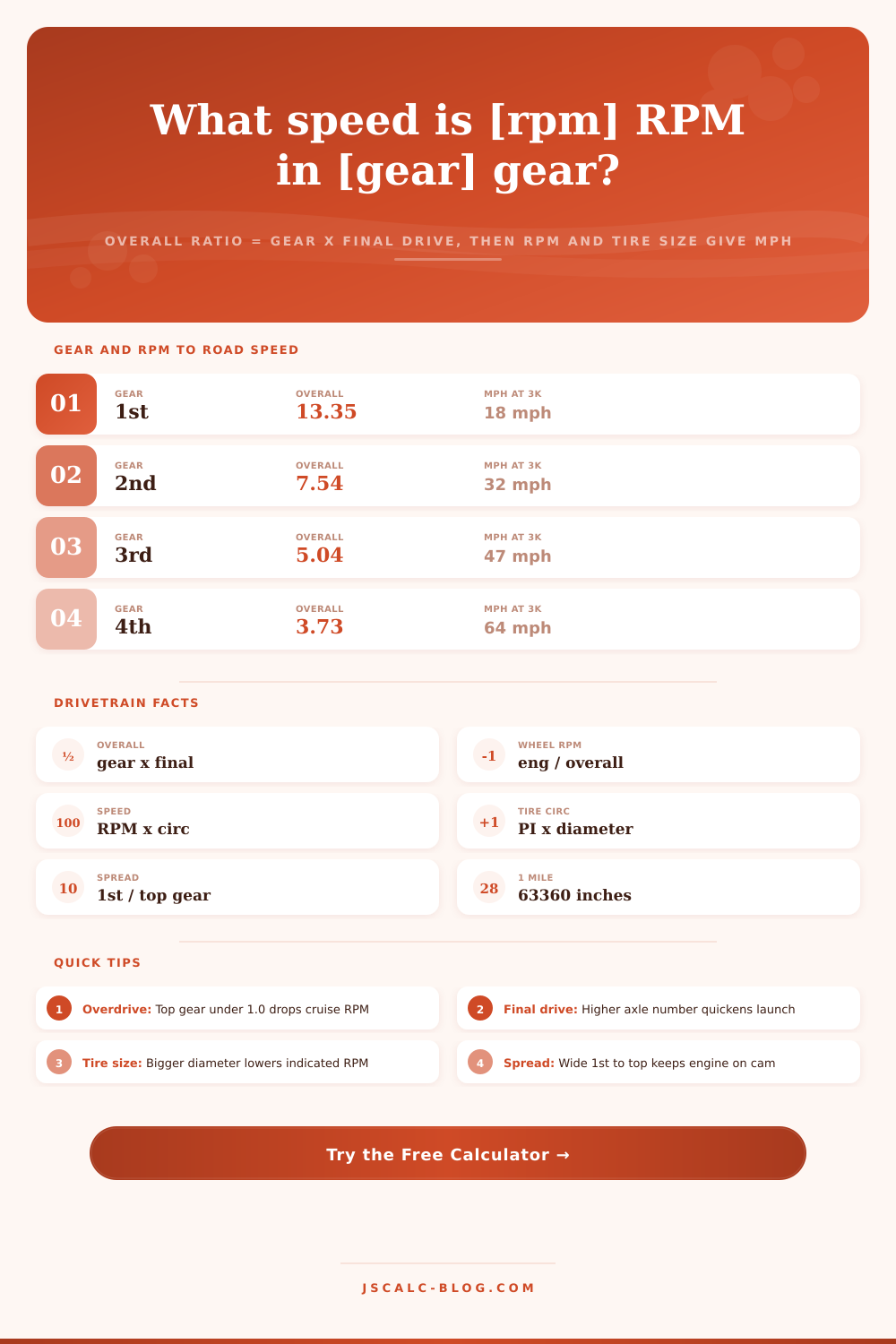
Multiply each transmission gear by the final drive axle ratio to get the overall ratio, add your tire diameter, and read road speed at any engine RPM. Flip it around to find the exact RPM your engine turns at a target cruising speed, and see the full 1st-to-top ratio spread for every gear.
🏁Real Drivetrain Presets
⚙Transmission and Final Drive
Lowest gear, the strongest launch multiplier.
First upshift, still well below 1:1.
Mid range, common for on-ramp merges.
Direct drive on most manuals, exactly 1:1.
Overdrive, ratio drops below 1.0.
Tall overdrive for low-RPM highway cruising.
Ring and pinion ratio in the differential.
Gear used for the speed and RPM cards.
Crankshaft speed to convert into road speed.
Enter a sidewall size or a measured diameter.
Format width_mm / aspect R rim_in, e.g. 265/70R17.
Used when the input method is set to diameter.
Speed used to solve engine RPM in the chosen gear.
🔢Formula Snapshot
📋Sample Transmission Gear Sets
| Vehicle Type | 1st | 2nd | 3rd | 4th | 5th | 6th |
|---|---|---|---|---|---|---|
| V8 pony car 6-speed | 3.58 | 2.02 | 1.35 | 1.00 | 0.87 | 0.68 |
| Sport compact 6-speed | 3.27 | 2.13 | 1.51 | 1.16 | 0.94 | 0.81 |
| Roadster 5-speed | 3.14 | 1.89 | 1.33 | 1.00 | 0.81 | — |
| Half-ton truck 6-speed | 4.03 | 2.36 | 1.53 | 1.15 | 0.85 | 0.67 |
| Muscle sedan 8-speed | 4.71 | 3.14 | 2.10 | 1.67 | 1.29 | 1.00 |
| Grand tourer 7-speed | 2.97 | 2.07 | 1.43 | 1.00 | 0.84 | 0.66 |
🔧Common Final Drive Axle Ratios
| Final Drive | Character | Best For | Trade-Off |
|---|---|---|---|
| 2.73 | Very tall | Fuel economy cruisers | Lazy off the line |
| 3.09 | Tall | Highway grand touring | Softer acceleration |
| 3.27 | Balanced | Daily sport driving | Compromise both ways |
| 3.73 | Sporty | Track and street V8 | Higher cruise RPM |
| 3.90 | Aggressive | Rally and AWD launch | Buzzy on freeway |
| 4.10 | Short | Towing and off-road | Low top-gear speed |
| 4.56 | Very short | Big-tire crawlers | Screaming at 70 mph |
📏Tire Size to Diameter
| Tire Size | Section Width | Aspect Ratio | Rim | Diameter |
|---|---|---|---|---|
| 205/55R16 | 205 mm | 55 | 16 in | 24.9 in |
| 225/45R17 | 225 mm | 45 | 17 in | 25.0 in |
| 245/45R18 | 245 mm | 45 | 18 in | 26.7 in |
| 275/40R20 | 275 mm | 40 | 20 in | 28.7 in |
| 285/35R19 | 285 mm | 35 | 19 in | 26.9 in |
| 265/70R17 | 265 mm | 70 | 17 in | 31.6 in |
🚗Speed per 1000 RPM by Gear
| Gear | Ratio | Overall (x3.73) | MPH per 1000 RPM |
|---|---|---|---|
| 1st | 3.58 | 13.35 | 5.9 mph |
| 2nd | 2.02 | 7.54 | 10.5 mph |
| 3rd | 1.35 | 5.04 | 15.8 mph |
| 4th | 1.00 | 3.73 | 21.3 mph |
| 5th | 0.87 | 3.25 | 24.5 mph |
| 6th | 0.68 | 2.54 | 31.3 mph |
📊Gear by Gear Comparison Grid
| Gear | Ratio | Overall (x3.73) | MPH at 3000 RPM | MPH at 6000 RPM | Typical Use |
|---|---|---|---|---|---|
| 1st | 3.58 | 13.35 | 18 mph | 36 mph | Standing launch |
| 2nd | 2.02 | 7.54 | 32 mph | 63 mph | City acceleration |
| 3rd | 1.35 | 5.04 | 47 mph | 95 mph | On-ramp merging |
| 4th | 1.00 | 3.73 | 64 mph | 128 mph | Backroad pulls |
| 5th | 0.87 | 3.25 | 73 mph | 147 mph | Highway passing |
| 6th | 0.68 | 2.54 | 94 mph | 188 mph | Overdrive cruise |
⚙Formula Breakdown
💡Gearing and Tire Tips
The transmission gear ratio calculator makes drivetrain math practical instead of abstract. The two multipliers used to translate engine speed into road speed are final drive ratio in the differential and the transmission gear you’ve selected. Multiply them and voila, you’ve got the overall ratio, one number that determines how fast your wheels spin for every turn of the crank. Add the rolling circumference of your tires and you can convert any RPM into miles per hour. You can also work backward from cruising speed to determine how hard engine turns. It’s physics, but after seeing the numbers, it starts to feel like intuition.
An automotive drivetrain is a two-stage reduction system. The engine’s crankshaft feeds the transmission which provides first gear ratio. Then, the driveshaft feeds into the rear end (differential). This differential multiplies the ratio again through the pinion/ring and pinion combo, which is axle’s final drive ratio. Multiply these and a sixth gear of 0.68 behind a 3.73 axle gives an overall ratio of 2.54. So for every one time the tire spins, it turns the driveshaft 2.54 times.
How Gear Ratios Work
To launch off the line, the same vehicle may use a lower first gear like 3.58. This would produce an overall ratio of 13.35 and tremendous torque multiplication off the starting line. The calculator computes the overall for whatever gear you choose and shows you the real number you get on the ground without having to do math in your head.
Now that we understand the overall ratio, road speed is simple geometry. Engine RPM ÷ overall ratio = wheel RPM. In our example of a 2.54 overall and 2500 crank RPM, you’ll find wheels are turning approximately 985 times per minute. Each revolution of the tire rolls it forward by its circumference. How far does it move? That’s just the circumference (pi times the tire diameter). With a 26.68 inch tire, each turn moves it around 83.8 inches. Multiply wheel RPM x circumference to arrive at inches per minute. Divide inches per minute by the 63360 inches in a mile and multiply by 60 minutes to arrive at miles per hour. The calculator chains them all together so when you enter RPM, it calculates your exact speed immediatly.
The other way around works too; what does my engine spin at during cruise? Cruise RPM matters a lot for comfort, fuel economy, and noise. Changing tires can make a huge difference and swapping gears changes it to. So this tool solves for RPM based off your target mph by rearranging that same formula. Enter your target mph (say 70) and tire size (such as a 26.68 inch tire with a 2.54 overall), and you’ll find out the engine spins about 2237 rpm. That immediately tells me if I have a taller overdrive it will be loafing comfortabley. Alternatively, a shorter axle will keep the motor buzzing when on a long trip. One is an ear splitting trip while the other is a relaxing drive.
Indicated RPM and speed are highly sensitive to tire diameter but also prone to mis-specification (it’s surprisingly simple to make an error here). For example, the side-wall designation 245/45R18 contains all information required (245 millimeters wide), sidewall height = 45% of that, mounted on an 18 inch wheel. The diameter is then simply the rim + twice the sidewall(s), which involves converting from mm to inches and adding the rim for a calculated value of roughly 26.68 inches in this case. You can either specify the tire diameter in inches (e.g. If running a custom setup) or let the calculator parse the side wall number itself. If this value is wrong, it makes all other calculations wrong.
The total range of the transmission is called ratio spread, it’s found by dividing first gear by the tallest gear. The lowest gear divided by the highest tells you the spread (for example 3.58 divided by 0.68 equals 5.26). That means the lowest gear provide more than five times the torque of the highest gear. Because moddern cars have such wide gear ratios, they can achieve both a relaxed (fuel sipping) overdrive and a stump-pulling launch gear. With older four and five speed boxes, there was a compromise (the box had a narrow spread), forcing the driver into one or the other. Today’s six, seven and eight speed transmissions widen the ratio spread so much that the engine remain near its powerband in each gear. This table on the page shows some common setups to compare against.
Without altering the transmission, the last drive ratio alone changes entire character of a vehicle. A numerically higher ratio like 4.10 gets you going quicker, helps when towing, increases the cruise RPMs and can diminish gas mileage. A lower ratio like 3.09 softens the launch punch but eases the highway. A taller axle paired with high overdrive gears is common in a highway cruiser; a shorter axle combined with large off-road tires recovers some of the gearing lost because the tires cover more ground. Lifting a truck uses taller gearing because bigger tires covers more distance with each turn of the wheel. This is why lifted trucks tend to feel slow until they are regeared.
There’s a starting point, a preset that resembles your car, and it’s a matter of dialing in the inputs to fit exactly what you’ve built. If you’re thinking about upgrading tires, knowing this gives you an idea how the car might react before you should of spent one dime. If it’s time to regear the axle, this helps you know what direction to head. It transforms guess work into strategy.