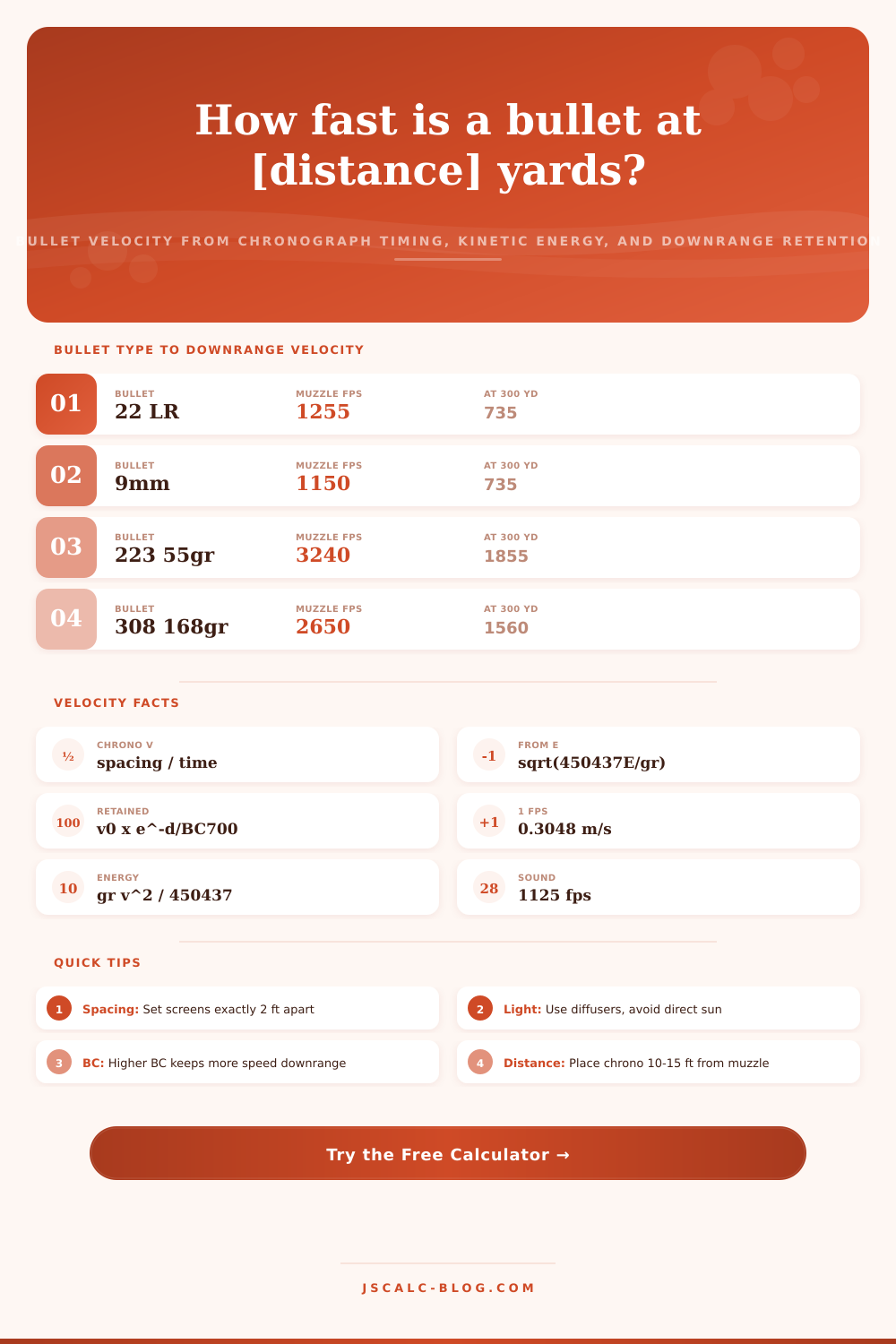
Bullet Velocity Calculator
Measure and derive bullet speed three ways: solve muzzle velocity from a two-screen chronograph using v = spacing divided by travel time, back-calculate velocity from kinetic energy with v = square root of 450437 times energy over grains, and estimate retained downrange velocity with a simplified G1 drag decay. Every result reports feet per second, meters per second, and kinetic energy.
🔫Choose a Method
🎯Real Load and Setup Presets
📝Velocity Inputs
Distance between the start and stop chronograph screens.
Elapsed time the bullet took to cross both screens.
Known muzzle or measured kinetic energy in foot-pounds.
Starting velocity at the muzzle for the downrange estimate.
G1 form factor. Higher BC bullets shed speed slower.
Downrange distance where you want the retained velocity.
Projectile mass in grains, 7000 grains equals one pound.
Controls decimals shown on every result card.
🔢Formula Snapshot
📈Typical G1 Ballistic Coefficients by Bullet Type
| Bullet Type | Weight (gr) | Typical BC (G1) | Profile Note |
|---|---|---|---|
| 22 LR round nose | 40 | 0.120 | Blunt, sheds speed fast |
| 9mm FMJ ball | 115 | 0.145 | Round nose pistol |
| 45 ACP FMJ | 230 | 0.195 | Heavy subsonic slug |
| 223 / 5.56 FMJ | 55 | 0.243 | Spitzer, thin jacket |
| 308 hunting spitzer | 150 | 0.435 | Boat tail soft point |
| 308 match HPBT | 168 | 0.462 | Sierra MatchKing class |
| 6.5mm match | 140 | 0.610 | High BC target bullet |
| 300 mag ELD | 200 | 0.625 | Long range hunting |
| 50 BMG match | 750 | 1.050 | Very high BC solid |
📏Chronograph Screen-Spacing Standards
| Setup | Screen Spacing | Time at 1200 fps | Note |
|---|---|---|---|
| Compact optical | 1 ft (0.305 m) | 0.833 ms | Short base, less precise |
| Common optical | 2 ft (0.610 m) | 1.667 ms | Most popular standard |
| Wide optical | 4 ft (1.219 m) | 3.333 ms | Larger base, more precise |
| Acoustic pair | 10 ft (3.05 m) | 8.333 ms | Sound trigger screens |
| Muzzle standoff | 10-15 ft | - | Distance ahead of muzzle |
| Doppler radar | No screens | - | Continuous tracking |
📉Velocity Retention Examples (This Model)
| Muzzle fps | BC (G1) | At 100 yd | At 300 yd | At 500 yd |
|---|---|---|---|---|
| 1255 | 0.120 | 922 | 498 | 269 |
| 3240 | 0.243 | 2427 | 1362 | 765 |
| 2650 | 0.462 | 2438 | 2063 | 1746 |
| 2700 | 0.610 | 2543 | 2255 | 2000 |
| 2960 | 0.625 | 2792 | 2485 | 2211 |
| 2820 | 1.050 | 2745 | 2596 | 2455 |
🔄Feet per Second and Meters per Second
| Feet per Second | Meters per Second | Mach (approx) | Note |
|---|---|---|---|
| 1125 fps | 342.9 m/s | 1.00 | Speed of sound, sea level |
| 1400 fps | 426.7 m/s | 1.24 | Fast pistol / 22 mag |
| 2000 fps | 609.6 m/s | 1.78 | Pistol carbine top end |
| 2650 fps | 807.7 m/s | 2.36 | 308 Win 168gr muzzle |
| 3000 fps | 914.4 m/s | 2.67 | Typical hunting rifle |
| 3240 fps | 987.6 m/s | 2.88 | 223 Rem 55gr muzzle |
🗃Bullet Type Velocity and Energy Comparison Grid
| Bullet Type | Typical BC | Muzzle fps | Velocity @ 300 yd | Retained Energy | Note |
|---|---|---|---|---|---|
| 22 LR 40gr | 0.120 | 1255 | 498 fps | 22 ft-lb | Rimfire plinker |
| 9mm 115gr | 0.145 | 1150 | 512 fps | 67 ft-lb | Pistol ball |
| 45 ACP 230gr | 0.195 | 835 | 446 fps | 102 ft-lb | Subsonic slug |
| 223 Rem 55gr | 0.243 | 3240 | 1362 fps | 227 ft-lb | Varmint spitzer |
| 308 Win 168gr | 0.462 | 2650 | 2063 fps | 1588 ft-lb | Match HPBT |
| 6.5 Creedmoor 140gr | 0.610 | 2700 | 2255 fps | 1581 ft-lb | Long range target |
| 300 Win Mag 200gr | 0.625 | 2960 | 2485 fps | 2742 ft-lb | Magnum hunting |
| 7mm Rem Mag 175gr | 0.520 | 2860 | 2299 fps | 2053 ft-lb | Flat magnum |
| 243 Win 95gr | 0.370 | 3060 | 2148 fps | 973 ft-lb | Deer and varmint |
| 50 BMG 750gr | 1.050 | 2820 | 2596 fps | 11228 ft-lb | Extreme range |
⚙Formula Breakdown
💡Chronograph and Ballistics Tips
The physics of the bullet explain how quick it will leave the barrel. And most shooters simply glance at the muzzle velocity written on the box and accept it as gospel. That’s just one piece of the equation, though.
What really matters are how much speed air resistance robs during flight and what velocity will remain when it reaches your target. This tool fills in those blanks. It allows you to work backward to find velocity based off known amounts of energy, estimate remaining velocity down-range, and even figure out velocity using a chronograph reading. It converts something vague like “ballistic data” to something real and useful.
Why Bullet Speed Changes in the Air
A two-screen chronograph represent the simplest approach. Here you set up two screens a known distance away (typically two feet) and time the bullet’s passage between them. It’s as simple as distance over time. The timer will capture fractions of a millisecond which the calculator translate into seconds before making calculation.
For instance, with the screens spaced at two feet and the bullet passing through in 1.7 milliseconds, the answer come out to approximately 1176 feet per second. Because fractions of a millisecond can throw your read off by several feet per second, accurate timing is important. When calculating energy, that error gets compounded so good timing accuracy coupled with accurate screen spacing are required if you want an accurate load development process.
Sometimes you start with energy rather than speed. Because bullets are measured in foot-pounds, kinetic energy is frequently listed first in load data; it’s a measure of what the bullet will do when it hits something. You can reverse regular equation (the one with the magic number 450437 in it) to solve for velocity. That part is done for you in the calculator.
If you’re told, say, that a 168-grain bullet puts out 2620 foot-pounds of muzzle energy, it’ll compute what that equates to in velocity: approximately 2652 feet per second. This feature comes in handy if you need to compare loads only quoted in terms of energy or simply double-check a manufacturer’s claim against your measurement.
No. Velocity isn’t fixed. All bullets is slowed by air resistance, and how fast they lose speed is closely linked to their ballistic coefficient. Bullets with high BC cut through the air more efficiently, losing speed less rapid than a rounder-nosed bullet.
Retained velocity is calculated at your desired distance with a simple, exponential decay model. This is not a complete trajectory solver, only an approximation, but it serves well enough to show us how a sleek 6.5mm match bullet will out-perform a standard round nose downrange. Notice the denominator of the decay formula, the BC. Doubling the BC approximate cutting its rate of speed loss in half.
You’ll learn more about how bullets perform on the range and at the bench, and this knowledge will help you to make more informed shooting decisions. You want to know not only how quickly a bullet leaves the muzzle, but whether it retains enough energy to cleanly kill an elk at three hundred yards.
You can read results in either meters per second or feet per second and associated kinetic energy. This makes it easy to refer to metric tables or international data without needing to switch applications. It even displays the mach number, important when seeking to avoid transonic instability. Many times bullets crossing the sound barrier at target range distance tumble due to drastic changes in their flight dynamics near Mach one.
But even with accuracy of the numbers, safety comes first. Follow all gun handling rules. Treat every firearm as if it’s loaded. Point the muzzle at a safe target. Don’t put your finger on the trigger until you’re prepared to pull it.
When placing a chronograph down range, make sure it sits where the sensors won’t be in the line of fire and nothing can ricochet into you. And repeat this process to fine tune your load. Once you input your own variables, the calculator do the number crunching for you. It eliminates guesswork regarding energy estimations and velocity conversions. Input real-world information to get clear results.
Ballistics are a study in trade-offs. The rate at which a bullet lose speed depends heavily on its ballistic coefficient. Heavier bullets stays together longer. However, they accelerate slower than lighter bullets, which fly flatter but fall out of the sky quicker. No cartridge is perfect; every cartridge is simply the best one for your intended application and distance.
Knowing how drag, velocity and bullet weight relate to each other will allow you to make educated decisions instead of guessing based off vague assumptions. The next time you play with a new powder charge or load up your rifle, remember the number at the end of it isn’t the whole story.
It’s the beginning. What happens after it leaves the barrel is the thing.