Muzzle Velocity and Muzzle Energy Calculator
Enter your bullet weight in grains and muzzle velocity in feet per second to get muzzle energy in foot-pounds and joules, momentum in pound-seconds, and the IPSC and USPSA power factor. Or switch to chronograph mode and derive velocity from a two-screen skyscreen setup using the screen spacing and the recorded time of flight between screens.
🎯Choose an Input Mode
🔫Common Load Presets
📝Load and Velocity Inputs
Projectile mass. Grains is the reloading standard.
Grams convert at 1 g = 15.4324 gr.
Speed as it leaves the muzzle. Ignored in chrono mode.
m/s converts at 1 fps = 0.3048 m/s.
Informational context for the summary only.
Compares your power factor against the floor.
Distance between the start and stop skyscreens.
Recorded flight time in milliseconds.
Controls rounding on every result card.
🔢Formula Snapshot
📋Common Cartridge Muzzle Data
| Cartridge | Typical Bullet | Muzzle Velocity | Muzzle Energy |
|---|---|---|---|
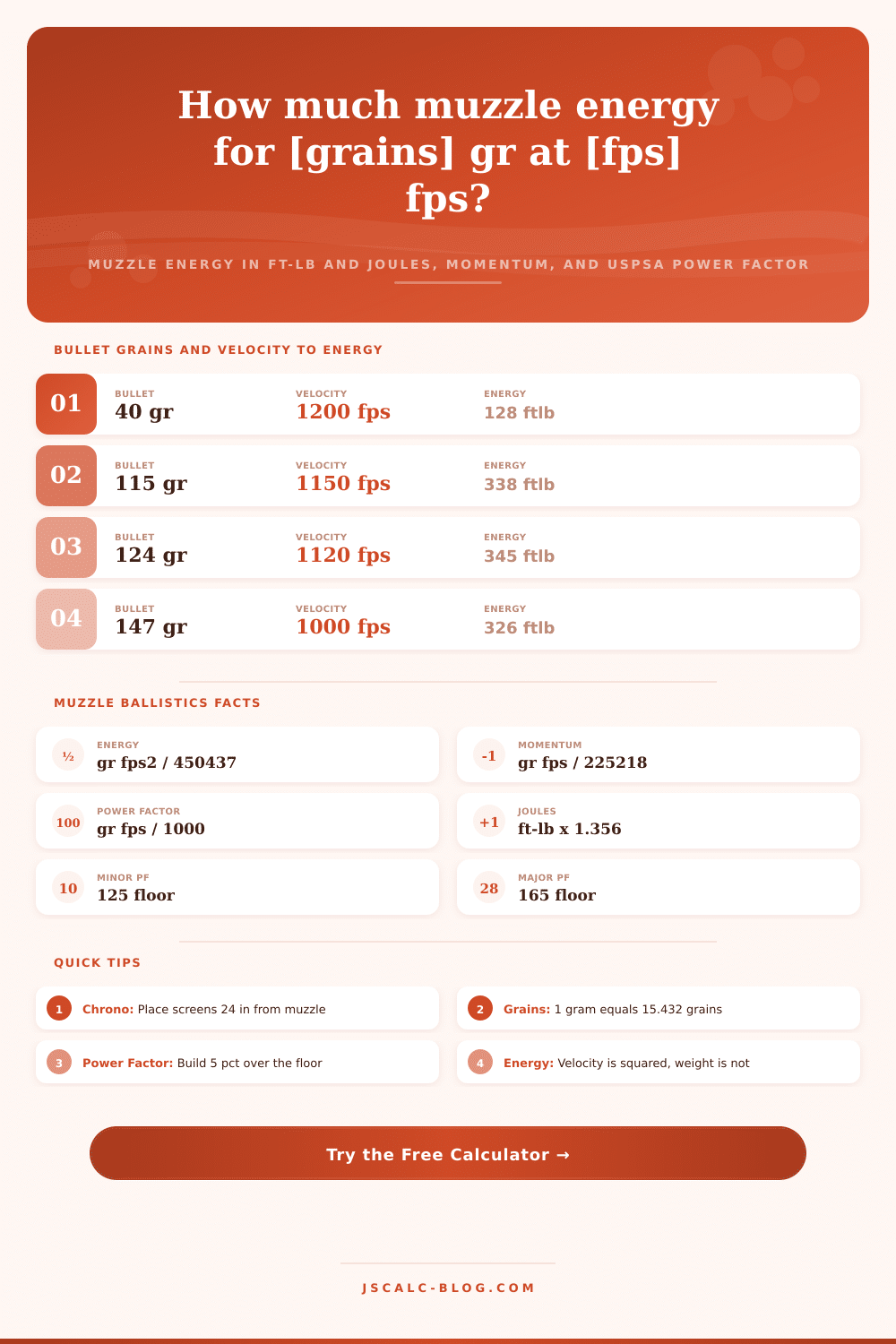
| 22 LR | 40 gr | 1200 fps | 128 ft-lb |
| 9mm Luger | 115 gr | 1150 fps | 338 ft-lb |
| 45 ACP | 230 gr | 850 fps | 369 ft-lb |
| 223 Rem / 5.56 | 55 gr | 3240 fps | 1282 ft-lb |
| 308 Winchester | 150 gr | 2820 fps | 2648 ft-lb |
| 30-06 Springfield | 180 gr | 2700 fps | 2914 ft-lb |
⚖Grains and Grams Conversion
| Grains (gr) | Grams (g) | Typical Use | Note |
|---|---|---|---|
| 40 gr | 2.59 g | 22 LR | Rimfire plinker |
| 115 gr | 7.45 g | 9mm | Light 9mm ball |
| 124 gr | 8.04 g | 9mm | NATO weight 9mm |
| 147 gr | 9.53 g | 9mm | Heavy subsonic 9mm |
| 230 gr | 14.90 g | 45 ACP | Classic 45 ball |
| 1 g | 1 g | Reference | Equals 15.4324 gr |
📏Velocity fps and m/s Conversion
| fps | m/s | Regime | Note |
|---|---|---|---|
| 850 fps | 259.1 m/s | Subsonic | Heavy 45 ACP |
| 1000 fps | 304.8 m/s | Near sound | Speed of sound approx 1125 fps |
| 1150 fps | 350.5 m/s | Supersonic | Standard 9mm |
| 2650 fps | 807.7 m/s | Rifle | Match 308 |
| 3240 fps | 987.6 m/s | Rifle | Light 223 |
| 1 fps | 0.3048 m/s | Reference | Exact conversion |
🏆USPSA Power Factor Floors
| Class | PF Floor | Example Load | PF of Example |
|---|---|---|---|
| Minor | 125 | 9mm 124 gr at 1015 fps | 126 |
| Minor | 125 | 9mm 147 gr at 900 fps | 132 |
| Major | 165 | 40 SW 180 gr at 950 fps | 171 |
| Major | 165 | 45 ACP 230 gr at 800 fps | 184 |
| Major | 165 | 10mm 180 gr at 1000 fps | 180 |
| Below floor | — | 9mm 115 gr at 1050 fps | 121 |
🗃Cartridge Muzzle Comparison Grid
| Cartridge | Bullet (gr) | Muzzle (fps) | Energy (ft-lb) | Power Factor | Typical Use |
|---|---|---|---|---|---|
| 22 LR | 40 | 1200 | 128 | 48 | Plinking, small game |
| 9mm Luger | 115 | 1150 | 338 | 132 | Defense, USPSA Minor |
| 9mm Luger | 147 | 1000 | 326 | 147 | Subsonic, suppressed |
| 40 SW | 180 | 1000 | 400 | 180 | USPSA Major, duty |
| 45 ACP | 230 | 850 | 369 | 196 | Defense, big bore |
| 223 / 5.56 | 55 | 3240 | 1282 | 178 | Varmint, patrol rifle |
| 308 Win | 168 | 2650 | 2619 | 445 | Precision, hunting |
| 30-06 Sprg | 180 | 2700 | 2914 | 486 | Big game hunting |
| 12 ga slug | 438 | 1600 | 2490 | 701 | Deer, close range |
⚙Formula Breakdown
💡Reloading and Range Tips
We’ve got the muzzle velocity and bullet weight. Those seem like enough information. They’re not though. To understand a load, we must translates those values into power factor, momentum, and energy.
The chart above do all of that. Your starting points. Your naked numbers; are fed into it, and it produces four number that tell us exactly what will occur at the moment of pulling the trigger. We’ll have the power factor (in both USPSA and IPSC), the momentum (in pound-seconds) and the muzzle energy (both in Joules and foot-pounds). Gone is the guessing game of how the round will perform down range, now the focus is on the instant the barrel spits the round. It is absolute physics with the chrono installed right there.
Understanding Bullet Power and Speed
This first number is muzzle energy, which take into account the amount of kinetic energy given to an object at release. The formula uses squared value for velocity. This means speed matter far more then mass. Doubling the size of a bullet will double the energy, but doubling the velocity will quadruple the energy. For example, a light bullet traveling at three thousand feet per second has a lot more destructive power than a hefty one going at eight hundred feet per second.
The calculator does the math for you. You don’t need to worry about converting between grains and slugs since it applies the correct divisor for you. It just spits out exact amount of work the projectile can do before the air slows it down.
Recoil and terminal effect is not just an issue of energy. That’s where momentum comes in. Momentum equals mass times velocity. So you could have a light bullet traveling fast, or a heavy bullet going slow with equal energy. But the heavier bullet go deeper into soft tissue and pushes harder on your shoulder than a lighter bullet. When comparing muzzle energy to muzzle momentum you get full story of the tradeoff between snap and push. Shooters focus on the bigger looking foot-pound number. The pound-second one is often more true to how it feels shooting the gun.
For competitive shooters, power factor are the only metric that determines your scoring class. It’s a straightforward index aimed at maintaining a minimal level of lethality for all practical shooting sports. Simply put, it’s the product of bullet weight times velocity divided by one thousand. In USPSA, you need 125 or more to shoot minor; 165 or more to shoot major.
Many new shooters go right to the line with their loads. Powder burn rate varies with temperature, and chronograph screens aren’t perfectly calibrated either. What may read 125 at home can be 124 at a chilly outdoor match. That knocks you below the floor. This is also a great tool because you can toggle back and forth between the two classes (Minor/Major) to check if you’ve loaded enough cushion.
This is an optical chronograph. If you’re using an optical chronograph to time a shot from one set of skyscreens to another, sometimes it’s not clear how fast something was moving. With an optical chronograph, you just put in the time in milliseconds it took to travel between two skyscreens as well as the distance apart and the system will tell you the speed. It takes the human error out of calculating speed based off time. It’s also great when you want to look at raw timing logs. You can verify their data with the speed they got.
Switching from metric to imperial units is seamless as well. Want meters per second? Or do you rather like feet per second? Grains? Or do you prefer grams? No worries because the math work under the hood no matter what units you choose to work in. Behind the scenes, the system does the conversion and you’ll be able to work in whatever makes the most sense to you.
Knowing what those are allows you to pick loads to match your needs. You no longer select based on what looks best on a box at a glance. Instead, this ties raw numbers into real information such as terminal performance, recoil and scoring categories. Looking at momentum, power factor, and energy at the same time will eliminate guesswork. You’ll begin engineering loads with purpose. If you measure it properley, the numbers won’t lie.