Bacteria Growth Calculator
Model exponential microbial growth by binary fission. Enter a starting count and doubling time to get the final population, number of generations, the growth rate constant, and the time needed to reach a target count.
🧪Culture Presets
📝Growth Inputs
Starting number of viable cells or CFU.
Population you want to reach (used in find-time mode).
🔢Formula Snapshot
📈Growth Over Time
| Elapsed | Generations | Fold 2^n | Population | Scientific |
|---|---|---|---|---|
| Enter values above to project growth over time. | ||||
🦠Doubling Times by Species
| Organism | Doubling Time | Generations / Hr | Rate k (per hr) | Condition |
|---|---|---|---|---|
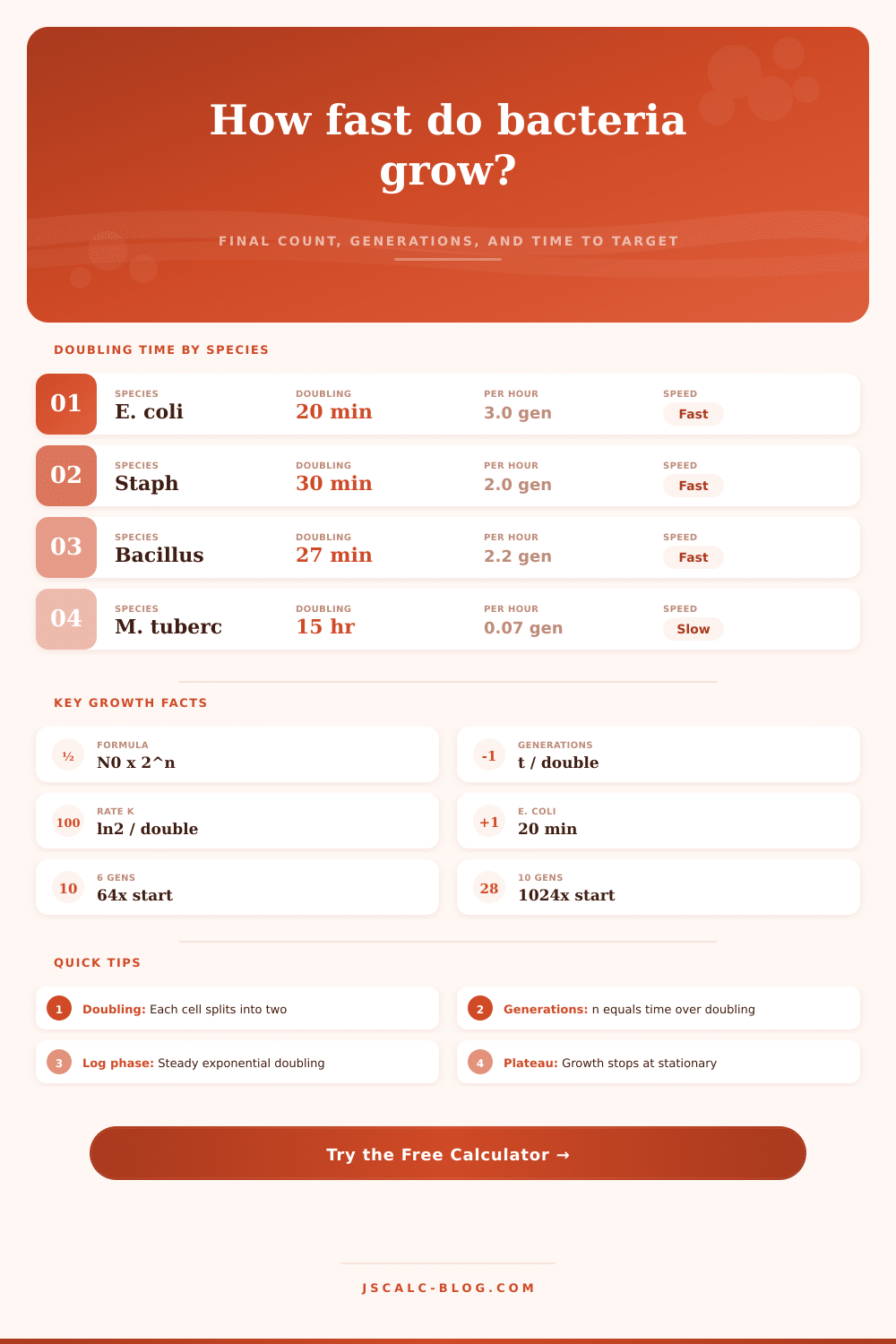
| Escherichia coli | 20 min | 3.00 | 2.08 | Rich broth, 37°C |
| Staphylococcus aureus | 30 min | 2.00 | 1.39 | Nutrient agar, 37°C |
| Bacillus subtilis | 27 min | 2.22 | 1.54 | Aerobic, warm |
| Pseudomonas aeruginosa | 35 min | 1.71 | 1.19 | Aerobic, 37°C |
| Lactobacillus (yogurt) | 75 min | 0.80 | 0.55 | Milk, 40°C |
| Mycobacterium tuberculosis | 15 hr | 0.07 | 0.046 | Slow grower |
| Clostridium (food risk) | 10 min | 6.00 | 4.16 | Optimal, anaerobic |
📊Generations vs Population
| Generations n | Fold 2^n | From N₀ = 1 | From N₀ = 1,000 | Time at 20 min/gen |
|---|---|---|---|---|
| 0 | 1 | 1 | 1,000 | 0 min |
| 5 | 32 | 32 | 32,000 | 1 hr 40 min |
| 6 | 64 | 64 | 64,000 | 2 hr |
| 10 | 1,024 | 1,024 | 1.02 × 10^6 | 3 hr 20 min |
| 20 | 1,048,576 | 1.05 × 10^6 | 1.05 × 10^9 | 6 hr 40 min |
| 30 | 1.07 × 10^9 | 1.07 × 10^9 | 1.07 × 10^12 | 10 hr |
| 40 | 1.10 × 10^12 | 1.10 × 10^12 | 1.10 × 10^15 | 13 hr 20 min |
🕑Growth Phases
| Phase | What Happens | Doubling? | Population Curve | Notes |
|---|---|---|---|---|
| Lag | Cells adapt, enzymes ramp up | Little to none | Flat | No net increase yet |
| Log (exponential) | Steady binary fission | Constant | Straight on log scale | This calculator models this |
| Stationary | Nutrients drop, waste builds | Growth = death | Plateau | Count levels off |
| Death (decline) | Cells die faster than divide | Negative | Downward | Exponential model no longer holds |
⚙Full Formula Breakdown
📋Time to Reach Common Counts
| Target from 1 Cell | Generations Needed | Time at 20 min | Time at 30 min | Time at 60 min |
|---|---|---|---|---|
| 1,000 (10^3) | ~10.0 | 3 hr 19 min | 4 hr 59 min | 9 hr 58 min |
| 1 million (10^6) | ~19.9 | 6 hr 38 min | 9 hr 58 min | 19 hr 55 min |
| 1 billion (10^9) | ~29.9 | 9 hr 58 min | 14 hr 57 min | 29 hr 53 min |
| 1 trillion (10^12) | ~39.9 | 13 hr 17 min | 19 hr 55 min | 39 hr 50 min |
💡Practical Growth Tips
Microbes split into two (and then each of those splits into two). It seems like it takes forever if you observe bacteria in real time inside a petri dish, but here’s what most folks don’t understand: Microbial growth isn’t linear. The number of microbes double in each generation. Exponentially. Until there are no more resources.
Our minds think in a straight line, but reality grow exponentially. This is why your leftovers could go from harmless to harmful within hours instead of days. It uses a logarithmic growth model that assumes that cells divides through binary fission in a steady rhythm during the log phase.
Why Microbes Grow So Fast
To begin with, type in your starting cell count: Maybe millions if you’re trying to test some contaminated water, maybe only a few thousand if you’re setting up a new culture. Next, enter the doubling time. That’s the doubling time. It might be as short as twenty minutes (if you’re growing something fast-growing, like E. Coli in rich broth) or it can extend to as much as fifteen hours (with hardy types such as Mycobacterium tuberculosis).
And there it is! The calculator crunches the numbers and tells you either how long it’ll take before reaching any given target number of cells or how many there’ll be by any given time. Why do the inputs matter? Because these represent actual biological constraints. Doubling time depend on things like temperature, oxygen level, and nutrient availability.
For example, lower the temperature of your culturing medium, and its enzymes will slow down to match, increasing the length of each generation. To account for this, the calculator lets you easily change units from minutes (for something fermenting quickly) to hours (for a slower process in the environment). It will then output the growth rate constant. A mathematically standardized way to express just how fast the population is growing compared to time itself. That way, you can compare different species on an equal footing, even if one is inherently faster than another.
But that’s all math as long as there’s plenty of resources. We call it the exponential phase in the lab. Nature doesn’t support unlimited growth, though. Nutrients gets depleted and waste products accumulate until the population enters its stationary phase: birth rate equals death rate. At that point, the calculator does not account for the plateau.
It’s programmed for ideal conditions. It is not a bug; it is a feature. You pull out the calculator when you want to know the theoretical max before reality comes along and punches your numbers in the teeth. Once you know that number, you can develop safety protocols or design experiments with a clear idea of what the worst case could be.
Speaking of food: Think about what happens when we leave food items out at room temperature for a long time. Two hours is one well-known guideline. Why? Because if pathogens are already present, they can reach dangerous levels really quickly. Even if the initial load isn’t massive, the doubling time can get pretty swift after that and then you’ve got millions of cells in short order.
Knowing what the typical doubling time of each bug is puts things into perspective (the reference tables on the site provide those). For example, Staphylococcus aureus doubles in 30 minutes; E. Coli does it in 20. Ten minutes can make a huge difference over several hours. This changes your perception of time. An hour, which feels like a long time if you’re growing microbes quickly enough; becomes an eternity. It’s more than enough time for several generations to pass through their life cycle, reproduce, and die. If you grow them slow, that same hour passes by in the blink of an eye.
Whether you work with clinical samples, treat wastewater, or brew yogurt at home, this is the kind of insight that matters. Because it isn’t about counting cells alone: it’s about following the pulse of division. Logarithmic math is taken care of by the tool itself, leaving you free to think about what’s happening biologically. It connects the dots between the theory of kinetics and the reality of observing populations. This makes all the difference.
It’s all about time. Whether you’re trying to let the bacteria grow or perish, you’ve got a race on your hands. And even a minor miscalculation of generation time can send your ultimate estimate spiraling out of control. Think your bug doubles each hour? In reality, it doubles every 40 minutes. After only six hours, you’ll have close to three times as many bacteria as you expected.
And that’s where people make a mistake. They don’t take into account the impact of growth building on itself. A good model can serve to anchor their expectations in math instead of gut instinct. It reminds them that small periods of time result in huge differences when working with something as tiny as cells. Just one little cell begins the journey and, before long, it could of represent the overwhelming majority. Don’t forget that you must respect the rhythm of its reproduction.