Rent vs Buy Break-Even Calculator
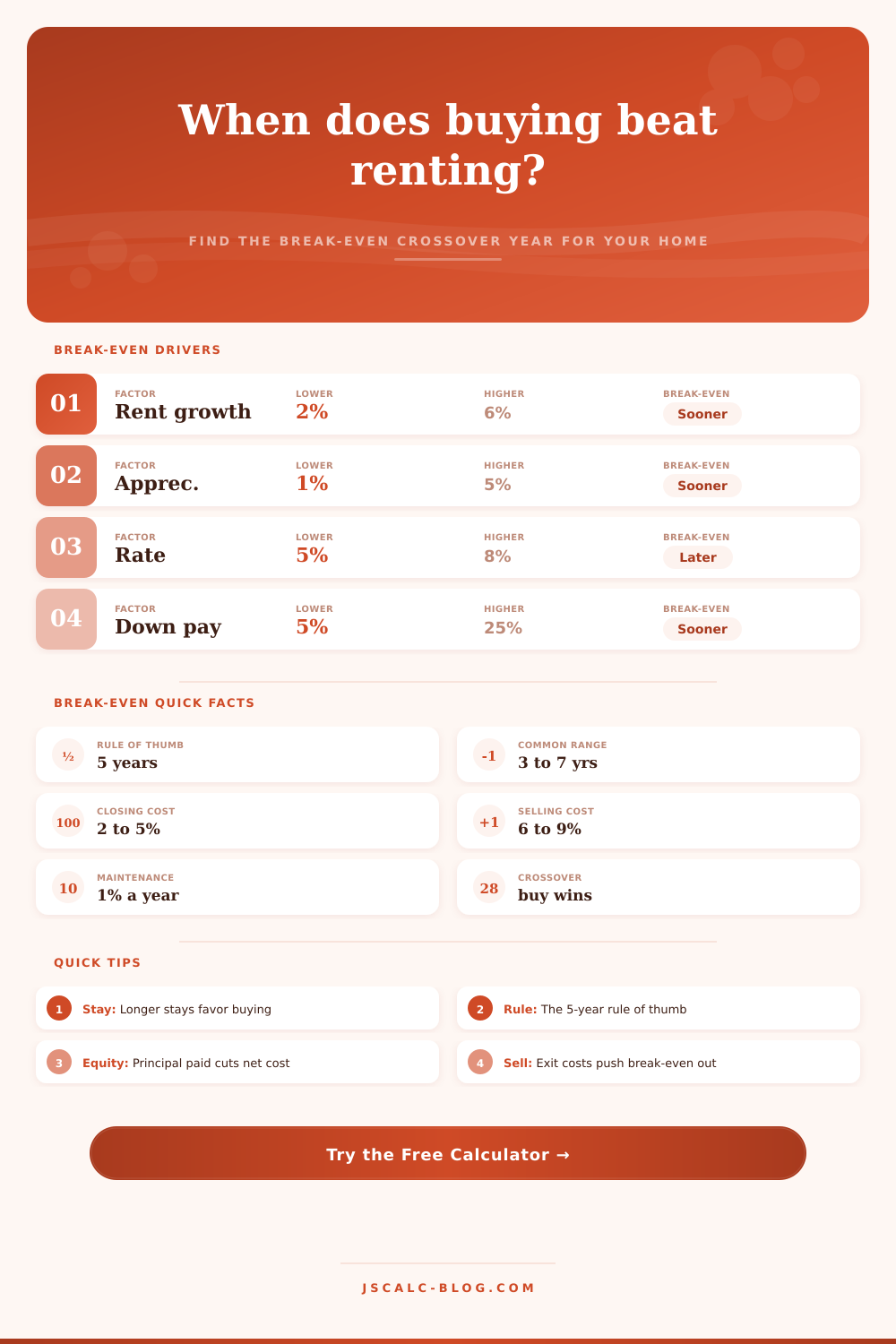
Find the year buying beats renting. This tool tracks cumulative buy cost against cumulative rent cost year by year, folding in mortgage payments, taxes, maintenance, equity from principal, home appreciation, and selling costs to reveal your break-even crossover year.
🎯Real Scenario Presets
📝Your Rent vs Buy Inputs
🔢How Break-Even Works
📊Year-by-Year Breakdown
| Year | Rent Paid | Buy Payments | Equity Built | Home Value | Net Buy Cost |
|---|---|---|---|---|---|
| Enter values above to see the year-by-year breakdown. | |||||
🗂Cumulative Comparison Grid
| Year | Cumulative Buy | Cumulative Rent | Difference | Winner |
|---|---|---|---|---|
| The cumulative comparison appears after calculation. | ||||
⚙Break-Even Formula Breakdown
📈Break-Even by Scenario
| Scenario | Rent Growth | Appreciation | Rate | Typical Break-Even |
|---|---|---|---|---|
| Balanced market | 3.5% | 3.5% | 6.5% | 4 to 6 years |
| High rent market | 6.0% | 4.0% | 6.5% | 2 to 4 years |
| Low appreciation | 3.0% | 1.0% | 6.5% | 7 to 10 years |
| Expensive metro | 4.0% | 4.5% | 7.0% | 5 to 8 years |
| Low rate era | 3.5% | 3.5% | 5.0% | 3 to 5 years |
| Flat prices | 2.5% | 0.0% | 6.5% | 9 years or more |
📋Rent vs Buy Cost Factors
| Factor | Typical Range | Side Affected | Push On Break-Even |
|---|---|---|---|
| Down payment | 5% to 25% | Buy upfront | More down reaches break-even sooner |
| Mortgage rate | 5% to 8% | Buy payments | Higher rate pushes break-even later |
| Rent growth | 2% to 6% a year | Rent | Faster rent growth favors buying |
| Appreciation | 0% to 5% a year | Buy equity | Higher appreciation favors buying |
| Maintenance | 0.5% to 2% a year | Buy outlay | Higher upkeep favors renting |
| Selling cost | 6% to 9% | Buy exit | Big exit fees favor a long stay |
💳Closing & Exit Cost Guide
| Cost Item | When Paid | Typical Amount | Counts Toward |
|---|---|---|---|
| Lender fees | At purchase | 0.5% to 1.5% | Upfront buy cost |
| Title & escrow | At purchase | 0.5% to 1% | Upfront buy cost |
| Prepaids & points | At purchase | 1% to 2% | Upfront buy cost |
| Agent commission | At sale | 4% to 6% | Selling cost at exit |
| Transfer & staging | At sale | 1% to 3% | Selling cost at exit |
💡Break-Even Tips
Should you buy or rent? That’s a popular topic, it appears obvious on the surface, yet what most people believe are unclear. Most financial planners say: If you intend to live in a place for at least five years, then buy. But this rule apply only to the most general cases; it doesn’t take into account your local real estate market, nor your personal finances.
Renting isn’t just the amount of money you pay each month. There are also upfront cash requirements, the rate of rent appreciation vs. There is also the rate of homeownership and the timing of owning versus renting. It is also about renting as an investment. Use a calculator to see where you’re ahead year-by-year, and whether owning will ever be profitable.
How to Decide: Buy or Rent?
The #1 mistake that most people make: they only consider their monthly mortgage payment. They don’t see the big picture. What they’re looking at is something that “fits” into their current income. But what about five years from now? What are you going to have then?
If you decide to buy a home, you should of considered the full cost of homeownership, including maintenance reserves, insurance, property taxes, and perhaps an HOA fee as well. To determine whether buying makes sense, you should consider the full cost of homeownership… Including maintenance reserves, insurance, property taxes, and perhaps an HOA fee as well.
Rent isn’t static, either. You also need to consider rent growth. If your mortgage payment remains fixed while your rent rises four percent per year, the gap between owning and renting get wider and wider. Renting means you are paying someone else’s equity instead of building up your own equity. The tool does all that math for you. It include your fixed mortgage payment versus rising rents, so you can see where those two lines cross.
Friction is the largest invisible expense of homeownership. On the buying side, you’ll shell out 2-5% of your purchase price as closing costs upfront. On the selling side, you’ll hand over another 7% or more in the form of transfer taxes and agent commissions. If you only stay in a house for a few years before selling, meaning if you buy and sell within three years. It’s possible the transaction costs themselves could cancel out your equity (or at least any appreciation).
That’s why rent wins by such a wide margin when the stay is short, transactional dollars don’t go right into your pocket. They get you time in a location. If you plan to live there long enough that monthly ownership savings will exceed those big lumps, then you should own.
A subtle but critical role: home appreciation A lot of people think “prices will skyrocket!” (They don’t; typical annual appreciation averages roughly three percent). That’s okay, though; even tiny gains can boost your ownership and require no additional funds. But if you’re in an area where house values is stagnant or falling, the breakeven period becomes a game-changer. Instead of breaking even quickly, you might need to stay ten years or more just to cover those transaction costs. High rent growth speeds up this process; low appreciation lengthens it. Think of it as a see-saw: on one side is amount you spend entering/leaving; on the other is the performance of the property during your ownership.
What about the down payment? The bigger it is, the lower your mortgage interest cost will be each month, but the more money you’ll have tied up in real estate initially. You could invest that money instead, and maybe earn a higher return elsewhere different than you do from housing appreciation. The smaller your down payment, the greater your debt service will be each month … but also the higher your cash will remain. There’s no right answer here. Your decision depends on your alternative investments and your risk tolerance.
Do you like the “forced savings” nature of a mortgage, where each principal payment adds to your equity automaticly? Or does locking up wealth into carpet and drywall make you unhappy because it’s so hard to turn into cash? It’s a marker of when your math changes from “renting is better” to “buying is better.”
So if you think you’ll be out in four years due to job relocation, and your break-even calculation shows year eight, then yes, it’s objectively financialy smarter to keep renting. No shame. The market won’t dissapears. Your housing plan should sync up with your real-world timeline, rather than some generic rule of thumb.
When you know your personal breakeven number, the stress of the question subsides. You have an exact answer to what you’re spending on housing, and whether or not it makes sense for you. That’s more valuable than any particular percentage point.