Rent and Invest vs Buy Calculator
Renting frees up the down payment and monthly savings to invest in the market, while buying builds home equity. This tool projects the net worth of both paths over your time horizon so you can see which one comes out ahead.
🎯Real Scenario Presets
📝Buy vs Rent Inputs
Used only when the mode above is set to fixed amount.
🔢Formula Snapshot
📊Net Worth By Year
| Year | Buy Equity | Portfolio Value | Difference | Leader |
|---|---|---|---|---|
| Enter values above to build the year-by-year comparison. | ||||
🗂Investment vs Equity Detail
| Year | Home Value | Loan Balance | Contributions | Portfolio | Invest Gain |
|---|---|---|---|---|---|
| The detailed path table appears after calculation. | |||||
📈Sensitivity To Investment Return
| Return | Buy Net Worth | Rent Net Worth | Difference | Winner |
|---|---|---|---|---|
| The return sensitivity table appears after calculation. | ||||
📋Assumptions Reference
| Assumption | Typical Range | Which Path It Helps | Why It Matters |
|---|---|---|---|
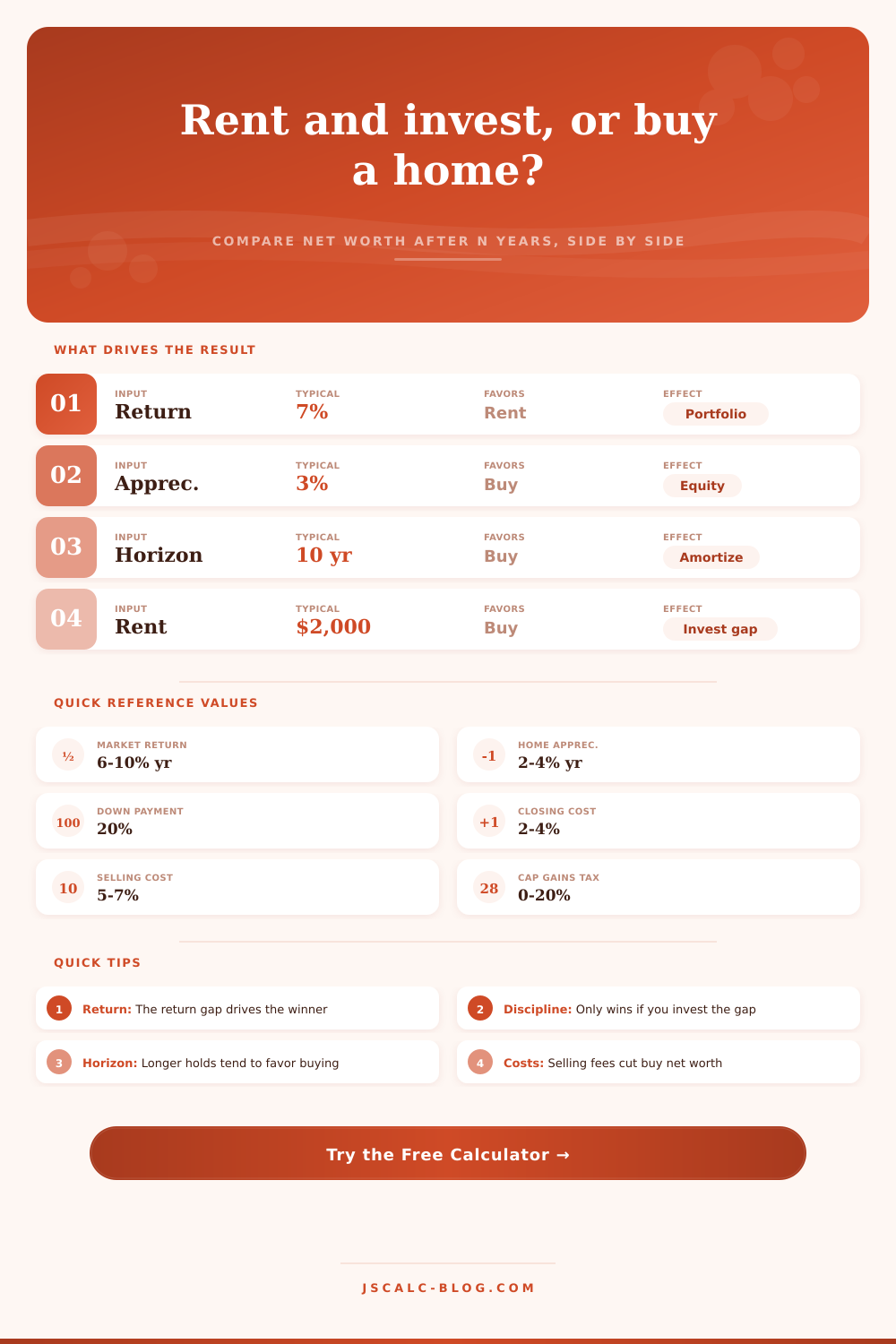
| Investment return | 6% to 10% yearly | Rent and invest | Compounds the invested gap over time |
| Home appreciation | 2% to 4% yearly | Buy | Grows equity above the loan balance |
| Time horizon | 5 to 30 years | Buy at longer holds | Amortizes loan and spreads buy costs |
| Monthly rent | $1,500 to $3,000 | Buy when rent is high | Lower rent leaves more cash to invest |
| Selling costs | 5% to 7% of value | Rent and invest | Cuts the buyer net worth at exit |
| Capital gains tax | 0% to 20% of gains | Buy | Trims the taxable portfolio at exit |
⚙Full Method Breakdown
💡Practical Comparison Tips
If you’ve been around the personal finance scene at all, then you’ve likely seen this discussion play out. On one hand, your friends tell you that homeownership is the golden ticket to wealth. On the other hand, your financial advisor says “Renting is equally wise” if you invest that money elsewhere. While both sides can point to data, neither side paint the full picture. In reality, there’s no universal answer. Neither option work for everyone every time. It all depends on how the actual numbers shakes out in your local real estate market.
To avoid guessing where the wind is blowing, input your own numbers into the calculator above and let it crunch the complicated math. It’s a pretty simple tension at the core here. Renting lets you have more cash in your hand each month. You don’t pay any fees or take on debt. Buying a home forces you to put away money, either in the form of increasing value or as a means of paying off your mortgage. The question is: Does the return from the market exceed the return from housing, net of all the hidden costs of ownership?
How to Choose Between Renting and Buying
Most folks get tripped up here because they fail to add up the cost. Consider the fate of your down payment. When you purchase, this cash goes into your home’s value and it grows along with the house, which has historicaally gone up about three percent a year. When you rent, you invest this same lump sum right away. Over longer periods, the stock market has averaged something like seven or ten percent, meaning there’s a huge difference if you compound over time.
But the market crashes occasionally. Rents continue to rise, which means houses generally don’t lose value in real terms. Your local market matter much more than any national average. People don’t consider other expenses either. When buying, you pay closing costs up front and selling costs down the road. Plus, there’s insurance, maintenance and property taxes. Every month, those cost reduce your equity. If you’re renting, it saves you from most headaches (but exposes you to risk, as your landlord could increase your rent. Or refuse to renew your lease). The tool allows you to input transaction fees and appreciate rates, so you can adjust accordingly to account for fixed obligations vs. Potential market volatility.
The biggest lever in this equation is time. Renting and investing will likely be a better deal than buying if you intend to occupy a house for just five years. You’ll end up losing all that money to transaction costs before you break even. (Lenders and agents will eat your upfront cash.) But hold that house for fifteen or two decades, then the story flips. As you pay down your mortgage principal, you build actual equity. After deflating away inflation, appreciation begin to compound significantly. Liquidity favors short stints such as rent. Forced savings favors buying and holding for a long time.
But here’s where discipline enters: you’ve got to get real with yourself. If you’re going to rent, then you must invest the monthly savings. Otherwise, you’ll end up spending it all on fancy dinners and cool rides, in which case, renting is a losing idea. When you buy, you are forced into saving. Each month, you build equity. It’s nearly impossible to “skip” a mortgage payment without bad consequences. Renters have the flexibility, but no structure. Pick the road that fits who you really are, not who you want to be.
There’s also an indirect effect from inflation: Rising prices make fixed-rate mortgages cheaper in real terms. If your wages keep pace with inflation, a $3,000 mortgage payment feels harder to pay today than it will in a decade. Fixed-rate mortgages becomes cheaper as prices rise and rent increases often track or exceed inflation. Over the really long run, this favors buyers because their rent remains constant while their salary rises; another sneaky benefit that you won’t see reflected in short-run predictions.
There’s no one-size-fits-all answer here. In some markets, rent-to-price ratios are so low that it doesn’t make much financial sense to buy a place. Rent gets so insane in other markets that you’re forced to own as your only sane option for stable shelter. To determine whether it would be right for you, plug your specific numbers into the calculator above. Review the sensitivity table to learn which factors drive results. See how minor fluctuations, like the return on your investment or interest rate, will influence the result.
Don’t believe what you read in headlines. Believe what you calculate. You’re not trying to own an asset exactly. You’re trying to live comfortabley and build wealth. How you do that (diversified portfolio/equity) is up to your situation. If you don’t know where to begin with some of these inputs, look in the reference section below for the assumptions range. From there, change those numbers so they reflect you. Don’t guess later, do this work now. You should of thanked yourself for it down the road. Start with the presets as a baseline and then tweak one variable at a time to see what makes the biggest difference.