Triangular Plant Spacing Calculator
Plan an offset (staggered) planting layout, find plants needed, row spacing, plants per row, and see how a triangular grid fits about 15.5% more plants than a square grid using the sin 60° = 0.866 factor.
🌱Crop Spacing Presets
📝Layout Inputs
Rows run along this direction.
Plants across each row.
Used when method is direct area.
Unplanted edge in plot size unit (dimensions mode).
🔢Triangular Layout Factors
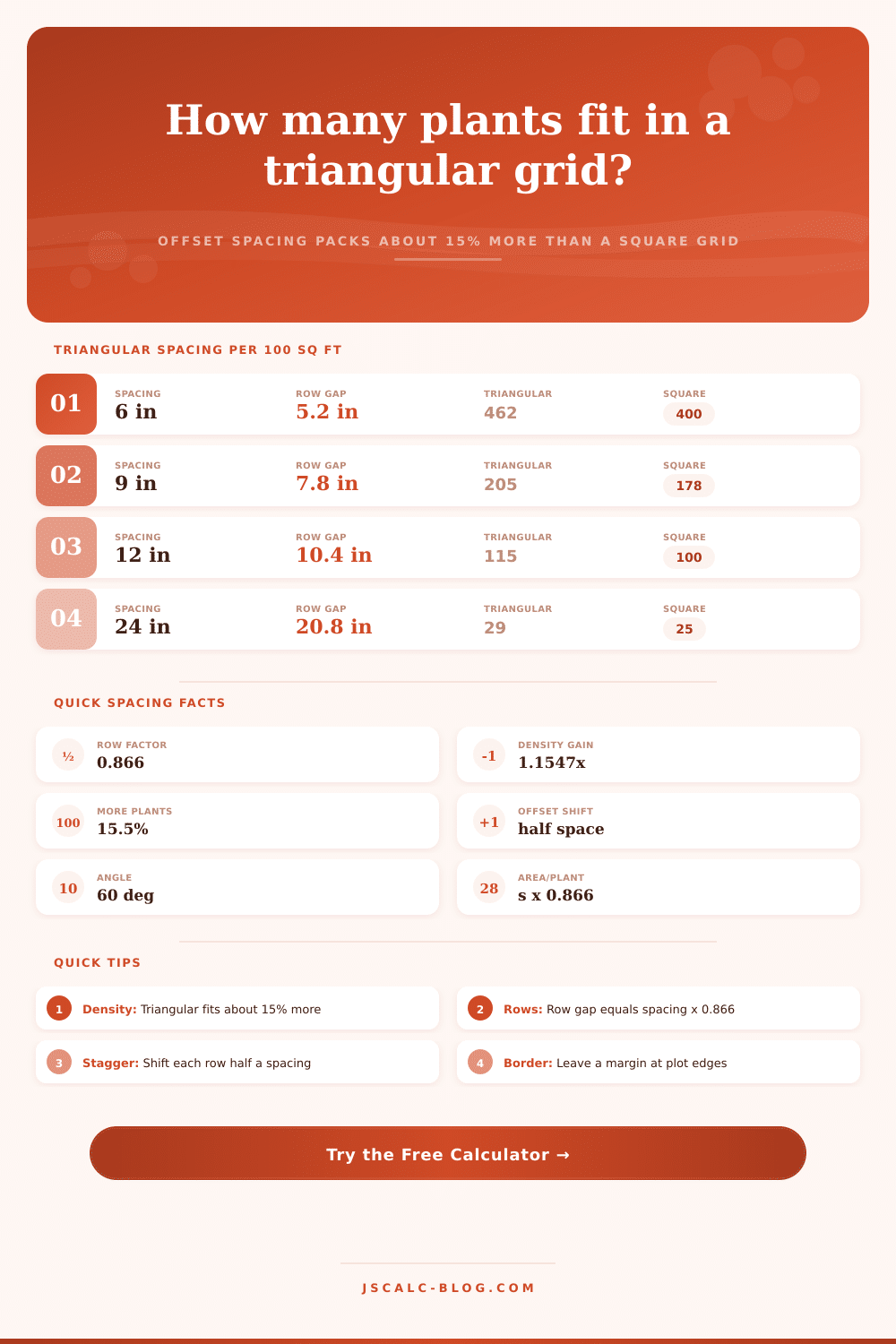
📊Spacing vs Plants per 100 sq ft
| Plant Spacing | Row Spacing | Triangular / 100 sq ft | Square / 100 sq ft | Extra Plants |
|---|---|---|---|---|
| 6 in | 5.2 in | 462 | 400 | +62 |
| 8 in | 6.9 in | 260 | 225 | +35 |
| 9 in | 7.8 in | 205 | 178 | +27 |
| 10 in | 8.7 in | 166 | 144 | +22 |
| 12 in | 10.4 in | 115 | 100 | +15 |
| 18 in | 15.6 in | 51 | 44 | +7 |
| 24 in | 20.8 in | 29 | 25 | +4 |
| 36 in | 31.2 in | 13 | 11 | +2 |
🗂Triangular vs Square Density Grid
| Spacing | Row Gap | Triangular / 100 sq ft | Square / 100 sq ft | Percent More |
|---|---|---|---|---|
| 4 in | 3.5 in | 1039 | 900 | 15.5% |
| 6 in | 5.2 in | 462 | 400 | 15.5% |
| 9 in | 7.8 in | 205 | 178 | 15.5% |
| 12 in | 10.4 in | 115 | 100 | 15.5% |
| 15 in | 13.0 in | 74 | 64 | 15.5% |
| 18 in | 15.6 in | 51 | 44 | 15.5% |
| 24 in | 20.8 in | 29 | 25 | 15.5% |
| 30 in | 26.0 in | 18 | 16 | 15.5% |
| 36 in | 31.2 in | 13 | 11 | 15.5% |
🌿Common Crop Spacings
| Crop | Spacing | Row Spacing | Layout Note |
|---|---|---|---|
| Carrots / radish | 3 in | 2.6 in | Intensive offset blocks |
| Flower bedding | 6 in | 5.2 in | Dense display coverage |
| Lettuce heads | 8 in | 6.9 in | Staggered salad grid |
| Basil / herbs | 9 in | 7.8 in | Offset kitchen rows |
| Corn / strawberry | 10 to 12 in | 8.7 to 10.4 in | Zig-zag hills or beds |
| Tomato / pepper | 18 to 24 in | 15.6 to 20.8 in | Wide staggered spacing |
| Shrubs | 3 ft | 2.6 ft | Hedge or mass planting |
| Orchard trees | 15 ft | 13.0 ft | Triangular orchard grid |
📐Row-Spacing Factor Reference
| Layout | Row Factor | Area per Plant | Density vs Square |
|---|---|---|---|
| Square grid | 1.000 | spacing² | 1.000× (baseline) |
| Triangular / offset | 0.866 | spacing² × 0.866 | 1.1547× |
| Row gap = spacing × | sin 60° | 0.8660 | +15.5% plants |
| Offset shift per row | half spacing | 0.5 × spacing | hexagonal packing |
⚙Full Formula Breakdown
💡Practical Spacing Tips
Usually, you start off thinking in squares. It’s the easiest shape to measure. It matches way we think of world in general. So you draw out row, make them straight, then go to work planting. This is great, unless your plant are relatively tiny (so they don’t really need a lot of room) or you have lots of cheap land to spread around.
But put dozens of strawberry runners or a couple dozen heads of lettuce in a raised bed and suddenly all that blank space in the middle of every other plant seems…well, wasteful. Using a triangular spacing calculator lets you fill in that empty space without overcrowding your crop. Stop thinking in squares and think in triangles, and you’ll see how easy the math gets.
How Triangular Planting Saves Space
With a square layout, each plant get an equal amount of space both up and down and side to side. So spaces where you grow things form a diamond shape between them. To get the staggered pattern, simply move every other row halfway to the left or right (half the distance between plants). Now instead of the rows being parallel, they’re nested, with one row filling gap left by the next. Because the geometry offsets, you can reduces the spacing between the rows without reducing the distance from plant to plant. That number’s basically the sine of sixty degrees.
This means you can keep your plants spaced the same distance from each other (center-to-center), but get the rows maybe a bit under fifteen percent closer together. That sounds like a little thing on paper, but in a small bed, it adds dozens more plant per season.
To set the layout, it’s not as simple as dropping things into the ground. It’s necessary to specify the width of your plot and its length. Remember that width mean how many plants can go across a row, and length means how long the row is. Enter those numbers into the tool. Or, enter your total plot size if you have an odd-shaped bed.
And it also takes into account border margins, which is something sensible to think about but something lots of folks forget. A plant that sits inches from the soil bank doesn’t get full sun. It also gets dragged on by hoses or stepped on by feet and it isn’t happy. You can leave an inch or half-inch margin around all sides to make sure that you’ve accounted for slightly less space in your planting area, so that number of actual plants you’re getting is closer to reality.
If you look at the table of references on the page, you’ll see that the density remains constant at every increment of spacing. This means the geometry is driving the increase in efficiency, not any particular type of crops.
And finally: What do you grow? Radishes and other dense-root crops such as carrots realy love triangular spacing; their foliage isn’t big, so there’s no problem having them right next to each other or the other plants. In fact, a six-inch distance between your plants sounds pretty close…but when laid out in triangles, it results in many more plant per square foot than if they were spaced in squares.
On the other hand, something like tomatoes or peppers (which are larger plant)… Require space to breathe. Set your plant spacing wide, about eighteen or twenty-four inches, but keep your rows closer together. You can do both at the same time in this system. Even with all this breathing room, the offset pattern still helps squeeze out some more capacity, though not at the expense of plants competing for resources.
The main point is to recognize that in this system, “row spacing” does not mean the same thing as “plant spacing.” You get closer together on your rows but keep the plants as far away from each other as they were originally set.
What’s the catch? Well, most people try to cram triangular arrangements on plants that require large aisle spaces (such as those that require frequent watering or heavy harvesting). Remember: When you must tread your path between each row, closing the gap makes no sense, you’ll simply wind up with a muddy trough instead of a productive garden. Triangular planting is optimal when access can be controlled from the sides and not the inside, think orchard, container garden, raised bed.
But it also has to do with getting the most out of an area, getting the most yield per square foot…while still accounting for the plant’s biological requirements. After you notice the additional capacity created by such a simple shape change, it’s difficult to return to straight rows. Every wasted corner starts looking like potential. And at last, you transform waste airspace into real food.