Loan-to-Value (LTV) Ratio Calculator
Find your loan-to-value and combined LTV in seconds. See your home equity, whether private mortgage insurance is required, and exactly how much principal to pay down to reach 80% LTV and drop PMI.
🏠Real Loan-to-Value Presets
📝Property & Loan Inputs
The lower of purchase price or appraised value is used for a purchase; use the fresh appraisal for a refinance.
Type affects the maximum LTV lenders will allow, shown in the reference tables below.
Toggle to enter the loan directly or start from your down payment.
Used when the mode above is set to loan amount.
Used when the mode above is set to down payment. Loan = value − down.
Home equity loan or HELOC drawn balance. Leave at 0 if you have no second lien.
80% is when you can request PMI cancellation; 78% is when servicers must auto-terminate it.
🔢Quick Equity Snapshot
⚙How Your LTV Is Calculated
📊Down Payment → LTV & PMI Chart
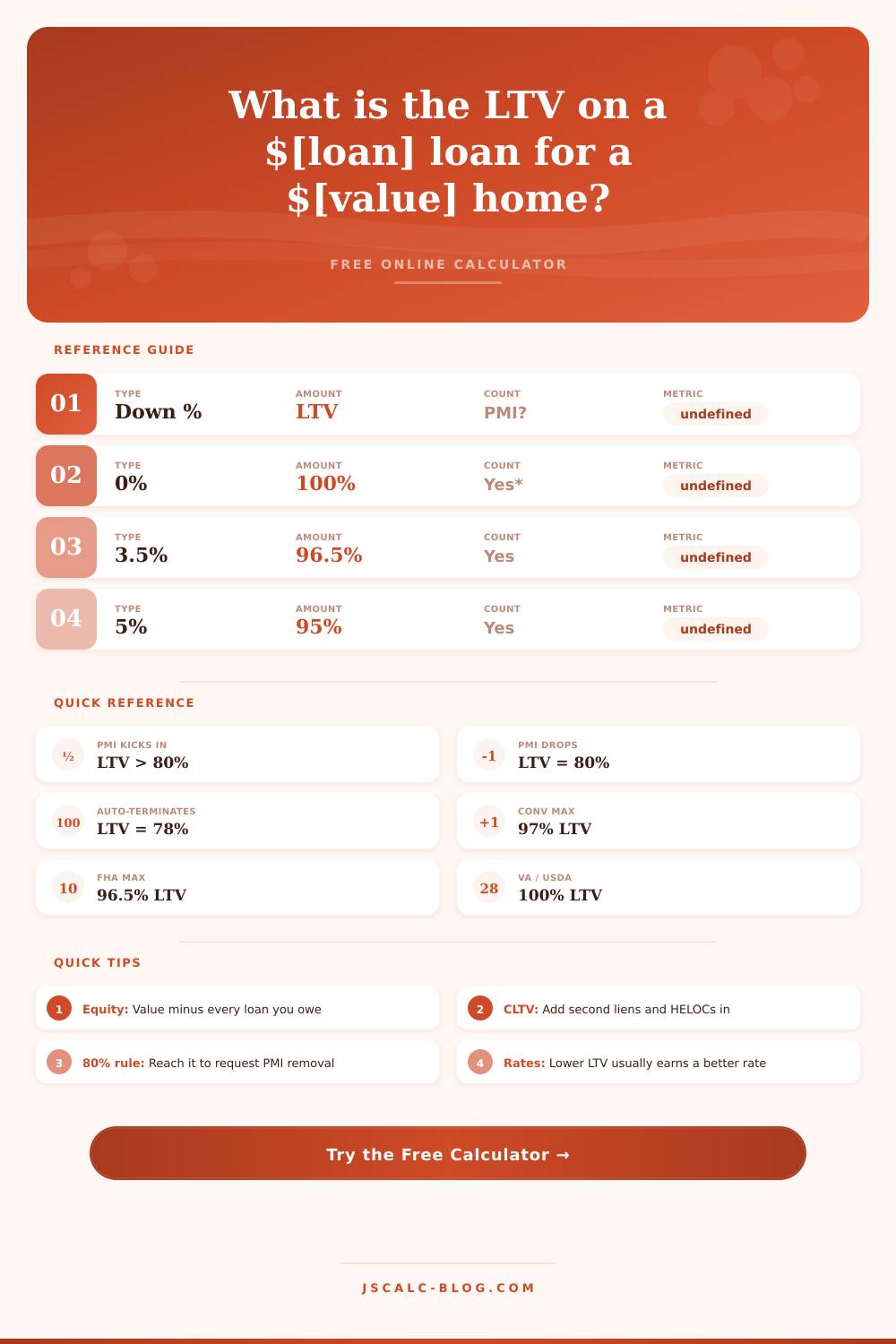
| Down Payment | Resulting LTV | PMI Required? | Note |
|---|---|---|---|
| 0% down | 100% | Yes (or VA/USDA fee) | Only zero-down programs; conventional not allowed |
| 3.5% down | 96.5% | Yes (FHA MIP) | FHA floor for a 580+ credit score |
| 5% down | 95% | Yes | Common conventional entry point |
| 10% down | 90% | Yes | Lower PMI cost than 95% LTV |
| 15% down | 85% | Yes | Getting close to the PMI-free line |
| 20% down | 80% | No | The classic PMI-free threshold |
| 25% down | 75% | No | Often unlocks better pricing tiers |
| 30% down | 70% | No | Strong equity cushion from day one |
| 40% down | 60% | No | Lowest-risk tier lenders reward most |
🏦Max LTV by Loan Program
| Loan Program | Typical Max LTV | Min Down | Mortgage Insurance |
|---|---|---|---|
| Conventional (Fannie/Freddie) | 97% | 3% | PMI until 80% LTV |
| FHA | 96.5% | 3.5% | MIP, often for the life of loan |
| VA (eligible veterans) | 100% | 0% | None; one-time funding fee |
| USDA (rural) | 100% | 0% | Annual + upfront guarantee fee |
| Jumbo | 80% (up to 90%) | 10% to 20% | Varies; often none at 80% |
| Cash-out refinance | 80% | -- | Depends on resulting LTV |
| HELOC / 2nd (CLTV cap) | 85% to 90% CLTV | -- | None on the line itself |
| Investment property | 75% to 80% | 20% to 25% | PMI if above 80% (rare) |
💰PMI Thresholds & LTV Rate Impact
| LTV | PMI / Rate Milestone | What Happens | Typical Rate Note |
|---|---|---|---|
| > 80% | PMI in force | Monthly PMI added to payment | Highest add-ons |
| 80% | Request removal | You may ask the servicer to cancel PMI | Best conventional pricing |
| 78% | Automatic termination | Servicer must drop PMI on schedule | No PMI cost remains |
| 75% | Better tier | Often a small rate improvement | Roughly 0.125% better |
| 70% | Strong equity | Lower risk-based pricing | Roughly 0.25% better vs 90% |
| 60% or less | Top tier | Best rate/fee adjustments available | Lowest cost of borrowing |
📑LTV Scenario Comparison Grid
| Scenario | Down % | LTV | PMI? | Loan Program | Typical Rate Note |
|---|---|---|---|---|---|
| 20% Down Conventional | 20% | 80% | No | Conventional | Best mainstream pricing |
| 3.5% Down FHA | 3.5% | 96.5% | Yes (MIP) | FHA | Higher insured cost |
| 10% Down + PMI | 10% | 90% | Yes | Conventional | Moderate PMI add-on |
| VA 0% Down | 0% | 100% | No (funding fee) | VA | Competitive veteran rate |
| Refi 75% LTV | 25% equity | 75% | No | Rate/term refi | Small rate improvement |
| HELOC 90% CLTV | 10% equity left | 90% CLTV | No on line | HELOC 2nd lien | Variable line rate |
| Investment 25% Down | 25% | 75% | No | Conventional (NOO) | Investor rate add-on |
| Jumbo 80% | 20% | 80% | No | Jumbo | Portfolio pricing |
| Cash-Out Refi 80% | 20% equity left | 80% | Maybe | Cash-out refi | Slightly higher than rate/term |
💡Tips For Managing LTV
If you’re refinancing or purchasing a new home, there’s one number working behind the scenes. It determine your interest rate, how much the lender will give you, and how much your monthly insurance payment will be. I’m talking about the loan-to-value ratio, or LTV. Borrowers typically think about down payment dollar amount … or the size of their mortgage. But what matters more to the lender is connection between those two numbers. That’s why this calculator converts that vague percentage into hard facts: Where does it put you? How much principal should you pay off in order to shed private mortgage insurance?
Your LTV is a measure of fraction of the property’s appraised value that’s being financed with debt. So if you bought a house for $400,000 and borrow three-hundred twenty grand, then you’ve got an LTV of eighty percent. Your equity, the piece of the building you truly own, free and clear, would be the other twenty percent.
Understanding Your Loan-to-Value Ratio
Lenders look at this number because it tells them how much risk they’re exposed to. If you’ve got big-time skin in the game, and they can get their money back even if something goes wrong, that’s a low LTV. If the loan covers almost the whole value, and there’s hardly any cushion against a drop in housing prices, that’s a high LTV.
If you’ve put down twenty percent, no one needs to tell you why it saves you from mortgage insurance. But here’s what they should of told you: It doesn’t just save you money. There’s a science to it, too. When you buy with a conventional loan larger than eighty percent LTV… So when your lender wants to protect himself in case you default. He force you into private mortgage insurance. This isn’t meant as protection for you; it’s meant to protect him.
According to federal law, he’s supposed to cancel it for you when your balance reaches eighty percent of the original purchase price; or (if you’re current) at seventy-eight percent. The calculator does all this math for you. It tells you exactly how much additional principal to throw at the beast until you cross these magical lines.
Things get trickier with additional debt such as home equity line of credit (HELOC), though. At this point, it’s not just your first mortgage LTV that matters anymore. Instead, consider combined loan-to-value (CLTV), which is all your debts compared to the house’s value. Why? Because lenders has an upper limit on their CLTVs to protect themselves from excess leverage. If you’re thinking of applying for an equity line, most lenders will let you stack up to 80-90% of the house value in combined balances. Knowing the combined number beforehand allows you to estimate how big of a line you’ll realistically qualify for and whether you’d be subject to tighter underwriting standards.
These ratios has pretty strict limits depending on which kind of loan program you’re pursuing. For example, conventional mortgages max out at ninety-seven percent. FHA loans max out at ninety-six and a half percent. USDA and VA loans for eligible borrowers offer zero-down financing up to 100% of the purchase price. Generally speaking, jumbo loans cap out at around eighty percent. The tool’s reference table will lay those ceilings out in plain view for you, and immediately let you know if your financial picture would fit within a certain program’s guidelines.
Outside of insurance, your interest rate is determined by your ratio. Each rung on the ladder sees a bit more favorable pricing because lenders price risk. You could save quite a bit by moving from eighty to seventy-five percent or from ninety to eighty percent. And those savings build at the compounding rate of thirty-year debt. If you have the option of putting a few extra bucks down to move into a purer band of equity, it almost always will pay you back many times what you lose in immediate liquidity. It’s a tradeoff between liquidity now versus a longer-term savings which has different meanings for each borrower.
As long as the value of your home increases in your neighborhood, an updated appraisal might reduce your percentage to under eighty percent. This could allow you to refinance at better rates or drop the insurance sooner then amortization alone would allow. If you’re watching the market, it converts movement of others’ homes into gains for yourself.
All that to say, leverage… As measured by the loan-to-value ratio, is nothing more than leverage. Less leverage means paying more in cash up front (safe/cheap) but needing less capital (less risky). More leverage means getting into the game earlier for less cash (less safe/more expensive), but it comes at the cost of higher interest rates plus monthly premium payments. You need to find the sweet spot between how much you can save and how much peace of mind you want.
Run the numbers, know how much real equity you hold, then ask yourself whether that additional downpayment saves you paper (or just dollars).