Mash pH Calculator
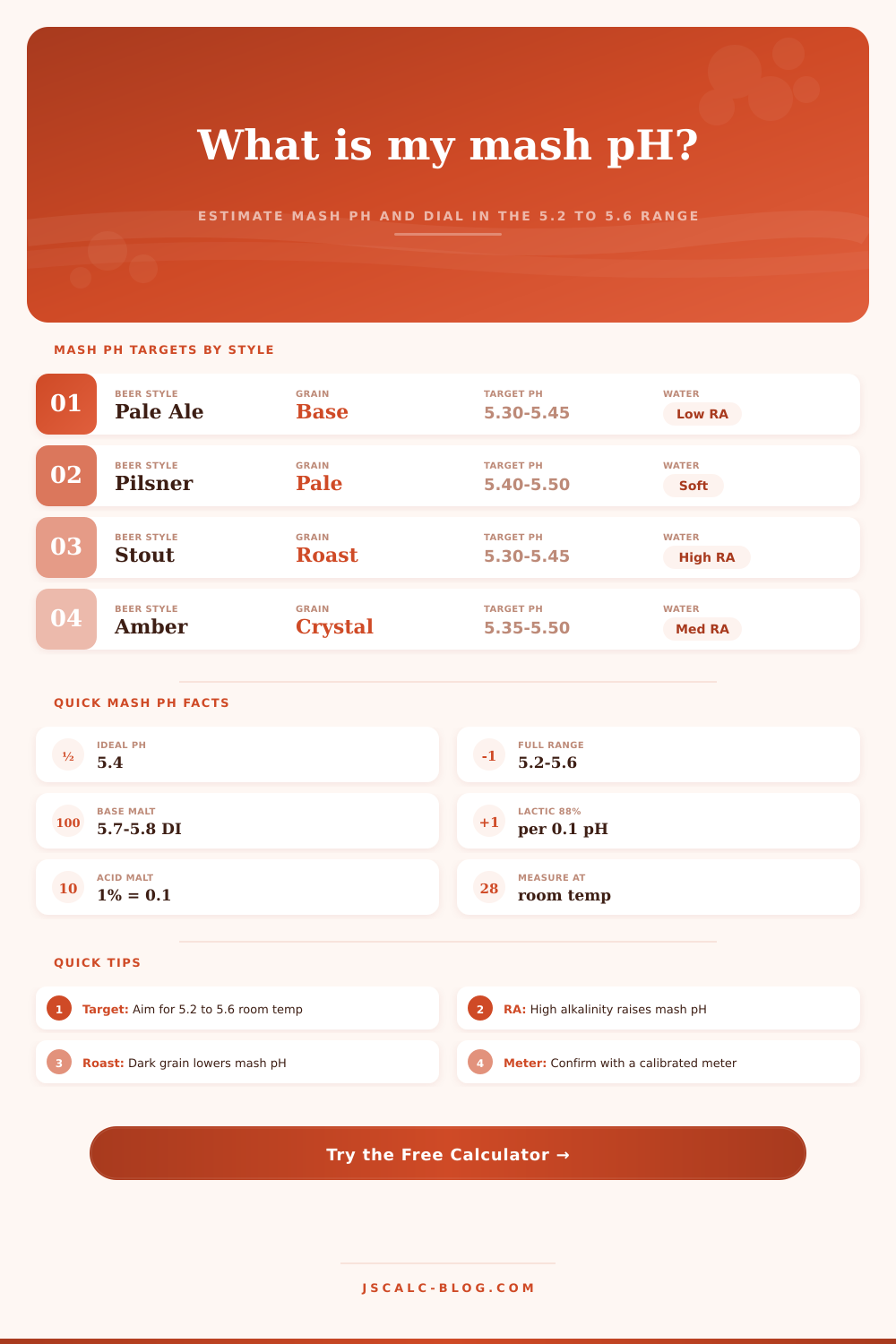
Estimate your homebrew mash pH from the grain bill color and water chemistry, then find the lactic acid, phosphoric acid, or acidulated malt needed to reach the 5.2 to 5.6 target range measured at room temperature.
🍺Real Brew Presets
📝Grain Bill and Water Inputs
Batch-weighted average malt color of the grist.
🔢Chemistry Snapshot
📊Target pH Ranges by Beer Style
| Beer Style | Grist Character | Typical Color | Target Mash pH | Water Note |
|---|---|---|---|---|
| Pilsner / Helles | All pale base | 2 to 4 °L | 5.40 to 5.50 | Very soft, low RA |
| Pale Ale / IPA | Base plus light crystal | 5 to 9 °L | 5.30 to 5.45 | Low to medium RA |
| Hazy IPA | Base plus oats/wheat | 4 to 7 °L | 5.20 to 5.40 | Soft, chloride forward |
| Amber / Red Ale | Base plus crystal 60 | 10 to 16 °L | 5.35 to 5.50 | Medium RA is fine |
| Brown Ale | Base plus chocolate | 18 to 26 °L | 5.35 to 5.50 | Moderate RA helps |
| Porter / Stout | Base plus roast | 30 to 45 °L | 5.30 to 5.45 | Higher RA balances roast |
💧Residual Alkalinity and pH Effect
| Residual Alkalinity | Water Type | Direction | Approx pH Shift | Best Suited For |
|---|---|---|---|---|
| Below 0 (negative) | Soft / RO built up | Lowers pH | −0.05 to −0.15 | Pale, hoppy beers |
| 0 to 30 | Soft to balanced | Near neutral | 0 to +0.10 | Most pale ales |
| 30 to 60 | Moderate mineral | Raises pH | +0.10 to +0.20 | Amber and brown |
| 60 to 120 | Hard / alkaline | Raises pH more | +0.20 to +0.35 | Dark, roasty beers |
| Above 120 | Very alkaline | Raises pH strongly | +0.35 and up | Needs acid or roast |
🧪Acid Strengths and Dosing
| Adjustment | Strength | Typical Dose | Per 0.1 pH Drop | Notes |
|---|---|---|---|---|
| Lactic acid | 88% | 1 to 4 mL/gal | ~0.8 mL/gal | Common, slight tang if heavy |
| Phosphoric acid | 85% | 0.7 to 3 mL/gal | ~0.55 mL/gal | Flavor neutral, strong |
| Phosphoric acid | 10% | 6 to 25 mL/gal | ~5 mL/gal | Easier to measure, dilute |
| Acidulated malt | ~1 lactic % | 1 to 4% of grist | ~1% of grist | Built into grain bill |
| Calcium (gypsum/CaCl) | via RA drop | 50 to 150 ppm Ca | lowers RA, not direct | Also shifts flavor ions |
🌾Grain Color pH Impact
| Grain Type | Color Range | pH Direction | Relative Effect | Example Malts |
|---|---|---|---|---|
| Pale base malt | 1.5 to 3 °L | Sets baseline high | Distilled ~5.7 to 5.8 | 2-row, Pilsner, Maris |
| Light crystal | 10 to 40 °L | Lowers mildly | Small drop | Crystal 20, Caramel 40 |
| Dark crystal | 60 to 120 °L | Lowers more | Medium drop | Crystal 60, Special B |
| Chocolate / brown | 200 to 450 °L | Lowers strongly | Large drop | Chocolate, Pale Choc |
| Roasted barley | 300 to 550 °L | Lowers strongly | Largest drop | Roast barley, Black |
🗂Grain Bill and Water Comparison Grid
| Scenario | Grist / Color | Water RA | Est. Mash pH | Acid Needed | Result pH |
|---|---|---|---|---|---|
| Pale ale, soft water | 10 lb / 6 °L | ~24 ppm | ~5.78 | ~4.2 mL 88% | ~5.40 |
| Pilsner, distilled | 9 lb / 3 °L | 0 ppm | ~5.71 | ~3.5 mL 88% | ~5.40 |
| Hazy IPA, chloride | 11 lb / 5 °L | ~7 ppm | ~5.77 | ~5.0 mL 88% | ~5.35 |
| Amber, RA 50 | 11 lb / 12 °L | ~53 ppm | ~5.78 | ~4.6 mL 88% | ~5.40 |
| High alkalinity all base | 10 lb / 4 °L | ~155 ppm | ~5.89 | ~5.4 mL 88% | ~5.40 |
| Brown ale, chocolate | 11 lb / 22 °L | ~73 ppm | ~5.74 | ~3.5 mL 88% | ~5.45 |
| Roasty stout, high RA | 12 lb / 40 °L | ~148 ppm | ~5.68 | ~3.6 mL 88% | ~5.40 |
| Acid malt method | 10 lb / 6 °L | ~24 ppm | ~5.78 | ~3.8% grist | ~5.40 |
⚙Full Formula Breakdown
📋Reference Values
| Item | Common Range | How It Is Used | Effect on Mash pH |
|---|---|---|---|
| Room-temp pH | 5.2 to 5.6 | Measured at 20 to 25 °C | Target window for conversion |
| Base malt DI pH | 5.70 to 5.80 | Distilled water mash baseline | Sets the starting point |
| Weighted color | 2 to 45 °L | Batch average of malt colors | Higher color lowers pH |
| Alkalinity | 0 to 250 ppm | Feeds the RA formula | Higher raises pH |
| Calcium | 40 to 150 ppm | Subtracts as Ca / 3.5 | Lowers RA and pH |
💡Practical Mash pH Tips
Much of what happens in your beer during fermentation hinges on something you can’t see: chemistry. It is less about pitching the right yeast or adding correct hops and more about mash pH, or acidity level. That determines whether fermentation will be sluggish or clean.
Brewers talk about mash pH in terms of enzyme efficiency. For starters, starches is converted to fermentable sugar through action of amylase enzymes. Is it too alkaline? Those same enzymes slows down and allow sugars to go unfermented. Go too far the other direction and mash becomes too acidic, harsh-tasting tannin-forming enzymes kicks in instead. Knowing how your grain and water work together is key.
Why pH Matters for Your Beer
The chemical process begins where your water starts the game. The calculator uses residual alkalinity, which is calculated by subtracting calcium and magnesium effects from total alkalinity, to help you understand your buffer. Consider alkalinity as a protective barrier that keeps mash out of harm’s way, preventing pH from dropping into acidic range. The thicker this barrier are, the higher its buffering power.
With hard water that has high bicarbonate, this barrier is beefy, protecting the mash from falling into the acidic zone, despite what your grain want to do. Pale malt is designed to be mashed at around a 5.2 to 5.6 range. Because darker malts have acidic properties inherent in them to counteract this type of alkalinity, they can withstand higher alkalinity than lighter styles.
Don’t worry if all these formulas seem like black magic to you; you don’t have to become a chemist to understand how these two relate. Simply plug your grain bill weight and your water report into the calculator above and let it calculate math for you. It will run the residual alkalinity formula, take into account effect of calcium and magnesium, and apply it to your individual batch size. And there you go! Now you’ve got an estimate of starting pH before you heat up a single drop of water.
The second part of this equation involve the grain itself. The malt is not neutral. More specifically, the pH of all-grain brewing begin too high; above target zone. Something has to pull it down. Enter color and added acids. More dark malts means more phenolic compounds and organic acids that reduces the mash pH. Naturaly adding darker malts such as roasted barley, chocolate malt, and crystal malt will add acidity to the mash. In fact, this is why we often don’t have to adjust pH very much during a stout mash whereas an IPA might require some help.
Enter The pH Tool. It accounts for this with a feature that allows you to enter weighted average color of your grist. A higher SRM means a greater downward pulling force on the pH number. If you’re familiar with overall color profile of beer you’re aiming for, you don’t have to weigh each individual specialty malt.
Now you have an estimate, maybe you’re still out there and now you need to add some acid. To do this, we use lactic acid and phosphoric acid. Another tool you can use is something called acidulated malt which fall nicely within the grain bill. How much? That all depends on how far off target you are as well as amount of water you’re using. If it’s more water then you’ve got more volume to treat.
4 mark. Better slow than overshoot. Remember, the only way to know for sure is with a pH meter and even then, that reading is highly sensitive to changes in temperature. Always do the measuring at room temp so you can be accurate.
The reward is not only clarity in your beer but improved hop use and a yeast that thrives rather than merely survives. Good beer begins long before the boil.