Golden Ratio Coffee Calculator
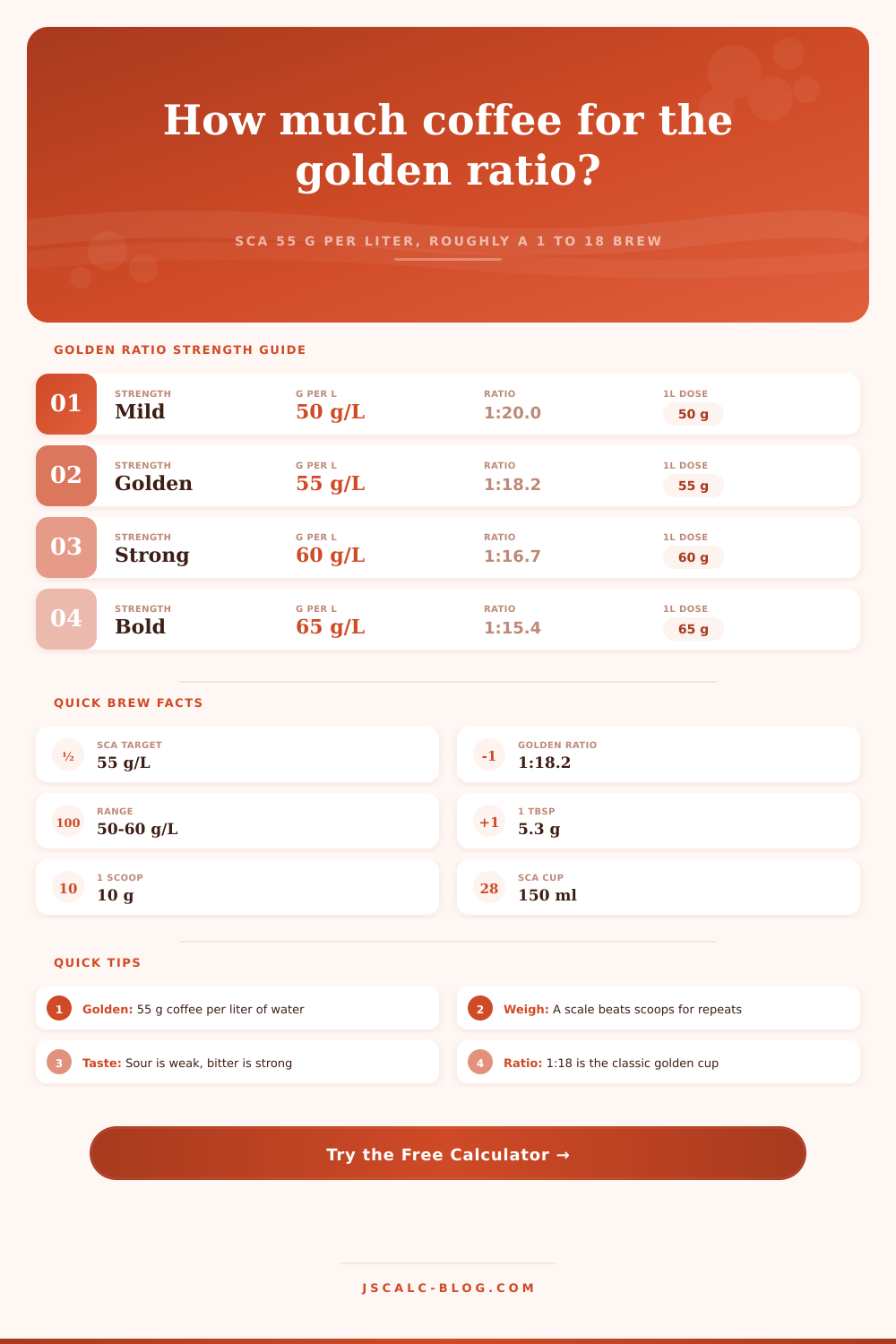
Dial in the SCA golden cup standard of about 55 grams of coffee per liter of water. Choose a water volume and strength to get coffee grams, the equivalent 1:N brew ratio, tablespoons, and scoops.
☕Real Brew Presets
📝Brew Inputs
Used only when strength is set to custom. 1:16 is stronger, 1:20 is milder.
🔢Golden Ratio Snapshot
📊Strength to Ratio Reference
| Strength | Grams / Liter | Ratio 1:N | Coffee per 1 L | Coffee per 500 ml |
|---|---|---|---|---|
| Very mild | 45 g/L | 1:22.2 | 45 g | 22.5 g |
| Mild | 50 g/L | 1:20.0 | 50 g | 25 g |
| Golden (SCA) | 55 g/L | 1:18.2 | 55 g | 27.5 g |
| Strong | 60 g/L | 1:16.7 | 60 g | 30 g |
| Bold | 65 g/L | 1:15.4 | 65 g | 32.5 g |
| Intense | 70 g/L | 1:14.3 | 70 g | 35 g |
🗂Coffee by Water Volume (Golden 55 g/L)
| Water Volume | Mild 50 g/L | Golden 55 g/L | Strong 60 g/L | Golden Tbsp | Golden Scoops |
|---|---|---|---|---|---|
| 250 ml | 12.5 g | 13.8 g | 15.0 g | 2.6 | 1.4 |
| 350 ml | 17.5 g | 19.3 g | 21.0 g | 3.6 | 1.9 |
| 500 ml | 25.0 g | 27.5 g | 30.0 g | 5.2 | 2.8 |
| 750 ml | 37.5 g | 41.3 g | 45.0 g | 7.8 | 4.1 |
| 1000 ml (1 L) | 50.0 g | 55.0 g | 60.0 g | 10.4 | 5.5 |
| 1250 ml | 62.5 g | 68.8 g | 75.0 g | 13.0 | 6.9 |
| 1500 ml (1.5 L) | 75.0 g | 82.5 g | 90.0 g | 15.6 | 8.3 |
| 2000 ml (2 L) | 100.0 g | 110.0 g | 120.0 g | 20.8 | 11.0 |
🥄Tablespoon & Scoop Reference
| Coffee (g) | Tablespoons | Scoops (2 tbsp) | Golden Water | Ratio |
|---|---|---|---|---|
| 5.3 g | 1 tbsp | 0.5 scoop | 96 ml | 1:18.2 |
| 10.0 g | 1.9 tbsp | 1 scoop | 182 ml | 1:18.2 |
| 15.9 g | 3 tbsp | 1.5 scoops | 289 ml | 1:18.2 |
| 21.2 g | 4 tbsp | 2 scoops | 385 ml | 1:18.2 |
| 27.5 g | 5.2 tbsp | 2.75 scoops | 500 ml | 1:18.2 |
| 55.0 g | 10.4 tbsp | 5.5 scoops | 1000 ml | 1:18.2 |
🧮Cup Size Conversions
| Cup Type | Volume | Golden Coffee | 4 Cups Water | 4 Cups Coffee |
|---|---|---|---|---|
| SCA cup | 150 ml | 8.3 g | 600 ml | 33.0 g |
| Small cup (6 oz) | 177 ml | 9.7 g | 708 ml | 38.9 g |
| Standard mug | 240 ml | 13.2 g | 960 ml | 52.8 g |
| Large mug (12 oz) | 355 ml | 19.5 g | 1420 ml | 78.1 g |
| Travel mug | 350 ml | 19.3 g | 1400 ml | 77.0 g |
⚙How the Math Works
📋Golden Cup Quick Facts
| Item | Value | Notes | Effect on Cup |
|---|---|---|---|
| SCA golden target | 55 g/L | Midpoint of the range | Balanced, classic strength |
| Accepted range | 50–60 g/L | Roughly 1:20 to 1:16.7 | Milder to stronger cup |
| Tablespoon weight | 5.3 g | Medium grind, level tbsp | Varies with grind and bean |
| Scoop weight | 10 g | One scoop is 2 tbsp | Handy when no scale is used |
| SCA cup size | 150 ml | Reference brewing cup | Sets per-cup coffee dose |
💡Golden Ratio Brewing Tips
When the beans are ground and the water’s heating up, it’s time for that favorite mug. And in that space between deciding and drinking, you’re realizing: I’ve got no clue how much coffee to put in here. Or maybe you’ll eyeball it. Maybe there’s a scoop in drawer?
But then, there’s also this simple ratio… Baristas swear by it. Home brewers swears by it. The Specialized Coffee Association recommends fifty-five grams of coffee per liter of water. This is a target in the middle of what most people consider a balanced cup. It is strong enough to taste like coffee without being so mild that it covers up the flavor off the bean.
How to Make Good Coffee
After inputting how much water you have and what strength you’d like it, the calculator on this page do the math for you. Most people assume they know what size cups they have (this is where most people make a mistake). On average, a normal mug is about two-hundred-forty milliliters; however, a common reference cup used by SCA are actualy one-hundred-fifty milliliters. This means the volume of water in question completely alters calculation depending on whether you’re making one serving in a travel mug or a whole pot for yourself and some friends. Then it takes that amount of water and turn it into grams of coffee required.
From there, it’ll convert that into tablespoons if you don’t have a scale. While that’s still useful information, it isn’t perfect as the density of spoons depends on the type of beans and grind size. To be consistent, use a digital scale to weigh your coffee. Even if both look like tablespoons’ worth when scooped out on the table, a scoopful of fine espresso powder won’t weigh as much than a spoonful of coarser French-press grounds.
Plug in what you prefer to the table of reference and notice that adjusting from a mild to a bold ratio mean needing different amounts of grams. Moving from fifty grams per liter to sixty adds ten percent more coffee. It is not very much, but it is enough to tell the difference between a strong wake-me-up and a weak wash-me-off.
So what’s with all this talk about strength? Everyone’s different. Some like the brightness of a light brew; others go for the deeper body of a darker brew. There’s a switch on the calculator where you can adjust from mild to gold to strong, or even customize your own ratio. Going custom (one part coffee to sixteen parts water) mean using more coffee solids in your final product. This is great if you like a lot of flavor; just make sure you pay close attention to your brew time so you don’t go past its limits and pull too much flavor from the coffee.
Bitterness typically signals that your brew time was too long / there’s too much coffee / you need less coffee. Under extraction / not enough coffee tends to sour. Tweaking the ratio will help you dial things in without having to waste any beans.
Finally, consider the coffee itself. You’ve got the right ratio of beans to water but what about the water? Hard water can leave scale on your kettle and dull flavors. Good-tasting filtered water that tastes good on its own tends to be the best kind. And speaking of water: how hot should it be? Water that is too hot, like right off the boil, can scorch delicate coffees. If it is too cold or lukewarm, it won’t do much of anything. Try to hit somewhere near ninety-two to ninety-six degrees Celsius and you’ll have extracted all those sweet and many-layered compounds without pulling out the harsh tannins that give coffee that muddy flavor.
The other variable that the calculator doesn’t take into consideration (but should of) is grind consistency. A uniform grind will extract evenly… Every particle contributing flavor at the same pace. An uneven grind will result in a muddled cup: a blend of over- and under-extracted chunks and fines. Your grind size should match the brew method, so make sure to maintain consistency if you’re adjusting strength with this tool. For example, use a finer grind for a pour-over style brew relying on speed and gravity; use a coarse grind for an immersion brewer such as French press.
There’s both an art and a science to coffee making. The former is in the ritual; the latter is in the numbers. Numbers provides parameters, but flavor preferences matter most in the end. Begin by going with the baseline: 55g/l. Brew it up. Taste it. Adjust a little according to preference. Use the calculator to do the math, and let your tastebuds guide the way.
From there, recreate that amazing cup every morning until…well, until you don’t want to anymore. This lasts until you are hosting friends and need to make enough to go around. Whatever it may be, knowing how much to add ensures that the act of coffee-brewing becomes not only a learned skill, but one that you’ll look forward to mastering.