Drip Coffee Ratio Calculator
Find how many tablespoons, level scoops, and grams of ground coffee to add for any automatic drip machine. Works from carafe cups, the real 5 to 6 oz machine cup size, and your chosen strength ratio.
☕Real Drip Coffee Presets
📝Brew Inputs
Ratio mode uses weight. Tbsp-per-cup mode uses a fixed spoon count.
The number on your machine water window, not mugs.
Most drip machines mark 5 or 6 oz cups, not 8 oz.
Higher N is weaker. Used only when method is ratio.
Classic guidance is 1 to 2 tbsp per 6 oz cup.
Grind note only adjusts the brewing tip, not the weight math.
🔢Ratio Snapshot
📊Carafe Cups To Tablespoons Chart
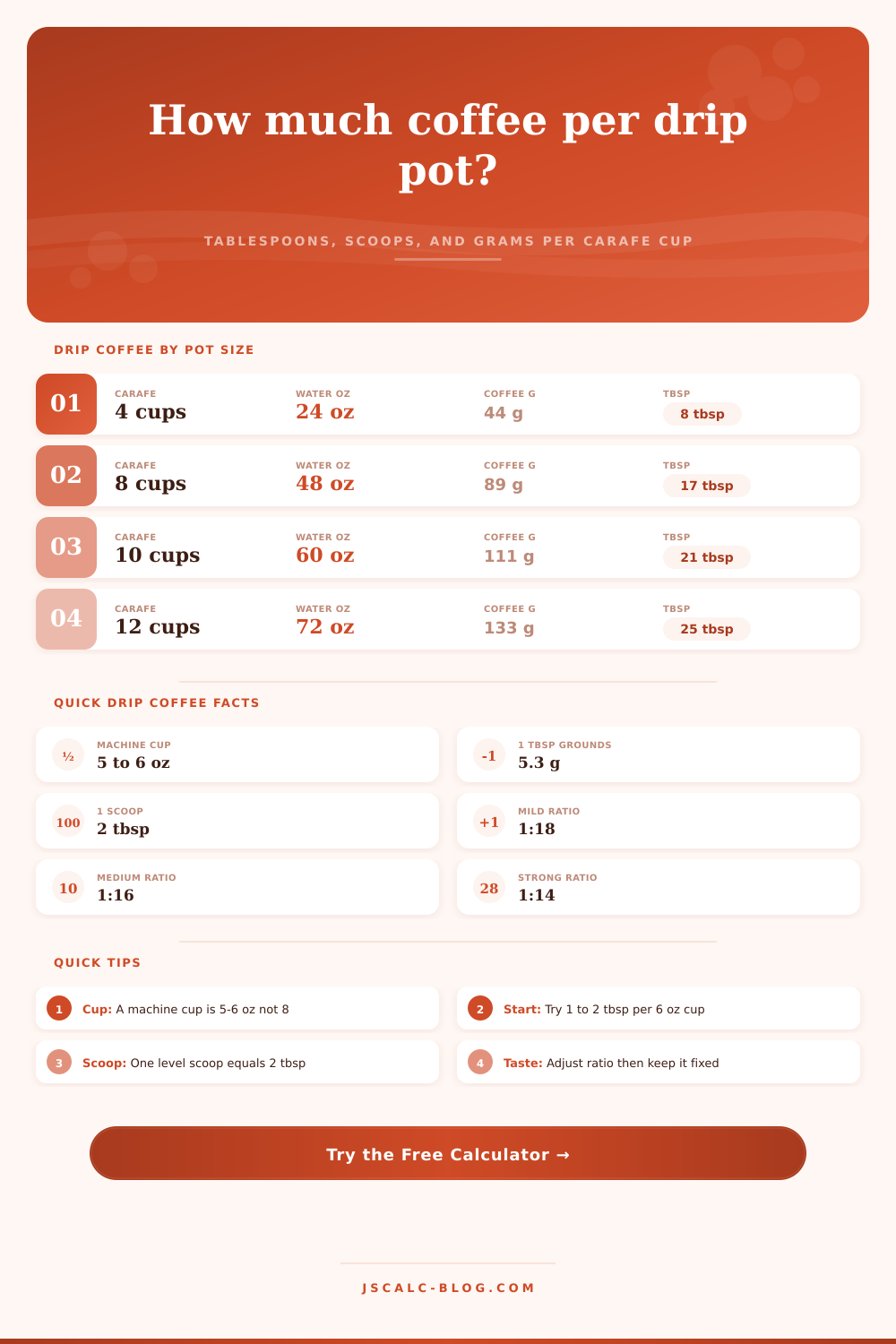
| Carafe Cups | Water oz (6 oz cup) | Coffee g (1:16) | Tablespoons | Level Scoops |
|---|---|---|---|---|
| 2 cups | 12 oz | 22 g | 4 tbsp | 2 |
| 4 cups | 24 oz | 44 g | 8 tbsp | 4 |
| 5 cups | 30 oz | 55 g | 10½ tbsp | 5 |
| 6 cups | 36 oz | 67 g | 13 tbsp | 6½ |
| 8 cups | 48 oz | 89 g | 17 tbsp | 8½ |
| 10 cups | 60 oz | 111 g | 21 tbsp | 10½ |
| 12 cups | 72 oz | 133 g | 25 tbsp | 12½ |
🗂Pot Size Comparison Grid
| Carafe Cups | Water oz | Water g | Coffee g 1:16 | Tbsp | Scoops |
|---|---|---|---|---|---|
| Comparison rows appear after calculation. | |||||
Grid uses your selected machine cup size and ratio, so values shift when you change strength or cup ounces.
📈Strength And Cup Size Reference
| Strength | Ratio 1:N | Grams Per 6 oz Cup | Tbsp Per 6 oz Cup |
|---|---|---|---|
| Very mild | 1:18 | 9.9 g | 1.9 tbsp |
| Mild | 1:17 | 10.4 g | 2.0 tbsp |
| Medium | 1:16 | 11.1 g | 2.1 tbsp |
| Medium-strong | 1:15 | 11.8 g | 2.2 tbsp |
| Strong | 1:14 | 12.7 g | 2.4 tbsp |
| Machine Cup Size | Milliliters | Water g Per Cup | Note |
|---|---|---|---|
| 5 oz cup | 148 ml | 148 g | Common on classic drip pots |
| 6 oz cup | 177 ml | 177 g | Most frequent machine standard |
| 8 oz cup | 237 ml | 237 g | A full mug, not a machine cup |
📏Grams, Tablespoon, And Scoop Reference
| Measure | Grams Grounds | Equivalent | Rough Water At 1:16 |
|---|---|---|---|
| 1 level tablespoon | 5.3 g | ½ scoop | 85 g water |
| 1 coffee scoop | 10.6 g | 2 tbsp | 170 g water |
| 2 tablespoons | 10.6 g | 1 scoop | 170 g water |
| 3 tablespoons | 15.9 g | 1½ scoops | 254 g water |
| 4 tablespoons | 21.2 g | 2 scoops | 339 g water |
⚙Full Formula Breakdown
💡Practical Drip Coffee Tips
So there you are, staring down at your coffee machine, a full pot of water and a bag of whole beans in hand. How much coffee do I grind up? A pinch? A fistful? A heaping scoopful… and hope for the best?
Often times it’s too strong and bitter, or too weak and flat. It’s not usually because of the beans you’re using. It’s nearly always because of something: the ratio.
How to Make Better Coffee Every Time
Brewing coffee are more than an odd art, it’s a science, a simple one based off volume and weight that will change everything you know about making coffee every single morning.
A Cup Is Not a Cup
The other problem with brewing at home is the idea of what constitutes a cup. Coffee makers is bad at communicating how much they can hold. Don’t be fooled by a “twelve-cup” carafe… That doesn’t necessarily refer to twelve 8-ounce mug worth of coffee. More often than not, it’s referring to a dozen 5- or 6-ounce pours.
If you’re measuring based on full-sized mug, this will throw everything off and cause you to underfill your reservoir when, without you knowing it, you was expecting a larger amount of coffee. Enter the calculator above, which takes care of all the math for you when you input how big your machine’s individual cup are. No more wondering if you’re getting a 72- or 96-ounce pot.
Now armed with your water amount, it’s time for you to choose the strength. For beginners, the one-to-sixteen ratio (one part coffee to sixteen parts water by weight) is a good place to start. This creates a balanced cup of coffee that lets flavors shine through without overpowering the drinker. To bump up the body and boldness, try a one-to-fourteen ratio. Going in the other direction, a one-to-eighteen ratio will result in a lighter, more tea-like beverage.
These ratios sounds random until you put them in terms of scoops or tablespoons; and that is where most people stop being precise. Tablespoons are great because they make measuring volume easy, but they also vary. Whether the coffee is heaped or level, or whether the grounds has packed down into the spoon, can result in huge differences.
Even if you use a scale, the grind size of your coffee determine its density. Coarse grinds chip around loosely; fine grinds settle compactly. So when we talk about weighing your coffee in grams, that takes all of this out of the equation. No matter how the grounds look in the scoop, you are ensuring you pull exactly the same amount of solubles each time. If there’s a brew you enjoy, you want to know you can repeat it again tomorrow without having to do any trial-and-error.
How much does it matter? Quantity and grind size does matter equally. For drip, we need a medium grind; like regular sand. If the grinds are too fine, the water can’t flow through them, leading to muddy, over-extracted coffee. If they’re too coarse, then the water flows through too quick and leaves behind sour underextracted notes.
To account for this, our calculator lets you adjust for both roast and grind type, which adjusts density slightly. A tablespoon of light roast is heavier than a tablespoon of dark roast because dark roast is less dense. Scales beat spoons for serious brewing for this kind of nuance.
Making better coffee doesn’t require becoming a barista. It only requires learning to measure rather than guess. Use the ratio suggestions based off pot size as your starting point. Make a batch and taste it. Is it too strong? Back off by half a tablespoon the following time. Is it too weak? Increase by half a tablespoon. When you hit your sweet spot, use those same numbers from now on.
This isn’t about perfecting each individual cup. This is about getting reliable results with every cup you make next. That’s what you deserve for your morning routine. Put in the water. Pour in the grounds. Let them steep. And out comes what you expect.