Cold Brew Coffee Ratio Calculator
Dial in your coffee-to-water ratio for a strong cold brew concentrate, then plan steep time and 1:1 dilution. Enter a batch size and ratio to get exact coffee grams, water, concentrate yield, and diluted servings.
🧊Real Cold Brew Presets
📝Brew Inputs
Picks a starting ratio and dilution. Switch to custom to set your own.
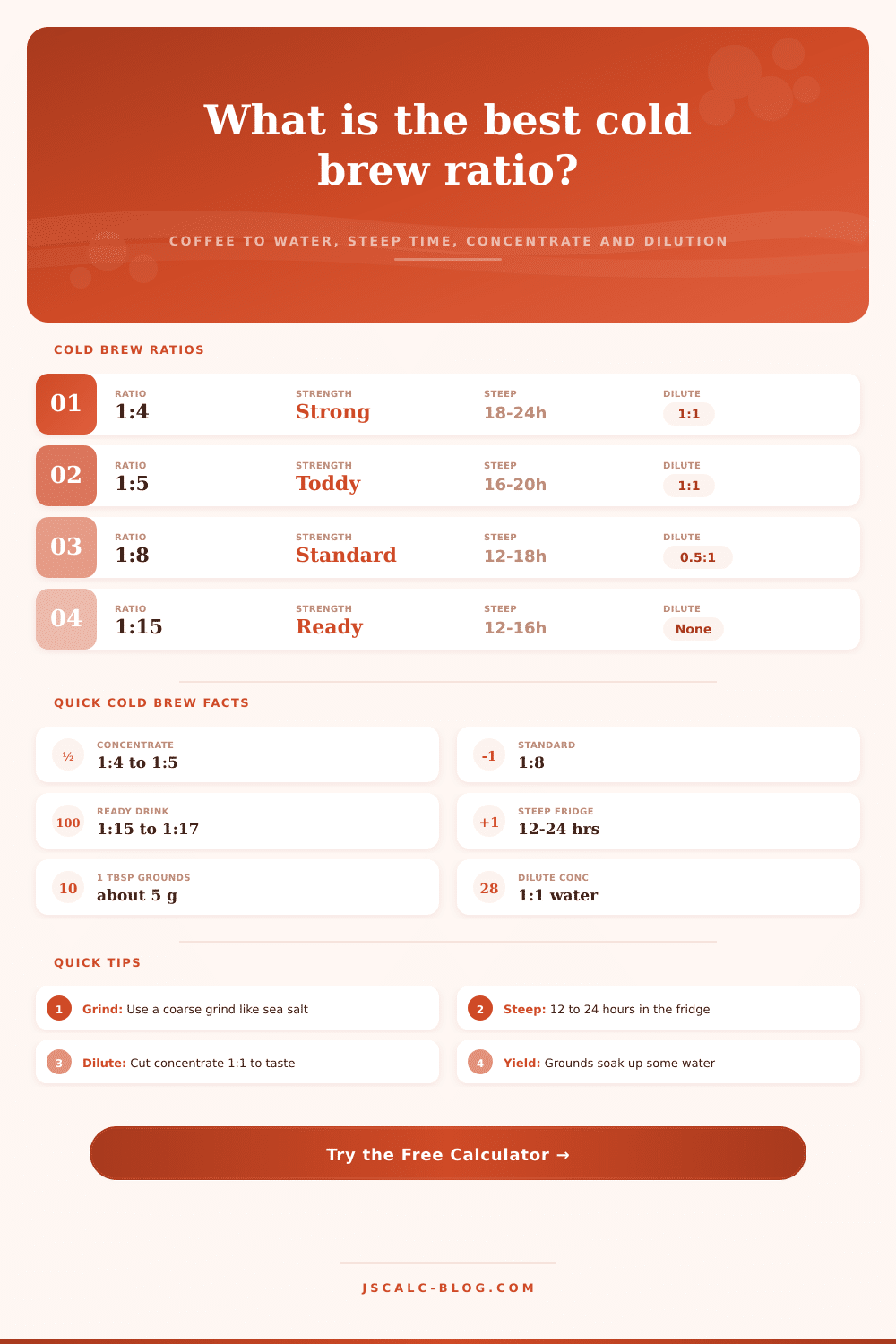
1:4 is very strong, 1:8 is standard, 1:15 is ready to drink.
Water, finished drink, or coffee weight, matching the choice on the left.
1 means cut concentrate 1:1 with water or milk. 0 means drink it straight.
12 to 24 hours in the fridge, or 12 to 18 hours at room temperature.
Coarser grind resists over-extraction on a long cold steep.
🔢Ratio Math Snapshot
📈Ratio to Strength Guide
| Ratio 1:N | Style | Strength | Suggested Dilution | Best For |
|---|---|---|---|---|
| 1:4 | Strong concentrate | Very intense | 1:1 or more | Iced lattes, milk drinks |
| 1:5 | Toddy style | Bold | 1:1 | Classic concentrate over ice |
| 1:7 | Rich concentrate | Strong | 0.75:1 | Small pitchers, quick dilute |
| 1:8 | Standard concentrate | Medium strong | 0.5:1 to 1:1 | Everyday batch, most popular |
| 1:10 | Light concentrate | Medium | 0.25:1 to 0.5:1 | Mild concentrate, quick cut |
| 1:12 | Near ready | Soft | Splash or none | Sipping with little dilution |
| 1:15 | Ready to drink | Light | None | Drink straight, no diluting |
| 1:17 | Ready to drink | Delicate | None | Tea-like sipping cold brew |
🗂Coffee Per Water Amount
| Water | 1:4 Strong | 1:5 Toddy | 1:8 Standard | 1:12 Light | 1:15 Ready |
|---|---|---|---|---|---|
| 250 ml (1 cup) | 63 g | 50 g | 31 g | 21 g | 17 g |
| 500 ml (2 cups) | 125 g | 100 g | 63 g | 42 g | 33 g |
| 750 ml (3 cups) | 188 g | 150 g | 94 g | 63 g | 50 g |
| 1000 ml (1 L) | 250 g | 200 g | 125 g | 83 g | 67 g |
| 1500 ml (1.5 L) | 375 g | 300 g | 188 g | 125 g | 100 g |
| 2000 ml (2 L) | 500 g | 400 g | 250 g | 167 g | 133 g |
| 950 ml (1 qt) | 238 g | 190 g | 119 g | 79 g | 63 g |
| 1900 ml (half gal) | 475 g | 380 g | 238 g | 158 g | 127 g |
⏱Steep Time Guide
| Method | Temperature | Steep Range | Sweet Spot | Notes |
|---|---|---|---|---|
| Fridge steep | About 4 °C | 12 to 24 hours | 16 to 18 hours | Smooth, low acid, most forgiving |
| Room temperature | About 20 °C | 12 to 18 hours | 14 to 16 hours | Faster extraction, watch bitterness |
| Short strong steep | Fridge | 10 to 12 hours | 12 hours | Use with higher coffee dose |
| Overnight easy | Fridge | Overnight rest | About 14 hours | Start at night, strain at morning |
| Long slow steep | Fridge | 20 to 24 hours | 24 hours | Max yield, can get earthy |
⚖Grams, Tablespoons and Ounces
| Coffee Grams | Tablespoons | Ounces | Rough Scoops |
|---|---|---|---|
| 5 g | 1 tbsp | 0.18 oz | Half scoop |
| 15 g | 3 tbsp | 0.53 oz | 1 scoop plus |
| 30 g | 6 tbsp | 1.06 oz | 3 scoops |
| 60 g | 12 tbsp | 2.12 oz | 6 scoops |
| 125 g | 25 tbsp | 4.41 oz | About 12 scoops |
| 250 g | 50 tbsp | 8.82 oz | About 25 scoops |
⚙Full Ratio Math Breakdown
📋Batch Comparison Grid
| Ratio | Coffee for 500 ml | Coffee for 1 L | Coffee for 2 L | Strength | Diluted Yield 1:1 |
|---|---|---|---|---|---|
| 1:4 | 125 g | 250 g | 500 g | Very strong | 2× volume |
| 1:5 | 100 g | 200 g | 400 g | Bold Toddy | 2× volume |
| 1:6 | 83 g | 167 g | 333 g | Rich | 2× volume |
| 1:8 | 63 g | 125 g | 250 g | Standard | 2× volume |
| 1:10 | 50 g | 100 g | 200 g | Light concentrate | Cut lightly |
| 1:12 | 42 g | 83 g | 167 g | Soft | Small splash |
| 1:15 | 33 g | 67 g | 133 g | Ready to drink | No dilution |
| 1:17 | 29 g | 59 g | 118 g | Delicate | No dilution |
💡Practical Cold Brew Tips
A refrigerator is actualy really good coffee-making machinery. Sure, it doesn’t do anything to press beans or heat water. But it has cold water and time to pull some of those flavors out of the grounds in a way that hot water just can’t. What that means is that cold brew makes coffee tasty even if someone isn’t able to master the art of the pour-over.
But most people are still just guessing at their proportions. They fill up a mason jar with some grounds and then dump in however much water they think is necessary (with their fingers crossed) and hope for the best. And they usually end up disappointed or drinking something muddy and bitter. Cold extraction have a sweet spot. You will either hit it, or you will miss it and end up with something watery or, worse, a bitter disappointment.
How to Make the Best Cold Brew
Once you input your ideal serving size in grams, it spits back out the exact weights of water and coffee required for your perfect cup. You won’t have to remember formulas or keep a spreadsheet running in the background as you pour. Just choose if you’re making a concentrate that needs to be diluted or a drinkable brew right away. Then, specify how many ounces or cups you’d like to make. Let it do the work. It’ll tell you exactly how much coffee you should of scooped and how much water you should put on top.
It even guesses at what your total yield will be once the grounds has soaked up some of the water during the steep time. That’s where that retention factor comes in: Wet grounds absorb quite a bit of water, generally about two grams per each gram of coffee. So if you forget about this, you’re going to have less liquid than intended; adjust your day accordingly.
Decide what you want your finished product to taste like and then choose the appropriate ratio. If you want to make something strong enough to pour over ice but still need water or milk to cut the flavor, try a ratio of one-to-four or one-to-five. Those ratios produces quite a concentrated shot that pairs nicely with some sweet dairy when poured over ice.
If you want something dainty that doesn’t need diluting, go one-to-fifteen. This is pretty close to a tea in terms of clarity/body. There’s just barely enough of a jolt to remind you there is some caffeine present; just not enough to overpower anything else on your palate.
Start off with a classic one-to-eight ratio if you are new to brewing. It’ll give you an all-purpose option that you can drink alone or add a dash of cream if you feel like it. The chart above breaks it down so you understand where the strong/weak scale match each coffee-to-water ratio.
The other key factor in how well it works? Grind size. Cold brew need coarse grounds. Think sea salt consistency. Any finer than that and it’s going to slip right through your filters (leaving behind sediment at the bottom of your glass). Too much surface area also means over-extracting, which pulls out the more bitter parts and throws off the smooth taste cold brew is loved for. Even if you leave them sitting for a while, a coarser grind won’t absorbs as much of those unpleasant flavors.
In general, you’ll want to let it steep for between twelve and twenty-four hours. Refrigerating it slows down the extraction process, which makes the coffee taste cleaner and brings out brighter notes. But letting it sit at room temperature speeds it up just enough. The tool lets you tweak that steep time depending on whatever method best suits you, so the math will match your tastes and schedule.
Preparation also saves trouble down the line with storage. Cold brew concentrate should keep in the refrigerator, properly sealed, for two weeks or so. Because of this, cold brew is an excellent candidate for batch brewing. This means you can brew a large jar at once on Saturday morning and enjoy fresh coffee all week long without ever having to touch your grinder.
The only caveat: instead of watering it down before storing it, wait until pouring individual servings to add water. That way, you can make sure it stays strong enough so you don’t waste any by changing how much milk or sugar you add each day.
So what is all this fuss? In the end, cold brew is a balance between precision and patience. The calculator makes the math easy, so you can get down to business, choosing your beans, setting the timer, waiting for the fridge. Pour it over ice and listen when you take that first sip. It will either whisper or scream, “Yes! I got it right!”
And that’s the thing most folks overlook. Good cold brew doesn’t scream; it whispers, showing itself one sip at a time.