Homemade Dog Food Serving Size Calculator
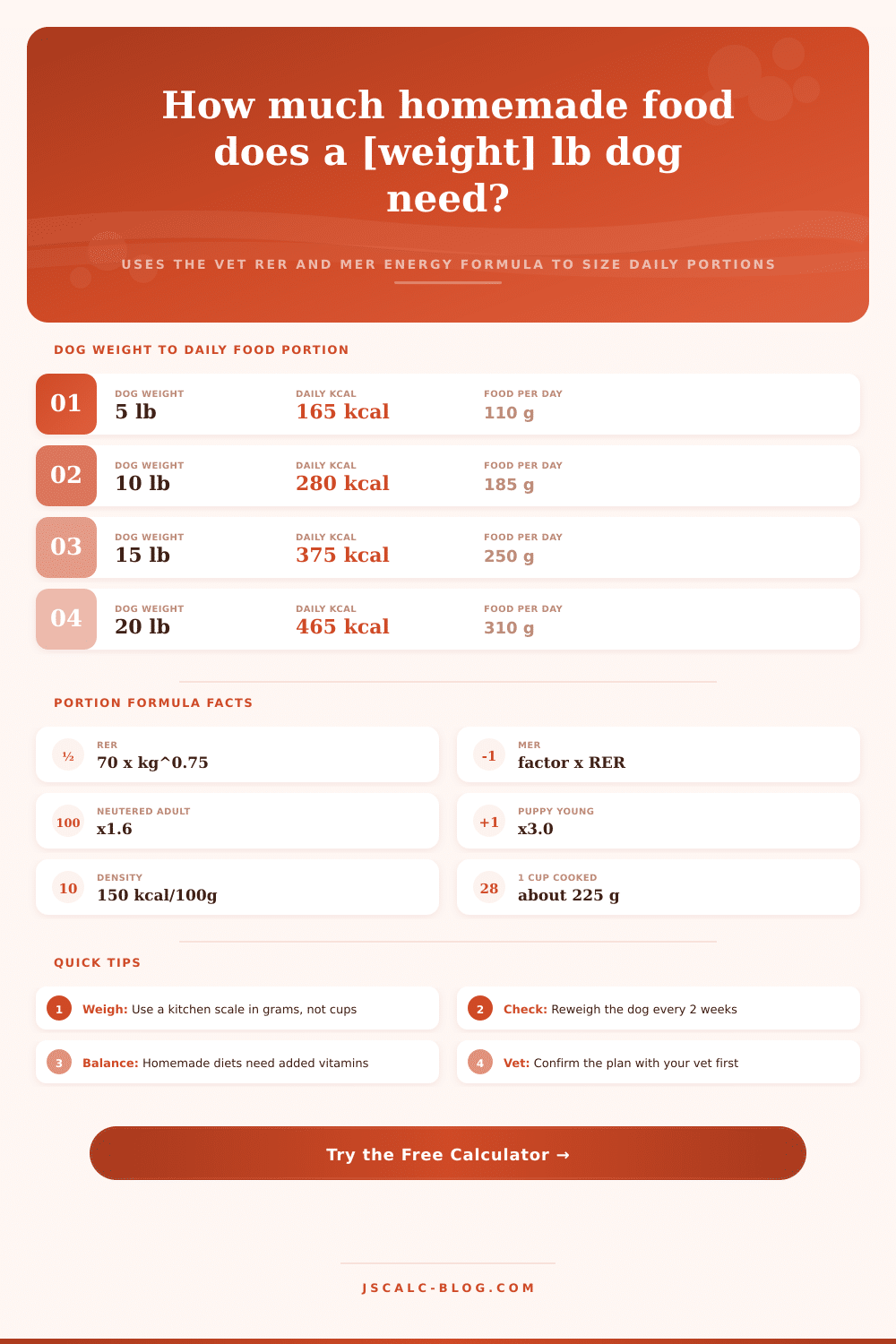
Size your dog's daily homemade meals with the veterinary energy formula. It finds resting energy RER = 70 x kg^0.75, scales it by a life-stage factor to the maintenance energy MER, subtracts treats, and converts the remaining calories into grams of food per day and grams per meal using your recipe calorie density.
⚖Weight Unit
🎯Real Dog Presets
📝Dog and Recipe Details
Current healthy body weight of your dog.
Sets the MER factor multiplied onto RER.
Cooked homemade meals average about 150 kcal per 100 g.
Daily grams are split evenly across meals.
Keep treats at or under 10 percent for a balanced diet.
Rounds the grams per day and per meal cards.
🔢Formula Snapshot
📋MER Life-Stage Factors
| Life Stage or Activity | MER Factor | MER Formula | Typical Use |
|---|---|---|---|
| Puppy 0 to 4 months | x3.0 | 3.0 x RER | Fast early growth |
| Puppy 4 months to adult | x2.0 | 2.0 x RER | Slowing growth |
| Intact adult | x1.8 | 1.8 x RER | Not neutered, active |
| Neutered adult | x1.6 | 1.6 x RER | Typical pet dog |
| Overweight or weight loss | x1.0 | 1.0 x RER | Calorie restriction |
| Weight gain or underweight | x1.7 | 1.7 x RER | Building condition |
| Senior or inactive | x1.4 | 1.4 x RER | Older, low activity |
| Light work | x2.0 | 2.0 x RER | Moderate exercise |
| Active or working | x2.5 | 2.5 x RER | High daily output |
| Lactating or nursing | x3.0 | 3.0 x RER | Variable, feeding pups |
📈RER by Common Body Weight
| Weight (lb) | Weight (kg) | RER 70 x kg^0.75 | Neutered MER x1.6 |
|---|---|---|---|
| 5 lb | 2.3 kg | 130 kcal | 208 kcal |
| 10 lb | 4.5 kg | 217 kcal | 348 kcal |
| 20 lb | 9.1 kg | 366 kcal | 585 kcal |
| 30 lb | 13.6 kg | 496 kcal | 793 kcal |
| 40 lb | 18.1 kg | 615 kcal | 984 kcal |
| 50 lb | 22.7 kg | 726 kcal | 1162 kcal |
| 70 lb | 31.8 kg | 934 kcal | 1494 kcal |
| 100 lb | 45.4 kg | 1219 kcal | 1950 kcal |
🍲Example Homemade Recipe Densities
| Cooked Recipe Style | kcal per 100 g | kcal per Cup (225 g) | Note |
|---|---|---|---|
| Lean chicken and rice | 130 kcal | 293 kcal | Low fat base |
| Turkey, rice, veggies | 145 kcal | 326 kcal | Balanced everyday |
| Beef and sweet potato | 160 kcal | 360 kcal | Moderate fat |
| Chicken, oats, oil added | 175 kcal | 394 kcal | Higher energy |
| Salmon and potato | 150 kcal | 338 kcal | Omega rich |
| Low-fat cottage cheese mix | 110 kcal | 248 kcal | Weight loss meals |
⏰Feeding Frequency by Age
| Age Group | Meals per Day | Why | Portion Split |
|---|---|---|---|
| Puppy under 4 months | 3 to 4 | Small stomach, high needs | Even small meals |
| Puppy 4 to 6 months | 3 | Steady energy supply | One third each |
| Puppy 6 to 12 months | 2 | Transition to adult | Half each |
| Adult dog | 2 | Stable blood sugar | Half each |
| Senior dog | 2 | Easier digestion | Half each |
| Toy breeds any age | 2 to 3 | Prevent low blood sugar | Smaller frequent |
📊Dog Size Portion Comparison Grid
| Dog Size | Weight Range | RER kcal | Neutered MER kcal | Food g/Day | Meals/Day |
|---|---|---|---|---|---|
| Toy | 4 to 8 lb | 110 kcal | 176 kcal | 117 g | 3 |
| Small | 9 to 22 lb | 300 kcal | 480 kcal | 320 g | 2 |
| Medium | 23 to 55 lb | 560 kcal | 896 kcal | 597 g | 2 |
| Large | 56 to 90 lb | 870 kcal | 1392 kcal | 928 g | 2 |
| Giant | 91 to 150 lb | 1300 kcal | 2080 kcal | 1387 g | 2 |
| Puppy Medium | 25 lb growing | 510 kcal | 1020 kcal x2.0 | 680 g | 3 |
⚙Formula Breakdown
💡Portioning Tips
How do you know? You look into a steaming pot of cooked rice and chicken, and stare at it wondering if this is enough for your dog? Or too much? It’s almost like you’re cooking for people except that pets can’t speak up when they’re full or hungry. Theyll simply wolf down whatever’s on their plate. That’s why controlling portions is key to homemade pet food.
A measuring cup will work against you. If you guess wrong, your dog may be slightly underweight (or overweight) and no one will notice until months has passed. Once you enter your dog’s weight and activity level into the calculator above, all you need to do is enter calories per 100g and let it crunch the numbers. You won’t have to do conversions or try to figure out coefficients anymore. Every bite is counted towards building a healthy body; not filling calories.
How to Feed Your Dog the Right Amount
Body weight isn’t directly proportional to metabolism. Big dogs don’t burn as many calories per pound of body weight as little dogs. That’s why veterinary nutritionists use the resting energy requirement equation. You multiply by seventy, raise it to the power of zero point seven five, and multiply again by animal’s weight in kilograms. Because that fractional exponent matters quite a bit: A ten-pound dog needs far more than half the calories of a twenty-pound dog would need if you just doubled the numbers. Your ten-pounder needs a lot more then half as many calories as his twenty-pound counterpart.
You won’t have to do any mental math to adjust from pounds to kilos; the tool does it for you, and it will figure out based off that metabolic base line just how much your dog is burning when completely still. But wait. Dogs don’t just sit around. They walk around, play, bark at the mailman and sometimes even chase a ball in the backyard.
Enter the maintenance energy requirement: this multiplies the resting number by a factor based on the dog’s life stage. For a typical sedate, neutered adult house pet, the factor is one point six. Fast-growing puppies has to build tissues and that costs them three times more than what they need at rest. More active breeds and working dogs drive the factor upward to reflect work they do. Here is where most people err by selecting the wrong factor.
Maybe you select the active multiplier for your elderly dog who now sleeps all day in the sunbeam. Next thing you know, he’s gaining weight in a hurry. The dropdown menu includes these real-world factors so you can match the number to your dog’s actual activity level instead of its breed standard.
So now we’ve got our daily calorie goal. Next step: translating that fuel into actual fuel (as in, something that sits on a plate). That’s all based on how dense each recipe is in terms of calories per gram. For example, some dishes are richer, such as sweet potatoes plus beef plus some oil, while others are more sparse, like white rice plus lean turkey. Two bowl of equal volume won’t contain the same number of calories. Because the rich dish contains more calories per gram, if your dog eats two bowls, he’ll put on weight quicker than another dog who ate two bowls of the leaner option.
So the calculator requests calories-per-100g so that it can divide the overall energy requirement by the calorie density of what you’re feeding. And it deducts treats first since most owners don’t remember to count them when calculating the rest of their dog’s diet. Treats typically contribute about 10 percent of daily caloric input, but those calories DO count! So if you fail to subtract the treat calories from the food allowance, your dog’s essentially consuming an additional 10 percent every day which over the course of a year realy adds up toward large weight gain.
This will output the number of grams per day. Then divide that number by the number of meals you feed. Picking up a kitchen scale and weighing food works so much better than measuring in cups. Grain or meat has such a wide range of packing densities (ie: how tight the grain/rice/meat gets pressed into the cup). The more loosely you scoop out rice from a cup vs. Packing the rice really hard, one cup will have a lot fewer grams. Using grams eliminates all that. It allows you to weigh one day’s worth, dish it out into your dog’s bowls throughout the day, and know exactly how many grams your dog is eating at any time.
This converts an estimate to a definite meal plan where you can tweak things over time if your dog grows older/slower/faster/etc. Besides how much to feed, there are other things to consider in a homemade diet. By default, homemade meals don’t include the correct vitamins, minerals, and calcium phosphorus ratios, etc. That’s why a recipe for your homemade meal is necessary. And even then, work with a board certified nutritionist or your vet to make sure the meal is formulated properly. Serving size calculators will answer the “how big” part of the equation but won’t help you create the meal.
Once you have the proper diet, start at the suggested portion amount and weigh him regularly. Change the amount up or down by an ounce or two if you can easily feel his ribs through his layer of fat when you check his body condition score. The goal is steady weight maintenance with good muscle tone. After all, you should of started this adventure because you desire to feed your pet well. Knowing the proper portion will ensure that delicious food turns into nutritious food, not merely a yummy snack.