Buoyant Force Calculator
Apply Archimedes' principle to find the upward buoyant force Fb = fluid density times submerged volume times gravity, then compare it to the object weight to see whether the object floats or sinks and read the displaced fluid mass and apparent weight.
🏗Real Object and Fluid Presets
💧Fluid and Gravity
Real densities at about 20 C, in kilograms per cubic meter.
Used only when the fluid above is set to Custom.
Gravity scales both buoyant force and weight equally.
📦Submerged Volume
Choose how to define the submerged volume of the object.
The part of the object that is under the fluid surface.
1 L = 0.001 m3 and 1 cm3 = 0.000001 m3.
Submerged box length, in centimeters.
Submerged box width, in centimeters.
Submerged box height, in centimeters.
⚖Object Mass and Total Size
Total mass of the object, used to test float or sink.
1 g = 0.001 kg and 1 lb = 0.45359237 kg.
Full volume in liters, for object density and submerged fraction.
🔢Formula Snapshot
💧Fluid Densities Reference
| Fluid | Density kg/m3 | Buoyancy per Liter | Note |
|---|---|---|---|
| Gasoline | 720 | 7.06 N | Light fuel |
| Ethanol | 789 | 7.74 N | Drinking alcohol |
| Olive oil | 910 | 8.93 N | Floats on water |
| Fresh water | 1000 | 9.81 N | Reference fluid |
| Sea water | 1025 | 10.06 N | Salt raises density |
| Milk | 1030 | 10.10 N | Slightly over water |
| Glycerin | 1260 | 12.36 N | Thick and dense |
| Mercury | 13534 | 132.8 N | Liquid metal |
🧩Material Densities: Does It Float in Water?
| Material | Density kg/m3 | Floats in Water? | Fraction Below |
|---|---|---|---|
| Cork | 240 | Yes | 24 percent |
| Pine wood | 500 | Yes | 50 percent |
| Ice | 917 | Yes | 92 percent |
| Oak wood | 750 | Yes | 75 percent |
| PVC plastic | 1380 | No | Sinks |
| Aluminum | 2700 | No | Sinks |
| Iron | 7870 | No | Sinks |
| Lead | 11340 | No | Sinks |
📏Volume Unit Conversions
| Unit | Equals | In Cubic Meters | Note |
|---|---|---|---|
| 1 m3 | 1000 L | 1 m3 | Base SI volume |
| 1 L | 1000 cm3 | 0.001 m3 | One liter |
| 1 cm3 | 0.001 L | 0.000001 m3 | One milliliter |
| 10 x 10 x 10 cm | 1 L | 0.001 m3 | Cube of 10 cm |
| 1 mL | 1 cm3 | 0.000001 m3 | Same volume |
| 1 US gallon | 3.785 L | 0.003785 m3 | Common tank unit |
🌞Gravity by Celestial Body
| Body | Gravity m/s2 | Vs Earth | Note |
|---|---|---|---|
| Moon | 1.62 | 0.17x | Weak pull |
| Mars | 3.71 | 0.38x | About a third |
| Earth | 9.81 | 1.00x | Standard gravity |
| Saturn | 10.44 | 1.06x | Near Earth level |
| Neptune | 11.15 | 1.14x | Slightly stronger |
| Jupiter | 24.79 | 2.53x | Strongest planet |
📊Material Buoyancy Comparison Grid
| Material | Density kg/m3 | Floats in Water? | Fraction Submerged | Floats in Sea Water? | Everyday Example |
|---|---|---|---|---|---|
| Cork | 240 | Yes | 24 percent | Yes | Wine stopper |
| Balsa wood | 160 | Yes | 16 percent | Yes | Model plane |
| Pine wood | 500 | Yes | 50 percent | Yes | Floating dock |
| Ice | 917 | Yes | 92 percent | Yes | Iceberg tip |
| Rubber | 1100 | No | Sinks slowly | No | Eraser |
| Aluminum | 2700 | No | Sinks | No | Soda can metal |
| Iron | 7870 | No | Sinks | No | Cast pan |
| Lead | 11340 | No | Sinks | No | Fishing sinker |
| Gold | 19300 | No | Sinks fast | No | Bullion bar |
⚙Formula Breakdown
💡Buoyancy Insight Tips
When you drop a stone into a pond, what happens? It sinks. When you throw in a piece of wood, it floats on top. Until you learn how this works, it looks magical. But it isn’t; it is just math made to look like magic. The buoyant force calculator above strips away the illusion and shows you exactly why something floats…or doesn’t.
Two thousand years ago, Archimedes figured out that if you put anything in a fluid, the fluid will exert an upward push against the object that has the same weight as the water (or other fluid) it pushes out of its way. This simple idea explains why steel bolts sink but steel ships float; why an iceberg hides most of its mass below surface; and why you feel light when stepping into a swimming pool.
How Buoyancy Works
All the tool require are three inputs: the mass of your object, its volume when submerged in whatever fluid, and the density of that fluid. It spits out the precise amount of force pushing up on the object in newtons, plus tells you clearly if it will float or not.
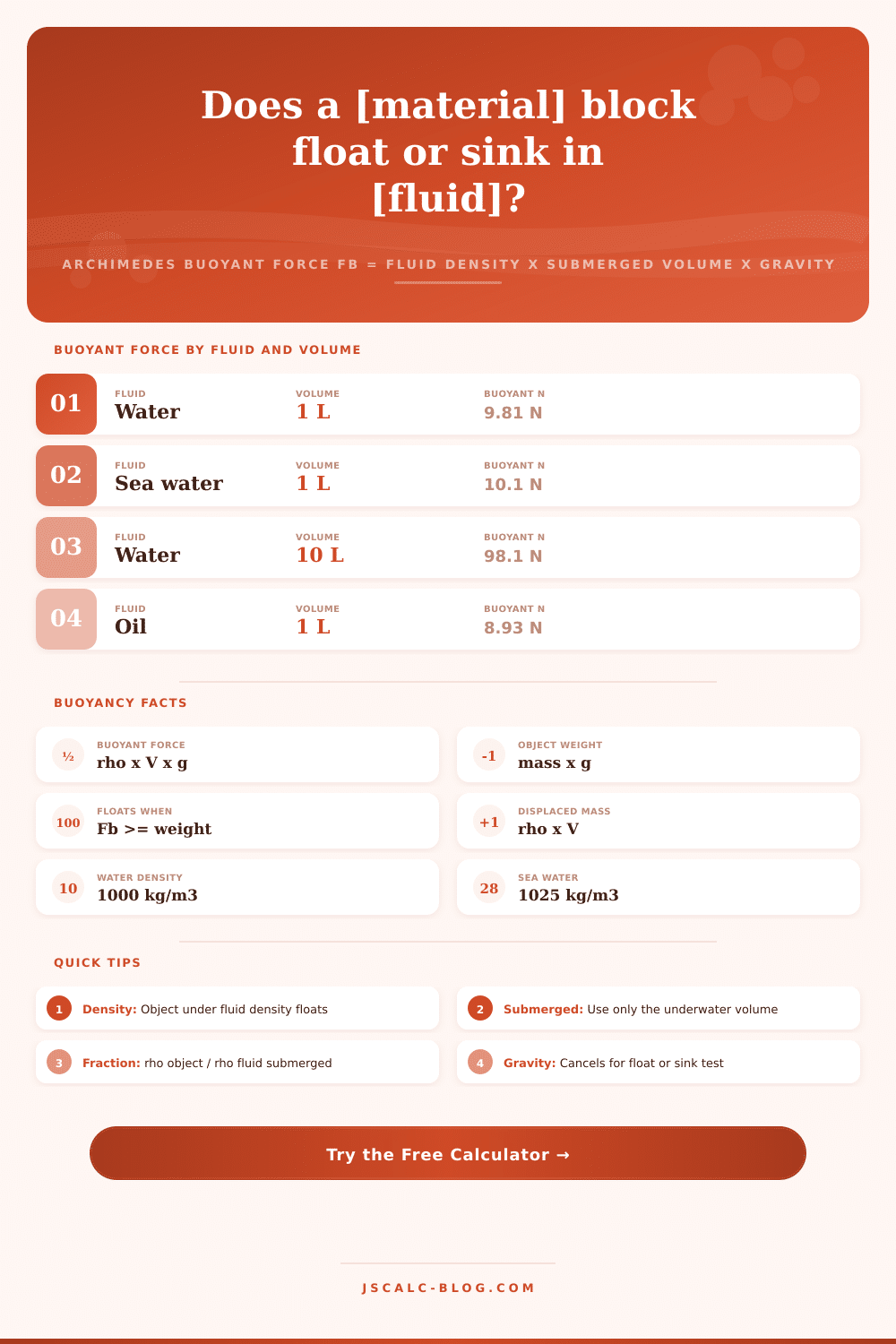
It’s simple math in its simplest form, but without paying attention to your units you’ll get some strange results. Buoyancy = (density of fluid) x (volume displaced) x (gravity). Density times volume equals the mass of the displaced fluid, and multiplying that by gravity give you weight instead of just mass. Now just remember that because that much fluid was moved out of the way, there must be an equal amount of upward push from that same fluid as it tries to move back toward equilibrium.
The upward push is literal weight of the displaced fluid. On Earth it’s 81 newtons. That’s what the calculator multiplies for you, but it also shows you the breakdown so you know how each number relates to the others. Understanding why each number fits together like that keeps you from accidently confusing the buoyant capacity of an object with its actual weight. Most people make that mistake.
It’s an easy battle of forces: if there are two objects, one of which floats and one doesn’t, they’ll fight until the one that doesn’t has gone deep enough under the surface that it displaces enough water to keep itself from sinking any further. The process of figuring out if something will float is basically just a matter of knowing how heavy it is and how much of it end up under the surface.
If it’s lighter than the material around it, if, for example, pine wood (which weighs 500 kilograms per cubic meter) is put into water, then all you have to do is let it go and let half of it stick out above the water line while half sits below. Because aluminum is almost exactly three times as dense as water (at 2700 kilograms per cubic meter), however, it would of have to take up more space floating than it actualy does, so it goes right to the bottom instead.
The numbers get crunched by the tool automatically and the answer is presented in plain language: whether your object will float or sink. The thing itself isn’t the only important factor; the fluid you use to submerge it is equally significant. Heavy objects floats more easily in salt water because it is thicker than fresh water, which gives them a little extra lift. For example, mercury is so dense that even an iron nail will float on top of it. Many people find this surprising because they have always assumed all metal sinks in every liquid.
There are preset options for popular fluids such as milk, olive oil, gasoline and more, and this lets you view the results with just a slight adjustment in density. You can also input specific density values for various lab solutions or specialty brines. That way, when you’re checking out some material in an environment different than what’s typically used in textbooks, you’ll know your math is based on real-world conditions, not theoretical ones.
Two routes for volume input are provided depending on scenario. One is direct volume input which allows for entry of a value in liters or cubic centimeters. The system will convert all inputs to cubic meters behind the scenes. The second is entry of dimensional data for a rectangular box in centimeters. It will calculate the submerged volume from that.
That’s nice if you’re working with something like a block or crate where you have the length, width, and height and don’t know the overall volume from the top of your head. One useful mental marker is that a cube ten centimeters on each side is one liter. That’s useful as a mental anchor for estimating displacement. It also means that getting this right is very important since any error in volume becomes immediately translated to force, throwing off your entire analysis.
Reading the results requires looking at more than just the final verdict. It outputs both the weight of the object and the buoyant force separately. This lets you determine whether there is a margin of danger or safety. You also learn something from the apparent weight of an object when it sinks in a fluid. It shows how hard the object pulls down even though the fluid is trying to push it up. This is why rocks seem light underwater until you break the surface.
The fraction of what is submerged lets you know how high a floaty object sits, and knowing ice has a density ratio of 0.92 means it sit 92 percent underwater. The fraction doesn’t change if gravity changes across planets (it alters the actual force values), but this shows that buoyancy is really all about the density ratio and not the strength of gravity itself.
This is all very abstract physics, but when you get a feel for this interaction between volume and density, you have something more than theory. You can apply this knowledge whether you’re designing a boat hull or simply wondering why ice cubes float in your beverage. Use the calculator to see the math, but realize that float doesn’t mean lightweight; float means less dense than the surrounding environment.
If you remember that, you’ll never be caught off guard by a reluctant floater or surprise sinker ever again.