Attic Insulation R-Value Calculator
Pick your US climate zone to get the ENERGY STAR recommended attic R-value, estimate the R-value you already have from your current insulation depth, then see exactly how many inches and how many bags or rolls of new material you need to reach the target.
📏Measurement Units
🎯Real Attic Scenarios
🛠Attic Details
Sets the ENERGY STAR recommended attic R-value target.
Measure the current loose fill or batt thickness. Use 0 for a bare deck.
Aged and compressed material has a lower R per inch than new.
R per inch of the fresh insulation you plan to install on top.
The insulated ceiling footprint, not the roof slope area.
Used to convert added volume into bags or packs to buy.
Extra material for over-blow, settling and coverage gaps.
Controls how depth and R-value results are displayed.
🔢Result Snapshot
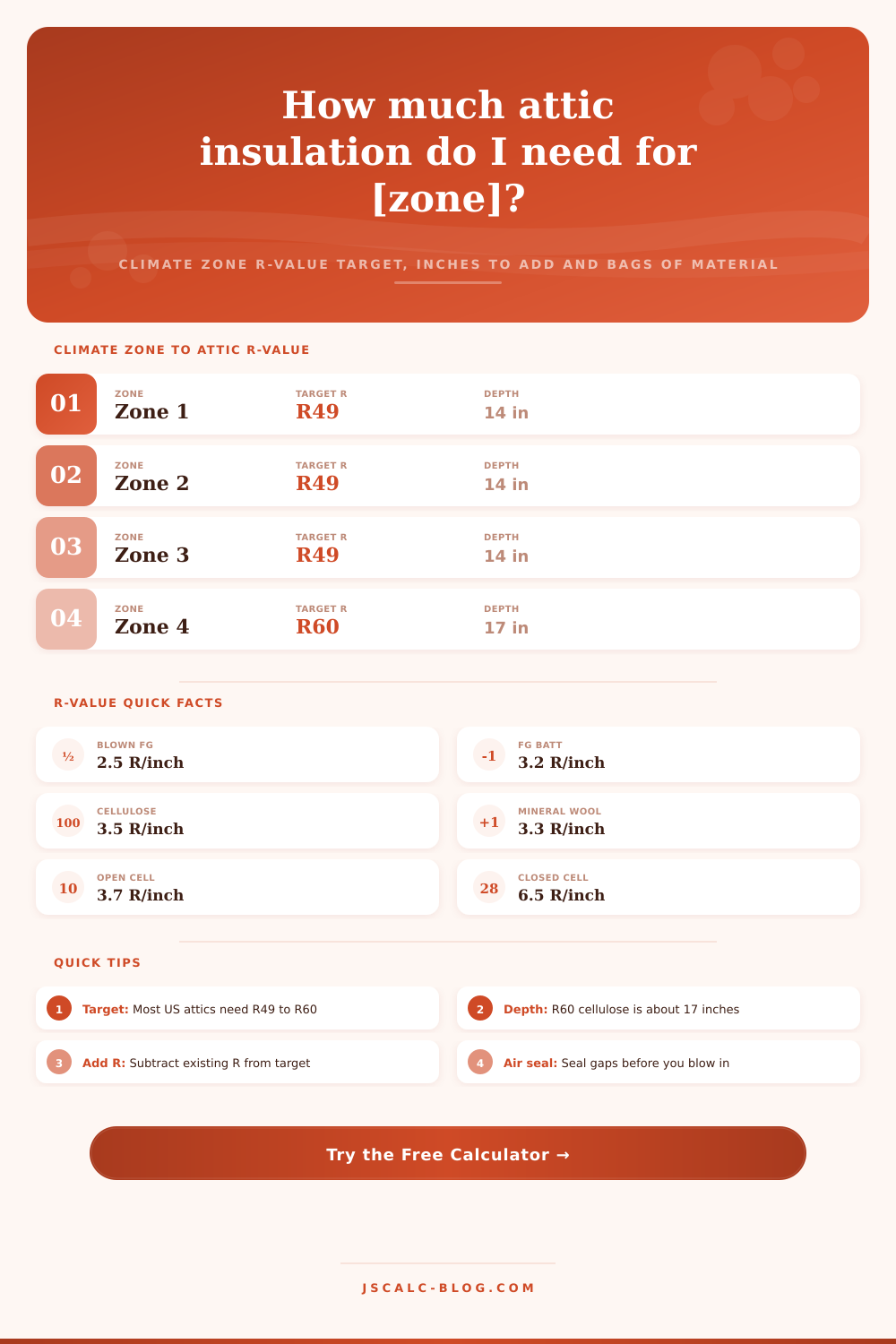
🌐Climate Zone to Recommended Attic R-Value
| Climate Zone | Example Cities | Recommended Attic R | Cellulose Depth |
|---|---|---|---|
| Zone 1 | Miami, Honolulu | R49 | about 14 in |
| Zone 2 | Houston, Phoenix | R49 | about 14 in |
| Zone 3 | Atlanta, Los Angeles | R49 | about 14 in |
| Zone 4 | Washington DC, Wichita | R60 | about 17 in |
| Zone 5 | Chicago, Denver | R60 | about 17 in |
| Zone 6 | Minneapolis, Burlington | R60 | about 17 in |
| Zone 7 | Duluth, Grand Forks | R60 | about 17 in |
| Zone 8 | Fairbanks, Barrow | R60 | about 17 in |
🧩New Material R-Value Per Inch
| Material | R Per Inch | Depth for R49 | Depth for R60 |
|---|---|---|---|
| Blown fiberglass | R2.5 | 19.6 in | 24.0 in |
| Fiberglass batt | R3.2 | 15.3 in | 18.8 in |
| Blown cellulose | R3.5 | 14.0 in | 17.1 in |
| Mineral wool batt | R3.3 | 14.8 in | 18.2 in |
| Open-cell spray foam | R3.7 | 13.2 in | 16.2 in |
| Closed-cell spray foam | R6.5 | 7.5 in | 9.2 in |
📐Existing Insulation R-Value Estimate
| Existing Material | R Per Inch | R at 3 in | R at 6 in |
|---|---|---|---|
| Bare joists / none | R0.0 | R0 | R0 |
| Old blown fiberglass | R2.2 | R6.6 | R13.2 |
| Settled blown cellulose | R2.7 | R8.1 | R16.2 |
| Fiberglass batt | R3.1 | R9.3 | R18.6 |
| Rock / mineral wool | R3.0 | R9.0 | R18.0 |
| Vermiculite granules | R2.5 | R7.5 | R15.0 |
📦Blown Insulation Coverage Per Bag
| Product | Settled Cu Ft / Bag | Sq Ft at R30 | Sq Ft at R60 |
|---|---|---|---|
| Blown cellulose | 2.0 cu ft | about 28 sq ft | about 14 sq ft |
| Blown fiberglass | 2.4 cu ft | about 40 sq ft | about 20 sq ft |
| Dense-pack cellulose | 1.7 cu ft | about 24 sq ft | about 12 sq ft |
| Fiberglass batt pack | 40 cu ft | about 88 sq ft | about 42 sq ft |
🗃Insulation Material Comparison Grid
| Material | R Per Inch | Cost Tier | Air Seals? | Moisture Risk | Best Use |
|---|---|---|---|---|---|
| Blown fiberglass | R2.5 | Low | No | Low | Budget top-up |
| Fiberglass batt | R3.2 | Low | No | Low | Open joist bays |
| Blown cellulose | R3.5 | Low-Mid | Partial | Medium | Deep loose fill |
| Mineral wool batt | R3.3 | Mid | No | Low | Fire and sound |
| Open-cell foam | R3.7 | High | Yes | Medium | Sealed roof deck |
| Closed-cell foam | R6.5 | Highest | Yes | Very low | Tight low-clearance |
| Dense-pack cellulose | R3.6 | Mid | Partial | Medium | Sloped cavities |
⚙Formula Breakdown
💡Attic Insulation Tips
How much insulation do I need? It’s the question all homeowners ask themselves before tackling another weekend project: How much should I add? This R-value calculator for attic insulation finds the answer using your US climate zone and the recommended energy target. It deducts what is already there and turns that amount into a shopping cart of bags and inches. No more wondering if adding just a few more inches will be enough; instead, you’ll know exactly what depth to use and how many materials it take. This is the difference between upgrading wisely and throwing money away.
The way that it works is with an R-Value. The R-Value indicates how much something will resist heat flow. A higher number means a greater level of insulation. How is it measured? In inches. What’s the value? It’s the thickness times the rate at which material resists heat flow (per inch).
How to Use the Insulation Calculator
Why does it payback quickest in the attic? Because most homes loses more heat through the attic than anywhere else. That’s why building codes make their strongest recommendations on the attic floor instead of exterior wall. So then the question becomes, what do I have now, and what am I missing?
There are eight climate zones in the United States (arctic Zone 8 down to hot Zone 1). Insulation recommendations vary by region, with hotter regions (zones 1-3) aiming for R49, and coldest regions (zones 4-8) aiming for R60 or more. That’s where the zone selection comes into play, as calculator automatically maps your zone directly to that goal. A home in Chicago aims for R60 insulation; a home in Atlanta aims for R49.
But this is the only number we recommend as the “one single-most-important piece of data” since everything else is relative to it. Yet most homeowners don’t think about it at all, and simply purchase whatever is on sale (which typically doesn’t align with their true energy need). Because most attics aren’t empty, proper estimation of what’s already in place is essential to prevent overbuying.
The system gauge your present R-value by multiplying your material’s per-inch rating by how much you have. To get thickness, you just use a ruler and measure the batt thickness or depth of a layer of loose fill; then select the material and the system will multiply by the per-inch rating for that material. Old insulation rates below spec, so if you’ve got old blown fiberglass, rate it around R2.2 per inch. So six inches of it would only equal roughly R13. Why? Older insulation isn’t as strong than new insulation. Measuring ensures you don’t assume your old insulation is at full strength.
It’s simple arithmetic, and you could do it in your head if you wanted…but you might also screw it up in your head. To add: take the target minus the existing value, which will never be less than zero. Divide that difference by the R-value of the new insulation; this tells you how many inches you’ll add to get there. If you start with three inches of fiberglass over Zone 5 (see chart) and top them off with cellulose, you’re looking at about fifteen additional inches to reach a total depth somewhere around eighteen. Follow the math through the breakdown panel; each step makes sense. It is not magic, mind you. It is just plain ol’ algebra applied to thermal physics.
But knowing how deep isn’t half the battle, you also need to purchase enough (or less). To do this, it calculates the volume of fill in cubic feet from the attic area, which is just inches x area/12. Then it multiplies that by the number of bags needed per sq ft, plus some extra to allow for settling, rounding up. That’s roughly 2 settled cubic feet per bag for blown cellulose, but much larger for batt packs. Selecting the wrong material in the drop down instantly throws off your shopping list… big time.
You must weigh depth and air sealing against cost when selecting insulation material. There is a trade-off based on how the material seals, how deeply it goes into a space, and what it costs. On an open attic floor, the lowest-cost approach that still provides thick coverage is with loose fill fiberglass or cellulose. Both are good insulators, but cellulose resists air movement slightly better than fiberglass. Because air leaks carry even more heat than conduction alone, cellulose performs best here.
When clearances are tighter, spray foams can do a great job as both air barrier and insulation. The following chart summarizes these trade-offs. To balance cost with depth of coverage, look at the table on the page. Match material to fit the space constraints, and insulate smart!
Insulating your attic is among the best bang-for-buck home improvements, but do it too thick or too thin, and it’s not cheap. This calculator lets you enter your climate target, make a reasonable guess at what’s there already, and figure out how much insulation will cost you (including waste) so you can stop guessing. Choose your insulator, seal your air leaks first, and get an exact number on how many bags sit between you and a warmer house that costs less to heat.
You should of measured once and buy twice. No thanks.