Baking Conversion Calculator: Grams to Cups
Convert grams to cups and cups to grams for each baking ingredient using real weight-to-volume densities. Pick an ingredient, enter an amount, and get cups, grams, ounces, and tablespoons at once.
🍳Quick Conversion Presets
🧁Ingredient & Amount
Scales the result up, for example 2 = double batch.
🔢Conversion Constants
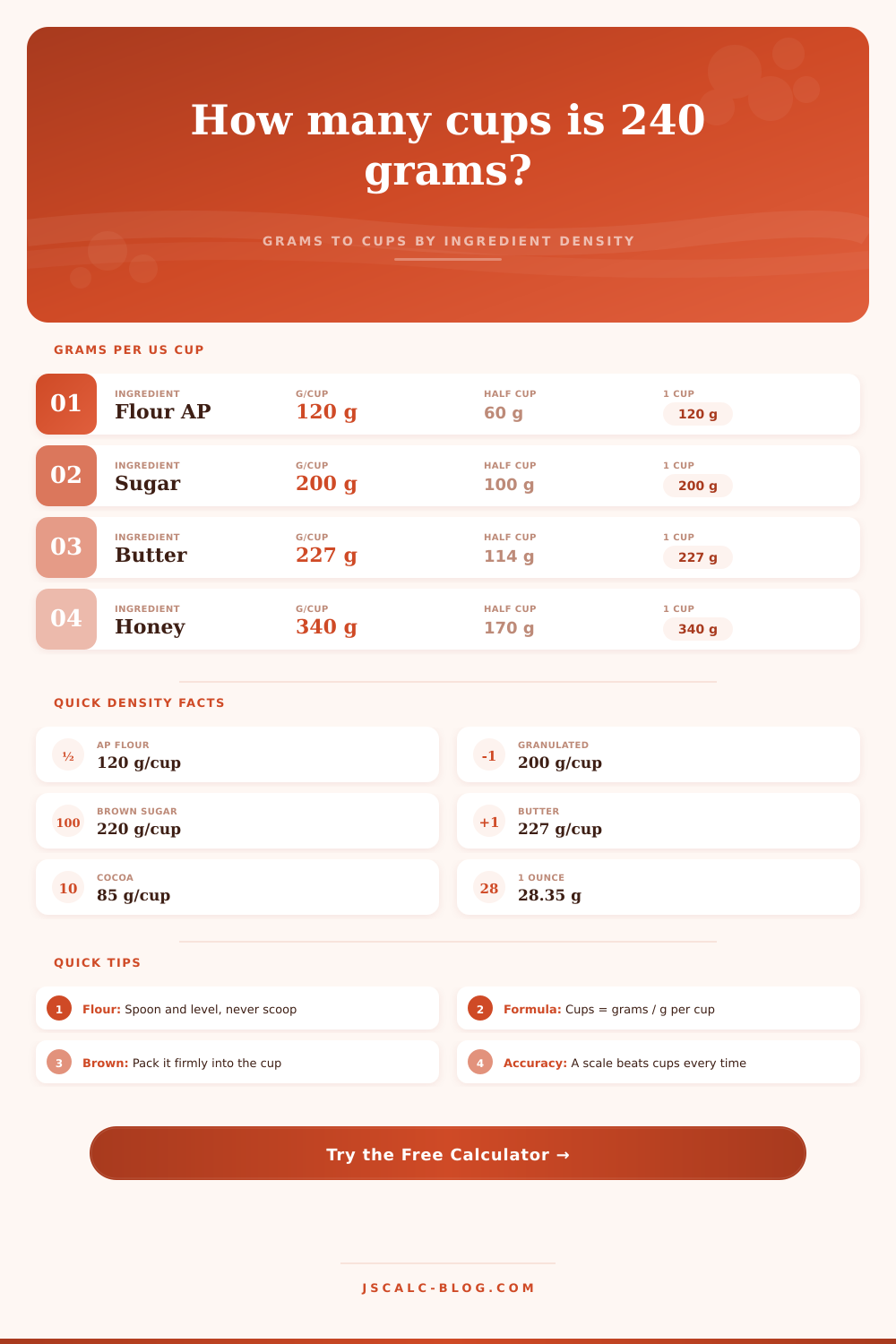
📋Ingredient Grams Per Cup Chart
| Ingredient | Grams / Cup | Ounces / Cup | Grams / Tbsp |
|---|---|---|---|
| All-purpose flour | 120 g | 4.23 oz | 7.5 g |
| Bread flour | 127 g | 4.48 oz | 7.9 g |
| Cake flour | 114 g | 4.02 oz | 7.1 g |
| Granulated sugar | 200 g | 7.05 oz | 12.5 g |
| Brown sugar (packed) | 220 g | 7.76 oz | 13.8 g |
| Powdered sugar | 120 g | 4.23 oz | 7.5 g |
| Butter | 227 g | 8.00 oz | 14.2 g |
| Honey | 340 g | 11.99 oz | 21.3 g |
| Cocoa powder | 85 g | 3.00 oz | 5.3 g |
| Rolled oats | 90 g | 3.17 oz | 5.6 g |
⚖Common Grams to Cups Conversions
| Grams | AP Flour | Sugar | Butter | Cocoa |
|---|---|---|---|---|
| 50 g | ⅓ cup | ¼ cup | 3.5 tbsp | 0.59 cup |
| 100 g | 0.83 cup | ½ cup | 0.44 cup | 1.18 cup |
| 120 g | 1 cup | 0.60 cup | 0.53 cup | 1.41 cup |
| 150 g | 1.25 cup | 0.75 cup | 0.66 cup | 1.76 cup |
| 200 g | 1.67 cup | 1 cup | 0.88 cup | 2.35 cup |
| 240 g | 2 cups | 1.20 cup | 1.06 cup | 2.82 cup |
| 250 g | 2.08 cup | 1.25 cup | 1.10 cup | 2.94 cup |
🥄Cups to Tablespoons to Teaspoons
| Cups | Tablespoons | Teaspoons | Fluid Ounces |
|---|---|---|---|
| ¼ cup | 4 tbsp | 12 tsp | 2 fl oz |
| ⅓ cup | 5.33 tbsp | 16 tsp | 2.67 fl oz |
| ½ cup | 8 tbsp | 24 tsp | 4 fl oz |
| ⅔ cup | 10.67 tbsp | 32 tsp | 5.33 fl oz |
| ¾ cup | 12 tbsp | 36 tsp | 6 fl oz |
| 1 cup | 16 tbsp | 48 tsp | 8 fl oz |
🗂Ingredient Weight Comparison Grid
| Ingredient | Grams / Cup | ½ Cup | 1 Cup | 2 Cups | Oz / Cup |
|---|---|---|---|---|---|
| All-purpose flour | 120 g | 60 g | 120 g | 240 g | 4.23 oz |
| Granulated sugar | 200 g | 100 g | 200 g | 400 g | 7.05 oz |
| Brown sugar (packed) | 220 g | 110 g | 220 g | 440 g | 7.76 oz |
| Butter | 227 g | 114 g | 227 g | 454 g | 8.00 oz |
| Honey | 340 g | 170 g | 340 g | 680 g | 11.99 oz |
| Cocoa powder | 85 g | 43 g | 85 g | 170 g | 3.00 oz |
| Rolled oats | 90 g | 45 g | 90 g | 180 g | 3.17 oz |
| Chocolate chips | 170 g | 85 g | 170 g | 340 g | 6.00 oz |
| Powdered sugar | 120 g | 60 g | 120 g | 240 g | 4.23 oz |
| Almond flour | 96 g | 48 g | 96 g | 192 g | 3.39 oz |
⚙How The Conversion Works
💡Baking Accuracy Tips
If you’ve ever been in a kitchen and tried to make something from a cookbook with cup measurements when all your other ingredients was measured in grams, you know what I mean: the tension of needing to bake NOW but not wanting to do any math. And then there’s the problem of cups: how do you convert volume into weight? This is where The Conversion Tool come in.
But here’s where the real benefit comes in: knowing a cup of flour isn’t the same as a cup of sugar (even though it may fit exactly into your measuring cup). And then there are the differences in densities. Sugar is granular and dense, flour is airy and light, honey is both viscous and heavy. Using the wrong density, treating everything as if it has the same weight for the same amount of volume, can mean that your baking won’t work out. Your glaze might not set up thickly enough, or your batter might turn into a runny sauce.
Why Weight Is Better Than Volume
The calculator do the math once you’ve picked an individual ingredient, so it eliminates any need to do these conversions by guessing. So being precise is more important then moving quickly during initial stages of baking. Take flour, for instance. By lightly spooning all-purpose flour into a cup and leveling the top, a typical cup will weigh around 120 grams. When you grab your cup from the bag and simply scoop up some flour, you’ll end up with more, an additional thirty or even forty grams in some cases, without realizing it because the powder compresses against itself. This make for a denser dough that won’t rise as intended.
Though the calculator take the average density for every ingredient, it’s unable to account for how you measured out your ingredients before placing them on the scale. It is a small distinction, but it is incredibly important for overall texture of what you’re making. Brown sugar has a different consistency because it is clumpy and holds more moisture than regular sugar. In fact, recipes usually call for the brown sugar to be packed firmly into the cup. You’ll notice that this makes it much denser than the granulated variety. Packed brown sugar weighs around 220 grams per cup, while the same volume of white granulated comes out to be about 200g. When you replace one with the other without accounting for the change in weight, your proportions is thrown off. Not only does the sweetness alter, but so does the amount of hydration in your batter. That’s what most folks should of accounted for when they’re substituting on-the-fly.
But liquids create other complications. Milk and water are fairly similar in density, so they’re interchangeable (most times) in a recipe. But then there’s honey. Honey is so heavy. A cup of it weighs approximately 340 grams. If your recipe asks for half a cup of oil, it weighs roughly 170 grams. If you substitute that with the same amount of liquid by volume (e.g., 1/2 cup), you’ll end up adding nearly double the weight. Not only does this change the taste of whatever you’re baking, but it also makes the result dense. You’re changing the way things come together structuraly.
This is all explained nicely in the reference table on the page where you can quickly compare weights and volumes. But the takeaway is: Trust what weight tells you, it’s consistent. Volume isn’t… On one side of the world, a “cup” may contain 5 ounces; on another, it will hold 4 ounces, all based off which standard they’re measuring from. Grams don’t vary; they’re universal. They take away the guesswork of whether you packed that ingredient down really tightly, or if your flour was extra-wet on a particularly humid day. They standardize the process so you know a recipe that worked for someone else will work for you exactly as intended.
This shift in perspective… From thinking about weights instead of volumes when reading a recipe, transforms the way you cook. It makes you view food as made up of stuff with certain characteristics instead of vague amounts. It teaches you what goes wrong with a cake when following directions doesn’t produce the same result that the person who wrote them had in mind (because they expected a different density). The mindset change is the upgrade, the tool is merely helpful.
The moral: Next time you’re staring at a metric-labeled product in a state of dismay, try remembering that it’s actualy freeing you from the cup-tastic tyranny. No more guessing about the compactness of your flour, just weigh what you have, and go from there. You’ll be able to make sure that your bread is light, your brownies are fudgy, and your kitchen remains peaceful. Precision always tastes better than approximation.