Turkey Leg Cooking Time Calculator
Estimate roast, grill, smoke, or air fryer time for turkey legs and drumsticks by weight, cooking temperature, target internal doneness, and thawed or frozen state. Dark meat is best pulled near 175°F.
🍗Turkey Leg Presets
📝Cooking Details
One average turkey leg is about 1.25 to 1.5 lb (0.57 to 0.68 kg).
Legs cook in parallel, so time does not add up per leg.
🌡Doneness Snapshot
📊Method, Time, and Temperature Guide
| Method | Cooker Temp | Rate (min/lb) | 1.5 lb Leg | Finish Internal |
|---|---|---|---|---|
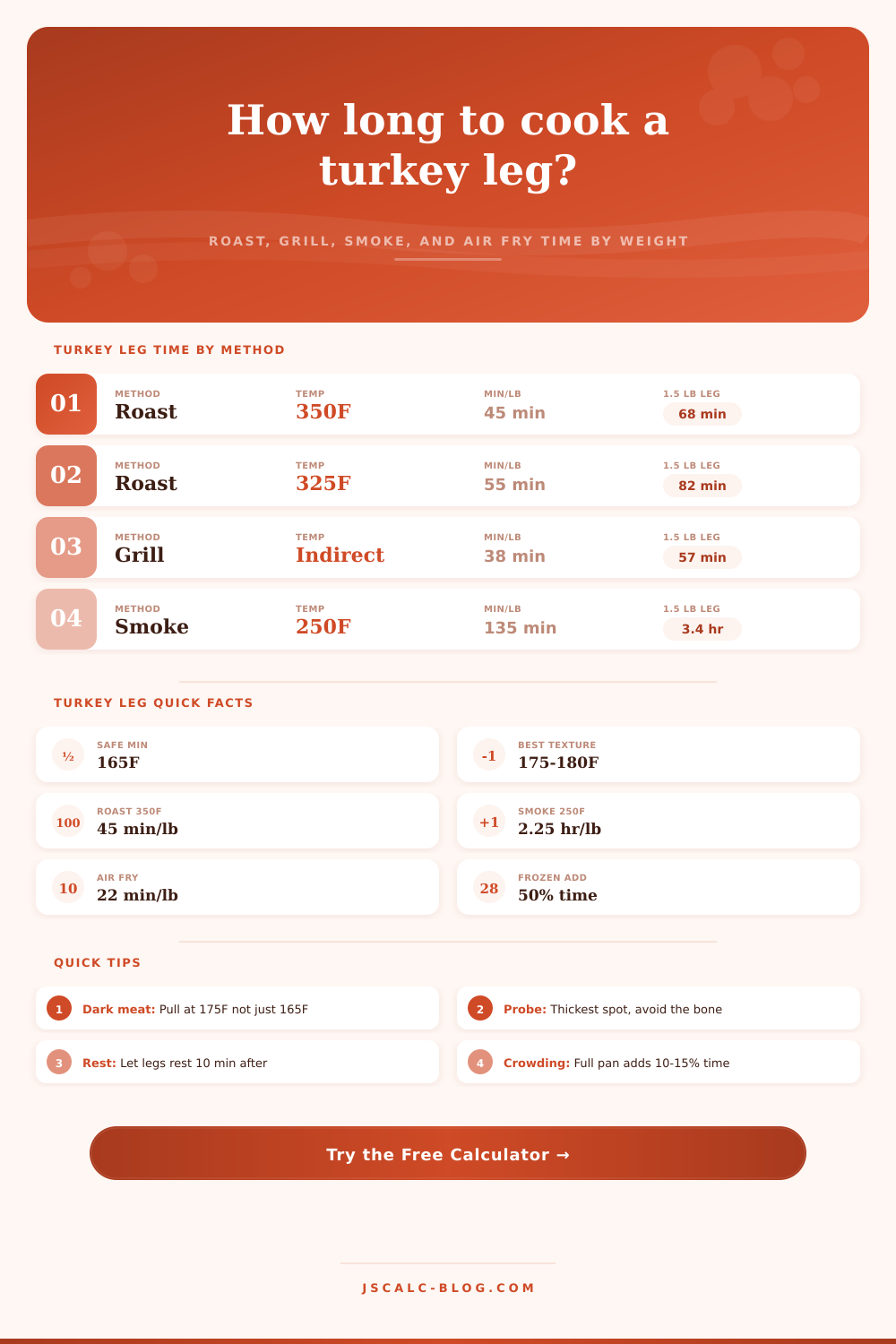
| Roast | 325°F | 55 min/lb | ~82 min | 175°F |
| Roast | 350°F | 45 min/lb | ~68 min | 175°F |
| Roast | 375°F | 38 min/lb | ~57 min | 175°F |
| Grill | Medium indirect | 38 min/lb | ~57 min | 175°F |
| Smoke | 225°F | 150 min/lb | ~3.75 hr | 175°F |
| Smoke | 250°F | 135 min/lb | ~3.4 hr | 175°F |
| Smoke | 275°F | 110 min/lb | ~2.75 hr | 175°F |
| Air fry | 380°F | 22 min/lb | ~33 min | 175°F |
| Air fry | 400°F | 19 min/lb | ~29 min | 175°F |
🗂Method Comparison Grid
| Method | Cooker Temp | Min / Lb | 1.5 lb Time | Internal Target | Texture Result |
|---|---|---|---|---|---|
| Roast low | 325°F | 55 | ~82 min | 175°F | Juicy, even |
| Roast standard | 350°F | 45 | ~68 min | 175°F | Balanced skin |
| Roast hot | 375°F | 38 | ~57 min | 175°F | Crispier skin |
| Grill indirect | 325 to 375°F | 38 | ~57 min | 175°F | Smoky char |
| Smoke slow | 225°F | 150 | ~3.75 hr | 175°F | Deep smoke ring |
| Smoke medium | 250°F | 135 | ~3.4 hr | 175°F | Tender, smoky |
| Smoke hot | 275°F | 110 | ~2.75 hr | 175°F | Faster, less ring |
| Air fry | 380°F | 22 | ~33 min | 175°F | Crisp, quick |
🕑Weight to Roast Time Chart (350°F)
| Leg Weight | Metric | Roast 350°F | Grill Indirect | Air Fry 380°F |
|---|---|---|---|---|
| 1.00 lb | 0.45 kg | ~45 min | ~38 min | ~22 min |
| 1.25 lb | 0.57 kg | ~56 min | ~48 min | ~28 min |
| 1.50 lb | 0.68 kg | ~68 min | ~57 min | ~33 min |
| 1.75 lb | 0.79 kg | ~79 min | ~67 min | ~39 min |
| 2.00 lb | 0.91 kg | ~90 min | ~76 min | ~44 min |
| 2.50 lb | 1.13 kg | ~113 min | ~95 min | ~55 min |
🧪Internal Temp and Safety Guide
| Internal Temp | Stage | Texture | Best For |
|---|---|---|---|
| Below 165°F | Unsafe | Tough, pink | Keep cooking |
| 165°F | Safe minimum | Firm, some chew | USDA food safety |
| 170°F | Improving | Collagen softening | Transition point |
| 175°F | Tender | Juicy, pulls clean | Best dark meat |
| 180°F | Very tender | Fall-off-bone | Shredding, fair legs |
| Above 185°F | Overdone | Dry, stringy | Avoid if possible |
⚙How the Estimate Works
💡Turkey Leg Cooking Tips
Many people pull their turkey leg out of the oven when it reaches 165 degrees F, which is minimum for safe food. But then they take a bite and realize that although it’s technically safe, it’s also tough and stringy! Why? Because those safety charts aims to kill bacteria, not soften connective tissue. That’s where the calculator comes in: It bridges the gap between “safe” and “optimal,” letting you factor in cooking method, weight, and goal (texture!) to get best result.
Connective tissues (like in turkey legs) is full of collagen, which is a dense network that needs time for slow heat to breakdown fully. You can’t just throw ’em on like breast meat… It’ll be all stringy and tough, because it’s realy a giant drumstick. With this tool, you set your desired target temp above the minimum safe mark. Ideally, you’d go all the way up to 180° or so; then you can tear meat right off bone. It seems crazy to cook something beyond safe… except that when you get dark meat that hot, those hard fibers melts into gelatin. The calculator takes care of these tweaks for you automaticly, without any guesswork about timing.
How to Cook Perfect Turkey Legs
Cooking time do depend heavily on weight. If you have a two-pound leg, it will take longer to cook then a one-pound leg. But other things matter too. Pan overcrowding will also slow down the process. Stacking the legs too tightly together will blocks the flow of air around individual pieces of meat, trapping some of the steam and hindering the heat from reaching the outside of meat. By enabling the input option to account for overcrowding, the app gives you a slight increase on your estimated cooking time to compensate for reduced airflow. This way, final few minutes won’t dry the meat because the heat wasn’t able to penetrate the exterior properly.
Cooking time varies drasticly depending on method. For example, smoking at 250 degrees Fahrenheit takes forever (but it infuses lots of flavor and renders fat). Roasting, which is typical for home-cooked meals that are ready in two or so hours, involves temperatures of 350 degrees. Air frying uses concentrated forced-air circulation like an industrial convection oven. This reduce cook times by as much as half compared to roasting.
Use the time references as your starting point. How long yours lasts depends on how accurate your thermometer is, and if meat was completely defrosted. Then there are the complexities of a frozen turkey leg. Sure, they’ll come out okay cooked from frozen in either a smoker or an oven, but you need to account for about half again as much time (fifty percent). You are melting ice crystals inside the muscle fibers, not simply heating meat. The result is that the meat cook unevenly, with the outside becoming dry while the interior remains below a safe temperature. If you have time, thaw those bad boys overnight in the fridge. It’s always best to thaw things first; it’s more predictable and ensures even heating throughout. You should of thawed them earlier if you could.
Everyone forgets one key step: letting it rest! If you cut into the meat as soon as you take the legs off the heat, all the juice will spill out onto your plate. It’s best to let it sit for about 10 minutes so proteins can relax and absorbs the moisture back in. You’ll be able to notice a big difference in the finished product. The calculator tells you what time to pull the tray off the heat; it is also important to wait before cutting it up. For juicy results, wait.
Learn how turkey leg collagen break down and manage your expectations. This isn’t magic. Time and heat, using our tools today, breaks down collagen. If you’re smoking some for your next barbecue or roasting some for your next holiday, that’s what it’s all about: getting clean separation between the bone and meat with no resistance. These estimates take the guesswork out of cooking. This lets you focus more on how to present and season your food, instead of worrying if you’ve cooked it enough or dried it out too much. Use your thermometer, follow the rest time, and give the heat time to do its thing.