Slow Roast Leg of Lamb Cooking Time Calculator
Plan a low-and-slow leg of lamb from weight, doneness, bone-in or boneless, and oven temperature. Get total roast time, minutes per pound, target internal temperature, and rest time.
🍖Popular Lamb Roast Presets
📝Lamb & Oven Inputs
Trimmed roast weight, not including any bone-out loss.
Plan roughly 0.5 lb bone-in or 0.35 lb boneless per adult.
🌡Doneness Snapshot
📊Doneness → Internal Temperature
| Doneness | Pull Temp °F | Pull Temp °C | Final After Rest | Texture |
|---|---|---|---|---|
| Rare | 125°F | 52°C | ~130°F | Deep red, very soft |
| Medium-rare | 130–135°F | 54–57°C | ~140°F | Rosy pink, juicy |
| Medium | 140–145°F | 60–63°C | ~150°F | Light pink center |
| Medium-well | 150°F | 66°C | ~155°F | Faint pink, firm |
| Well done | 160°F | 71°C | ~165°F | No pink, fall-apart |
🕑Minutes Per Pound by Oven Temp
| Oven Temp | Med-Rare | Medium | Well Done | Roast Style |
|---|---|---|---|---|
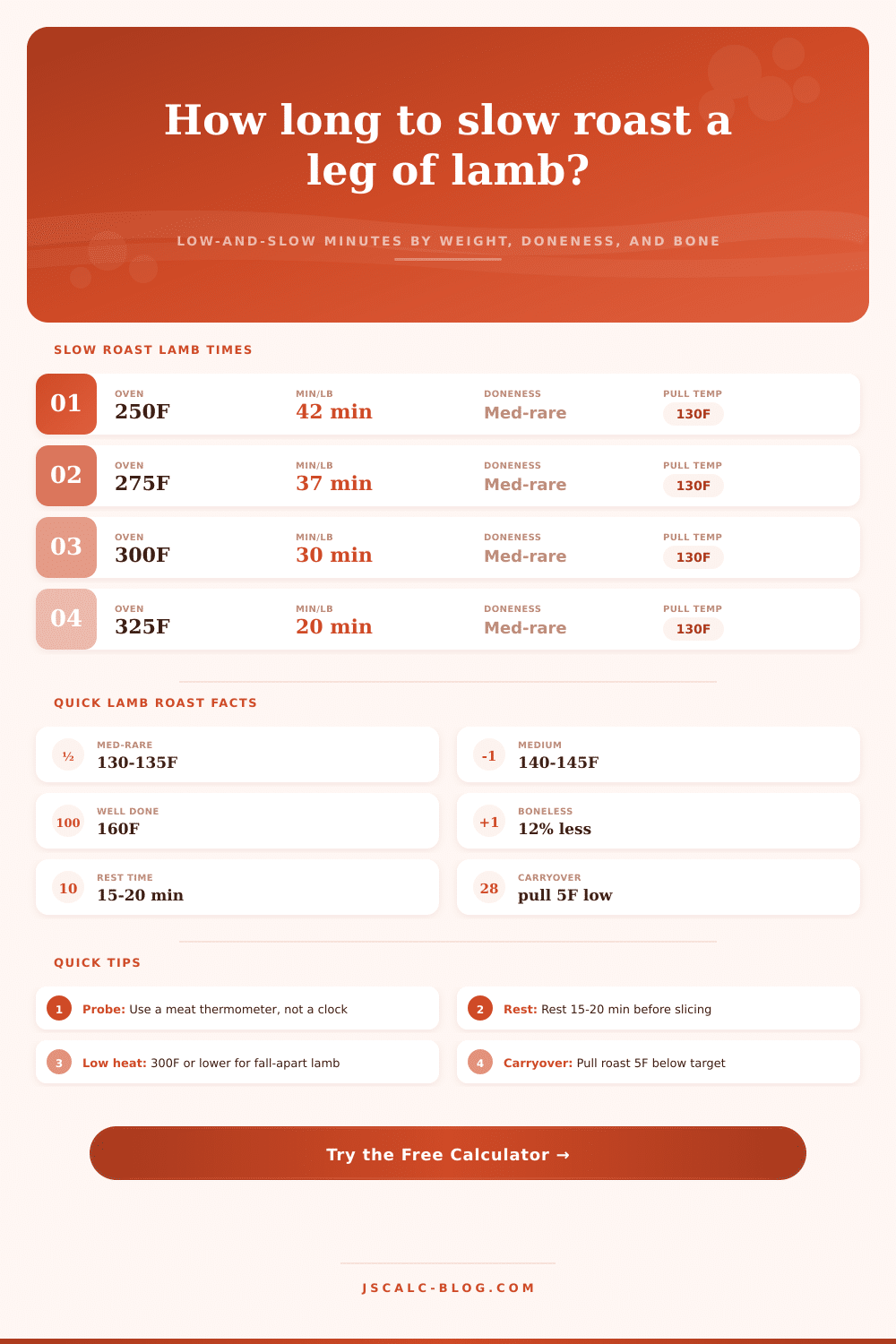
| 250°F / 121°C | 42 min/lb | 50 min/lb | 63 min/lb | Very slow, pulled |
| 275°F / 135°C | 37 min/lb | 44 min/lb | 56 min/lb | Low and slow |
| 300°F / 150°C | 30 min/lb | 35 min/lb | 45 min/lb | Classic slow roast |
| 325°F / 163°C | 20 min/lb | 24 min/lb | 30 min/lb | Moderate roast |
| 350°F / 177°C | 16 min/lb | 19 min/lb | 24 min/lb | Standard, faster |
Rates are for a bone-in leg. Boneless or rolled legs cook about 12% faster because heat reaches the center more evenly.
🦴Bone-In vs Boneless & Weight Chart
| Leg Weight | Bone-In 300°F | Boneless 300°F | Servings | Notes |
|---|---|---|---|---|
| 3 lb (1.4 kg) | ~1h 30m | ~1h 19m | 4–5 | Half leg or shank end |
| 4 lb (1.8 kg) | ~2h 00m | ~1h 46m | 6–7 | Small whole leg |
| 5 lb (2.3 kg) | ~2h 30m | ~2h 12m | 8–9 | Typical family leg |
| 6 lb (2.7 kg) | ~3h 00m | ~2h 38m | 10–11 | Easter centerpiece |
| 7 lb (3.2 kg) | ~3h 30m | ~3h 05m | 12–13 | Large bone-in leg |
| 8 lb (3.6 kg) | ~4h 00m | ~3h 31m | 14–15 | Extra-large roast |
Times shown at 300°F medium-rare, before adding any sear or rest. Always confirm with a probe thermometer.
🗂Weight vs Time Comparison Grid
| Weight | 250°F | 275°F | 300°F | 325°F | 350°F |
|---|---|---|---|---|---|
| 3 lb | 2h 06m | 1h 51m | 1h 30m | 1h 00m | 0h 48m |
| 4 lb | 2h 48m | 2h 28m | 2h 00m | 1h 20m | 1h 04m |
| 5 lb | 3h 30m | 3h 05m | 2h 30m | 1h 40m | 1h 20m |
| 6 lb | 4h 12m | 3h 42m | 3h 00m | 2h 00m | 1h 36m |
| 7 lb | 4h 54m | 4h 19m | 3h 30m | 2h 20m | 1h 52m |
| 8 lb | 5h 36m | 4h 56m | 4h 00m | 2h 40m | 2h 08m |
Bone-in leg, medium-rare pull temperature. Values scale directly with the minutes-per-pound rate for each oven setting.
⚙Full Roast Time Breakdown
📋Serving & Portion Reference
| Item | Bone-In | Boneless | How It Is Used |
|---|---|---|---|
| Per adult | ~0.5 lb | ~0.35 lb | Sets the servings estimate |
| Per hearty eater | ~0.65 lb | ~0.45 lb | Add for big appetites |
| Bone loss | ~20% | 0% | Bone-in yields less meat |
| Leftovers buffer | +25% | +25% | Extra for next-day meals |
| Rest window | 15–20 min | 15–20 min | Large roast, tented foil |
💡Slow Roast Lamb Tips
Cooking times for cuts like this one, particularly big, fatty ones like leg of lamb, are tricky. Online charts tend to give instructions about minutes-per-pound, but they is not very accurate if you do not factor in the starting temperature of meat or how bones is shaped. The calculator up top takes all that information, then computes exactly how long to cook your particular roast so it doesn’t overcook and turn out dry and gray inside. It gives you a clear plan instead of vague estimate. You just need to know why you entered your information to make it work even better.
What makes the most difference is whether it have bone in it. The bone conducts heat different than the flesh of the animal. It shields the outside from drying out too fast and holds back the transfer of heat to interior. When you roast something without bones, like a leg that has been deboned, heat travel more easily and doesn’t have to fight its way around a skeleton. This is why the tool automatically adjust the cook time down when calculating with a cut without bones. It’s typically around 12 percent less, or nearly ten minutes shorter on an hourlong roast. That makes difference between juicy pink meat and dry, overcooked toughness.
Why This Calculator Helps You Cook Lamb Better
It’s not that temperature matters for safety; it matters more for texture: If you roast something at two hundred seventy-five or even three hundred degrees, the connective tissue will gradualy break down, but its juices won’t squeeze out until later, when they’ve had time to get back inside fibers. Crank up the heat, though, and you’ll form a crust faster, but you might also end up with a half-inch-deep layer of gray from the outside in. The charts on the page show that dropping your oven temp results in both longer cooking times (a trade-off) and greater tenderness.
Most home cook overvalue convenience. The starting temperature is important: when you take your roast directly from the fridge, the outside cooks for twenty minutes before the inside starts warming up. You end up with a rare centre and a band of overdone meat around it. If instead you let the lamb reach room temp for an hour or two before putting it in the oven, the heat load will even out. The calculator also consider this. We ask if your meat is cold or at room temperature. If it is cold, the calculator adds more time because the oven has to warm up the meat and cook it. But if you ignore this, then no matter what time it suggests for you, it won’t be very good since starting conditions are wrong.
The science and the taste: How do you know when it’s done? According to science, one hundred thirty-five is the magic number; if you pull the roast at that temperature, it will continue to cook during its resting time and reach medium-rare. But what exactly does “done” mean? Lamb benefits most from a medium-rare preparation, which maintains tenderness and retains characteristic flavor. For me, one hundred thirty degrees has been perfect. Since roasting low and slow help connective tissues break down gently without squeezing out the juices, you really should of avoid overcooking it.
Carryover cooking ensures the temperature rises another five or so degrees as meat rests. And that’s where the rest comes into play. Carving too soon causes juices to drip onto the cutting board rather than remaining inside meat. The calculator also suggests a recommended rest time, which is typically fifteen to twenty minutes (depending on size of the roast). I know, your guests are starving… Wasted time, right? Nope. Skip it, and you’ll serve them a dry meal.
Using a clock is a bad idea for many reasons. First, every oven is calibrated differently; second, each piece of meat, such as a leg of lamb, is shaped different. A probe thermometer placed in the center of the thickest part of meat will tell you exactly what’s happening in real time. You’ll never be able to copy this using a chart. The calculator will help you get within range, after which the probe will do the rest. Remove the meat when its internal temperature is five degrees less than desired because of the carryover effect, which is the continued rise in heat while it rests under foil.
If you know anything about thermal mass, you know it behave consistently. You want the meat to be cooked, yet also remain tender enough that it will cut easily without falling apart and drying out in the process. Many factors matter: your oven temperature, whether the meat has bones, and its weight. The calculator takes all these tricky details into account and lets you concentrate on timing your side dishes and seasoning. Instead of stressing over what happens next, cooking a leg of lamb becomes a more approachable task with well-defined checkpoints. Yes, there’s still a thermometer, and yes, you’ll still have to monitor it… Just not as blindly.
Roasting a great leg of lamb: It’s all about knowing the meat and respecting it for what it can do (and won’t do). Once you know how much it will cook by itself, and how insulation from bone affects things, cooking this cut doesn’t seem as scary. The calculator makes prepping easier, but paying attention in the doing makes it work. Patience, not timing, is what this pretty roast requires.