Cooking Time Calculator for Different Temperatures
Know the cook time at one oven temperature but want to use another? This tool converts your roasting or baking time to the new temperature, adds convection adjustments, and flags dishes where the ratio rule is unreliable.
🍳Real Conversion Presets
📝Cook Time Inputs
The temperature your recipe was written for.
The temperature you want to bake at instead.
Only used for the per-pound estimate. Leave 0 to skip.
🔢Formula Snapshot
📊Comparison Grid: 60 min Original
| Original Temp | At 325°F | At 350°F | At 375°F | At 400°F | At 425°F |
|---|---|---|---|---|---|
| 325°F, 60 min | 60.0 min | 55.7 min | 52.0 min | 48.8 min | 45.9 min |
| 350°F, 60 min | 64.6 min | 60.0 min | 56.0 min | 52.5 min | 49.4 min |
| 375°F, 60 min | 69.2 min | 64.3 min | 60.0 min | 56.3 min | 52.9 min |
| 400°F, 60 min | 73.8 min | 68.6 min | 64.0 min | 60.0 min | 56.5 min |
| 425°F, 60 min | 78.5 min | 72.9 min | 68.0 min | 63.8 min | 60.0 min |
| 450°F, 60 min | 83.1 min | 77.1 min | 72.0 min | 67.5 min | 63.5 min |
🌡Temperature Conversion Chart
| Fahrenheit | Celsius | Gas Mark | Common Description |
|---|---|---|---|
| 275°F | 135°C | 1 | Very slow / low roast |
| 300°F | 150°C | 2 | Slow, gentle cooking |
| 325°F | 165°C | 3 | Moderately slow roast |
| 350°F | 175°C | 4 | Moderate, all-purpose |
| 375°F | 190°C | 5 | Moderately hot |
| 400°F | 205°C | 6 | Hot, browning roast |
| 425°F | 220°C | 7 | Hot bake, crisp finish |
| 450°F | 230°C | 8 | Very hot, fast roast |
🍗Common Roast Temps & Doneness
| Food | Typical Temp | Rough Time | Safe Internal Temp |
|---|---|---|---|
| Whole chicken | 375°F | 20 min per lb | 165°F breast |
| Beef roast, medium | 325°F | 22 min per lb | 145°F rest 3 min |
| Pork loin | 350°F | 20 min per lb | 145°F rest 3 min |
| Turkey, unstuffed | 325°F | 13 min per lb | 165°F thigh |
| Casserole / lasagna | 375°F | 40 to 55 min | 165°F center |
| Yeast bread loaf | 450°F | 25 to 35 min | 195°F crumb |
🌬Time Factor & Convection Reference
| Temp Change | Ratio Factor | Time For 60 min | Convection Note |
|---|---|---|---|
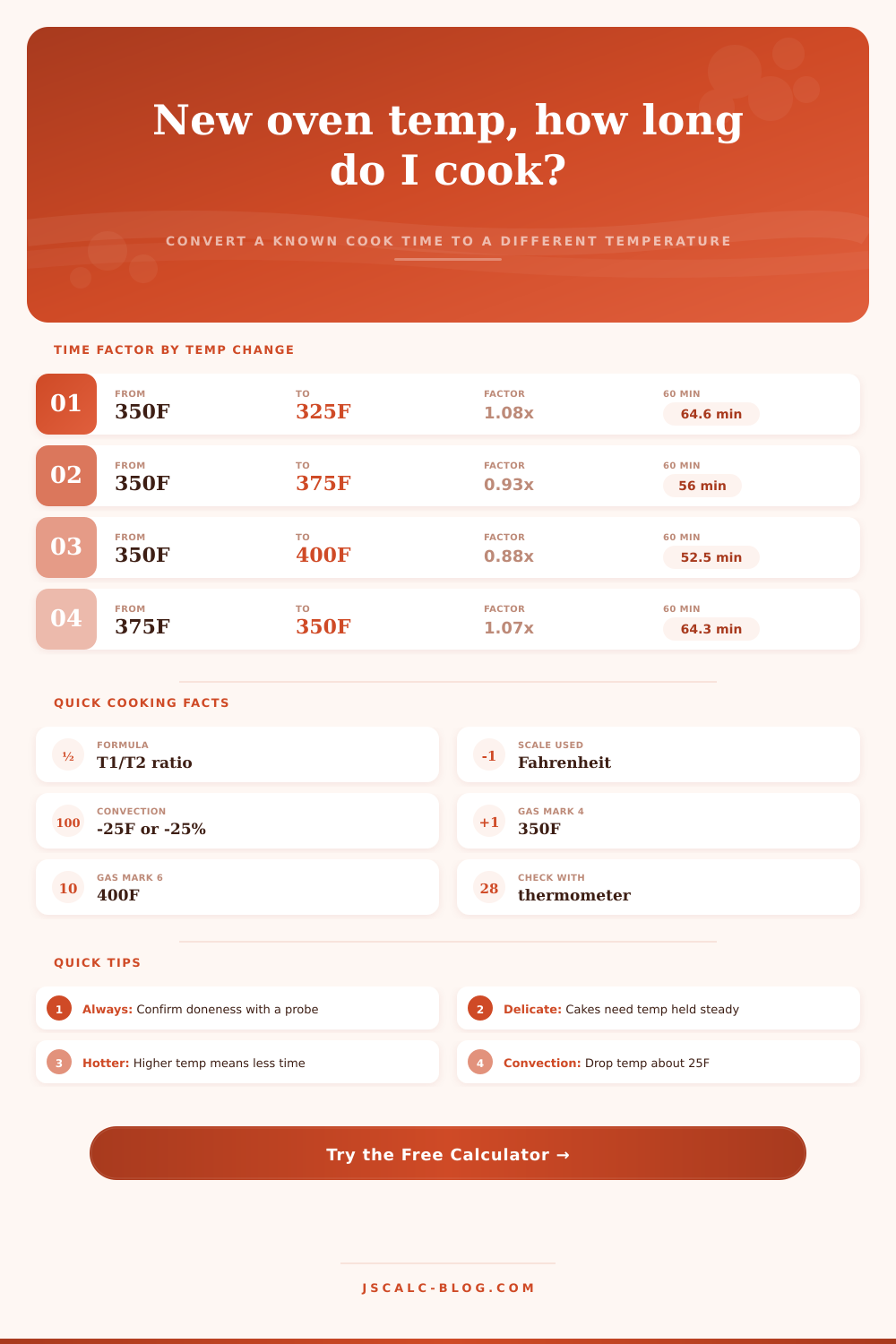
| 350 to 325°F | 1.077× | 64.6 min | Fan: set 300°F |
| 350 to 375°F | 0.933× | 56.0 min | Fan: set 350°F |
| 350 to 400°F | 0.875× | 52.5 min | Fan: set 375°F |
| 375 to 350°F | 1.071× | 64.3 min | Fan: set 325°F |
| 400 to 450°F | 0.889× | 53.3 min | Fan: set 425°F |
| Convection time cut | 0.75× | 45.0 min | Or drop temp 25°F |
⚙Full Formula Breakdown
📋How Inputs Are Used
| Input | Common Entry | Role In Formula | Effect On Result |
|---|---|---|---|
| Original temp | 325 to 450°F | Numerator T1 | Higher T1 lengthens new time |
| New temp | 325 to 450°F | Denominator T2 | Higher T2 shortens new time |
| Original time | 15 to 240 min | Base multiplier | Scales the whole result |
| Unit | °F or °C | Sets conversion | °C is changed to °F first |
| Convection | Temp or time | Fan adjustment | Lowers temp or cuts ~25% |
| Weight | 0 to 20 lb | Per-pound check | Shows minutes per pound |
💡Practical Cooking Tips
The recipe says 60 minutes at 350 degrees Fahrenheit, but your personal thermostat have other plans: Maybe you want a faster dinner because the kids are hungry or maybe you prefer a slower cook to keep meat tender. That’s why the calculator above isn’t just a piece of math. It’s a bridge from stiff directions to flexible reality, the difference between what you know works at a particular temp and what will work if you change temperature.
It doesn’t make you do the math; it does heavy lifting. But simply uses a basic ratio to convert your known cooking time for any desired temperature. That’s the basic math: cooking is just applied physics. Energy can moves into or through something via conduction and convection, meaning higher temperatures transfer energy faster. The hotter something is, the more quickly that will happen.
Why Temperature Changes Cooking Time
So what the tool does is take the raw cook time, then adjust for how much hotter (or colder) you want to go based off the proportion of the old temp to the new. So if you want to bake forty degrees warmer, it adjusts down the clock by that factor.
But the catch: it isn’t a direct ratio; it’s proportional, so while you’ll typically end up with fewer minutes for any amount overheat, a smaller change (say, two-and-a-half times as hot) won’t make quite as big an impact on most foods (a few degrees less will shorten your cake baking time by maybe five minutes, whereas a 25 degree swing will really knock off like fifteen from a roast). Why? Because heat moves different inside certain kinds of food than others, and also because baked structure is somewhat distinct. That’s why the accuracy of the output depend on your choice of foods in the inputs.
For example, casseroles and roasts are forgiving dishes whose structure accommodates swapping temperatures. A beef roast shifted from 350 to 400 degrees yields a decent guess from the calculator. On the other hand, custards and soufflés (delicate bakes) depends heavily on certain threshold heats to harden into shape. Adjusting heat here usually means ruining texture before they’re done cooking. Relying blindly on the ratio rule; which works well for meats but is dangerous with airy batters, highlights how sensitive these recipes are: you get what you pay for in terms of precision.
But with convection, everything changes. The moving air removes that insulating layer of air from the outside of your food. Therefore, you have the option to adjust downward either 25 percent (time) or 25 degrees (temperature). Both will reach the same end; one just impacts the outer surface more than other. Shortening the time can lead to drying out skin without warming up core. Dropping the temperature maintains moisture while maintaining crispness. It is a question of timing versus texture.
And the thing about both is that most home cooks feel more comfortablely adjusting downward in terms of temperature, which gives them some wiggle room. In the end it’s all about doneness, whatever the time may say. The calculator gives you an approximate starting point, not a finishing line. Cuts, fat amounts, and starting conditions all change interior temperature. A roast that was defrosted will behave differently than one that started out still frozen, even under identical oven heat levels. This is why we suggest pulling out your probe thermometer in bold type on the results page. The timer is only a guide; the internal temperature is the law. Pulling it out 10 minutes early prevents overcooking, which is far easier to prevent than to fix.
But once you understand those variables, cooking starts feeling like decision-making, not taking orders. Oh, I see, the oven is hot so it will brown things fast, but not cook them deeper inside every inch. And oh, yes, slow roasting works because gentle heat break down connective tissues slowly. This allows the fat to melt away without toughening up meat. With this tool in hand, you can instantly see how many more or fewer minutes you gain or lose with each choice. You can also see exactly how much real time those trade-offs give you control over. Heat becomes less of an abstract concept, and more of something concrete that you can manage.
In the end, there is no better way to gain confidence in the kitchen than to know not just what to do, but why you are doing it. Understanding that time and temperature have an inverse relationship (within reason) frees you to deviate from recipes without fear. Adjusting for your own mood, schedule, or quirkiness with your oven suddenly becomes second nature. Use the calculator above to get a base line like this. Then you can dial things in quickly by relying on your senses and a thermometer to get it right. It’s a mix of math and intuition that makes a good cook from someone who knows how to get by.