Steak Cooking Time Calculator
Estimate minutes per side, total cook time, target internal temperature, and rest time from steak thickness, cut, doneness, cooking method, and starting temperature. Always confirm with an instant-read thermometer.
🥩Real Steak Presets
📝Steak Details
Measure the thickest part of the steak, not the width.
Per-side time stays the same; total pan/grill batches scale up.
🌡Doneness Temperature Guide
📋Doneness → Internal Temperature
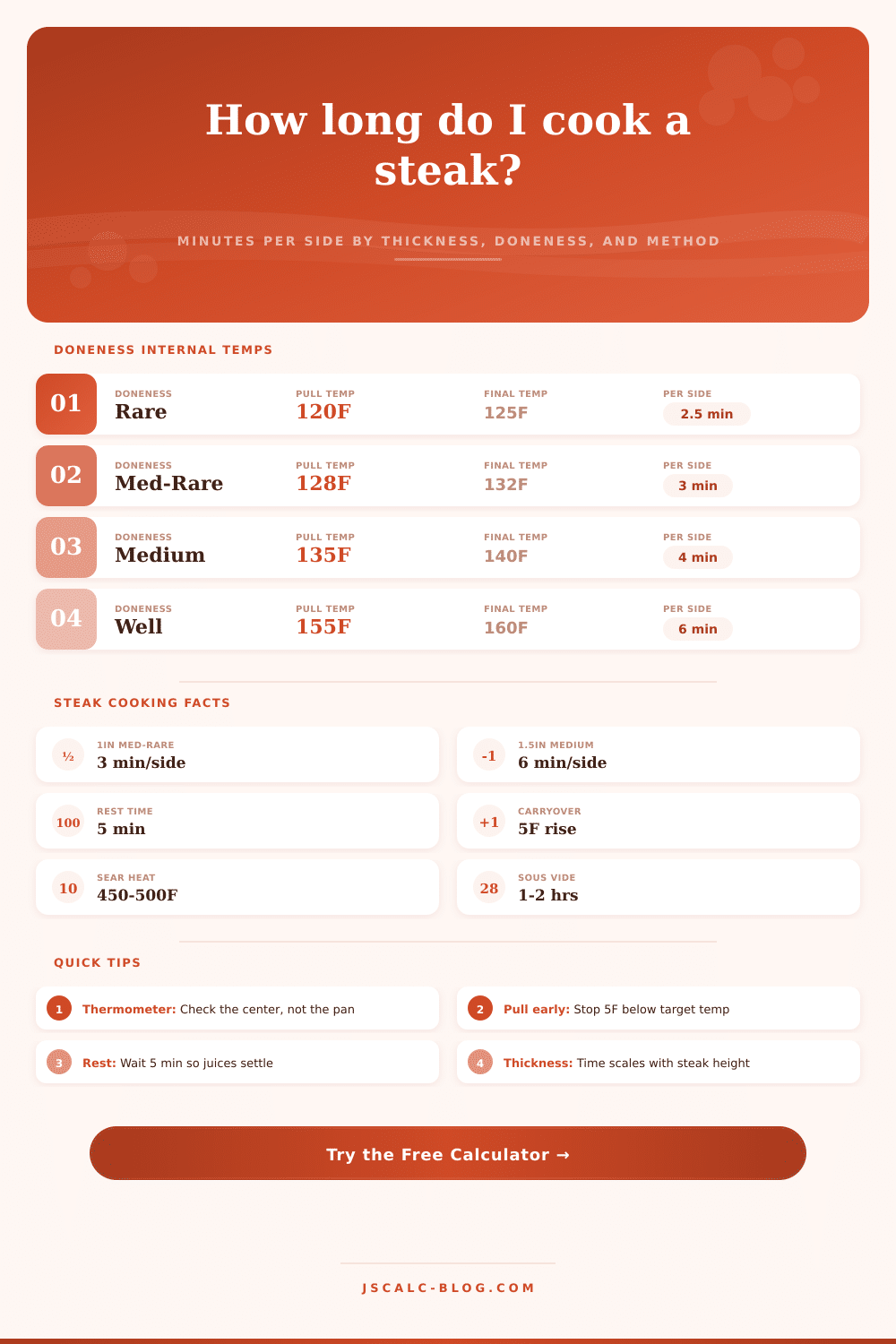
| Doneness | Final Temp °F | Final Temp °C | Pull Temp °F | Center Color |
|---|---|---|---|---|
| Rare | 125°F | 52°C | 120°F | Cool red center |
| Medium-rare | 130–135°F | 54–57°C | 128°F | Warm red center |
| Medium | 140°F | 60°C | 135°F | Warm pink center |
| Medium-well | 150°F | 66°C | 145°F | Slightly pink |
| Well done | 160°F | 71°C | 155°F | Little to no pink |
⏱Minutes Per Side by Thickness
| Doneness | 0.75 in | 1 in | 1.5 in | 2 in |
|---|---|---|---|---|
| Rare | 1.9 min | 2.5 min | 3.8 min | 5.0 min |
| Medium-rare | 2.3 min | 3.0 min | 4.5 min | 6.0 min |
| Medium | 3.0 min | 4.0 min | 6.0 min | 8.0 min |
| Medium-well | 3.8 min | 5.0 min | 7.5 min | 10.0 min |
| Well done | 4.5 min | 6.0 min | 9.0 min | 12.0 min |
Times assume a searing-hot grill or pan (about 450–500°F). Per-side time ≈ base(doneness) × thickness in inches.
🔥Method Comparison
| Method | Heat Style | Time Factor | Best For | Sear Finish |
|---|---|---|---|---|
| Grill | Direct high heat | 1.0× | 1–1.5 in steaks | On the grates |
| Pan-sear | Cast iron, high | 1.0× | Even crust indoors | In the pan |
| Broil | Top element | 1.1× | Thin cuts, flank | Under broiler |
| Reverse sear | Low oven, then sear | Low + short | 1.5 in and thicker | Quick hot sear |
| Sous vide | Water bath, then sear | Bath by thickness | Edge-to-edge even | Fast finishing sear |
🥩Cut Characteristics
| Cut | Marbling | Tenderness | Typical Thickness | Best Doneness |
|---|---|---|---|---|
| Ribeye | High | Very tender | 1–1.5 in | Medium-rare |
| New York strip | Moderate | Tender | 1–1.25 in | Medium-rare |
| Filet mignon | Low | Most tender | 1.5–2 in | Rare to medium |
| Top sirloin | Low | Fairly tender | 0.75–1 in | Medium-rare |
| Flank / skirt | Lean | Chewy, grainy | 0.5–0.75 in | Medium-rare |
| T-bone | Mixed | Tender + firm | 1–1.5 in | Medium-rare |
📊Doneness Comparison Grid
| Doneness | Internal Temp | Per Side 1 in | Per Side 1.5 in | Total 1 in | Rest Time |
|---|---|---|---|---|---|
| Rare | 125°F | 2.5 min | 3.8 min | ~10 min | 5 min |
| Medium-rare | 132°F | 3.0 min | 4.5 min | ~11 min | 5 min |
| Medium | 140°F | 4.0 min | 6.0 min | ~13 min | 5 min |
| Medium-well | 150°F | 5.0 min | 7.5 min | ~15 min | 5 min |
| Well done | 160°F | 6.0 min | 9.0 min | ~17 min | 6 min |
Total = 2 × per-side time + rest, shown for a fridge-cold 1-inch steak on grill or pan.
⚙How The Time Is Calculated
💡Steak Cooking Tips
There comes a time in every cook’s career when you realize that visual clues is no longer reliable. Sometimes a steak can be seared to perfection only to have it red in the center; another could appear medium rare, but be tough as nails. Patience is generally the key, and thickness. Rushing one is a sure way to ruin a perfectly good piece of meat, while most home cooks don’t pay attention to other.
The secret is understanding physics of heat conduction, how heat conducts through meats. There’s no magic here. It is physics. How fast that happens all depends off the distance the heat has to travel. How fast? That all depends upon the distance the heat have to travel. In a half-inch strip steak, the heat gets to the interior rapidy. That’s why they’re ready in minutes. With a two-inch ribeye, the outside starts cooking before the middle do, leaving the center cold until long after the outer surfaces reach temperature. Cooking them both with the same timer results in one being overdone while the other is rare.
How to Cook Steak Perfectly
The time calculator, above, removes any guessing from equation. By adjusting the cooking time based solely on physical height of the cut, it scales timing accordingly. All you have to do is measure thickness of your own steak. The mistake everyone makes is with that thickness measurement. You see a flat, wide slab of meat that slides right into pan and conclude it’s a thin cut. But the width doesn’t matter. The vertical distance heat has to pass through determine cooking time. If you’ve got a two-inch thick tomahawk ribeye anywhere on steak, that entire steak require enough cook time for the heat to reach through those two inches. That means measuring the thickest spot so you don’t yank it out too soon and end up with a cold middle. It sounds like a small detail but it’s far more important then any seasoning you apply.
But you also need to think about cut of meat itself. Filet mignons is going to be fine with a gentler touch because they’re pretty lean. There’s not much fat to render, which will keep them tender. Ribeyes, on the other hand, are loaded with marbling, which has two benefits: first, it helps insulate those muscle fibers from heat; second, it adds flavor when it melts during cooking. That’s where the blanket “five-minute-cooking-time” directive falls short. Because there isn’t as much insulation from the heat (less fat), a leaner cut will overcook in fewer minutes than a fattier one at the same temperature. Thin steaks cook faster and more evenly when grilled, whereas thicker steaks is better pan-seared so you can control the heat.
Now we get into what’s known as carryover cooking, big problem for well-meaning home cooks. Meat doesn’t stop cooking the second it comes off of the heat source. There’s a bunch of residual heat in there (especially at the edges), which continues to migrate inward, causing the temperature to rise another couple degrees or so. So if you leave the steak on the grill and let it cook all the way up to whatever’s your desired final temperature according to the thermometer, then you’ll have a well-done steak by dinnertime. Pull it earlier. Letting it go a few degrees shy gives extra heat enough time to do its thing during rest.
It’s not just good advice: resting is structural. Muscles are made up of fibers that contract when they is cooked. Cut open a steak right away and the juices will ooze out onto your plate, leaving you with nothing but dry meat. Allow the steak to rest for five or ten minutes and its muscles will relax and absorb some of their lost liquids. Resting takes nearly as long as cooking. It feels like a waste of time…until you put that steak in your mouth. A rested steak is juicy. An un-rested steak becomes sawdust.
So how do we do all this? We use this tool on the site. It’s not rocket science. It accounts for several variables, like starting temp, type of cooking method, and desired end result, to give you a reasonabel timeline. What I like most about it though is that it takes away the guesswork. You won’t have to wonder if it’s time to flip or time to remove it from heat. You’ve got a plan. And when you’ve got a plan, then maybe you can take time out to enjoy the sizzle and not stare at your watch. Because really, that’s what it’s all about, letting physics do its thing while you do yours: eat.