Steroid Half-Life Calculator
Compare anabolic ester half-lives, first-order decay, accumulation ratio, steady-state peak and trough, and active life so you can understand injection scheduling. Educational modeling only.
🎯Real Ester Presets
📝Compound & Schedule Inputs
Auto-filled by the selector; edit for a custom compound.
EOD = 2, E3D = 3, weekly = 7. For orals use fractions of a day.
Level is treated as cleared once it drops below this share of the peak.
🔢Formula Snapshot
🧪Injectable Ester Half-Life Library
| Compound | Ester | Half-Life | Rate k /day | Typical Interval |
|---|---|---|---|---|
| Testosterone | Propionate | 0.8 days | 0.866 | Every other day |
| Testosterone | Phenylpropionate | 1.5 days | 0.462 | Every 2–3 days |
| Testosterone | Isocaproate | 4 days | 0.173 | Twice weekly |
| Testosterone | Enanthate | 4.5 days | 0.154 | Weekly or E3.5D |
| Testosterone | Cypionate | 5 days | 0.139 | Weekly or E3.5D |
| Testosterone | Decanoate | 7.5 days | 0.092 | Weekly |
| Testosterone | Undecanoate | 20.9 days | 0.033 | Every 8–10 weeks |
| Trenbolone | Acetate | 1 day | 0.693 | Every other day |
| Trenbolone | Enanthate | 4.5 days | 0.154 | Weekly or E3.5D |
| Nandrolone | Decanoate | 7 days | 0.099 | Weekly |
| Nandrolone | Phenylpropionate | 1.5 days | 0.462 | Every 2–3 days |
| Boldenone | Undecylenate | 14 days | 0.050 | Weekly (large volume) |
💊Oral Steroid Half-Life Library
| Oral Compound | Common Name | Half-Life | Rate k /hr | Dosing Note |
|---|---|---|---|---|
| Methandienone | Dianabol | 4.5 hours | 0.154 | Often split through day |
| Oxymetholone | Anadrol | 8 hours | 0.087 | Once or twice daily |
| Stanozolol | Winstrol | 9 hours | 0.077 | Once or twice daily |
| Oxandrolone | Anavar | 9 hours | 0.077 | Once or twice daily |
🗂Ester Comparison Grid
| Ester | Half-Life | Weekly R (τ=7) | Steady State | Active Life (10%) | Clear Class |
|---|---|---|---|---|---|
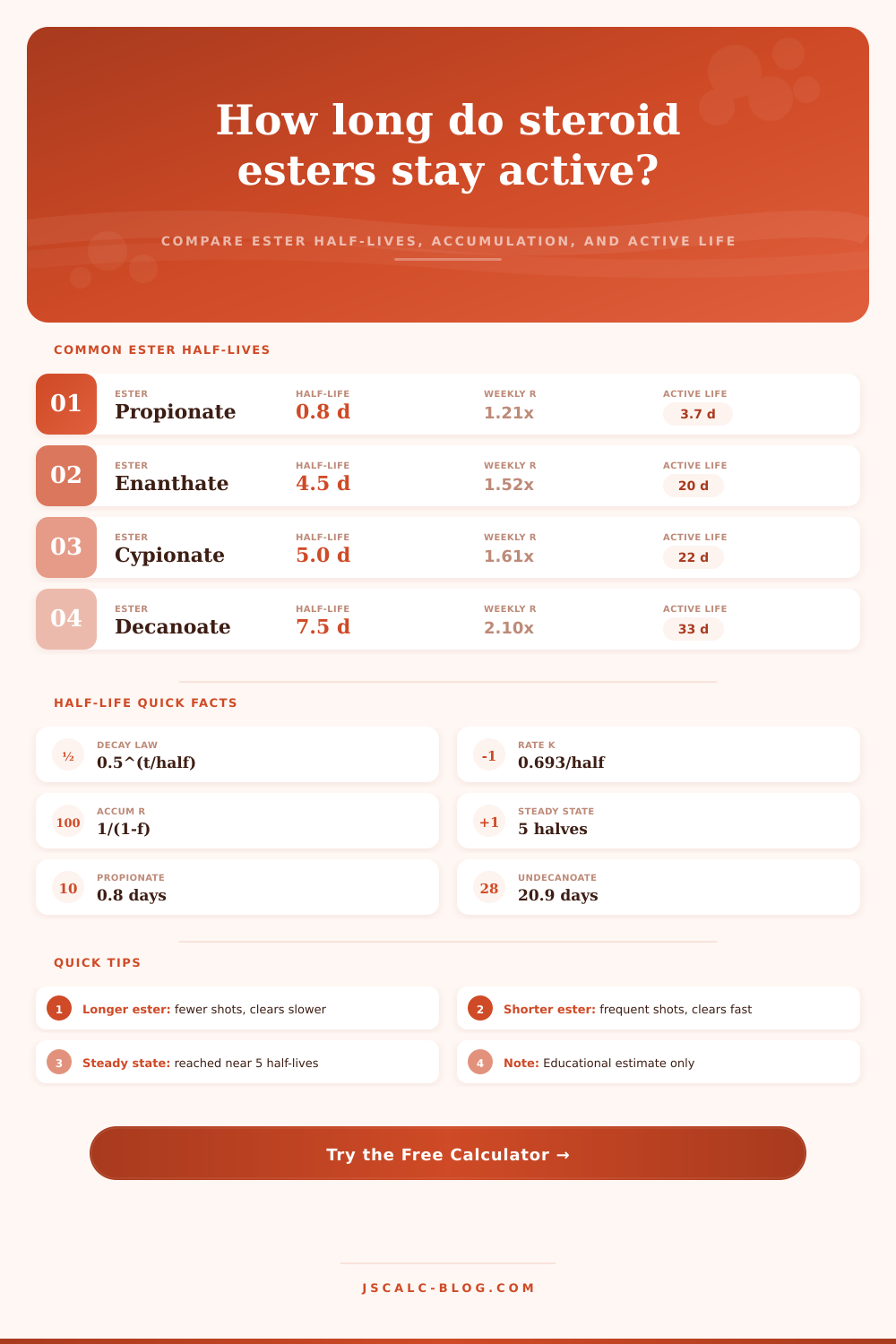
| Test propionate | 0.8 d | 1.21x | 4.0 d | 2.7 d | Very fast |
| Test phenylprop | 1.5 d | 1.28x | 7.5 d | 5.0 d | Fast |
| Nandrolone PP | 1.5 d | 1.28x | 7.5 d | 5.0 d | Fast |
| Test enanthate | 4.5 d | 1.52x | 22.5 d | 15.0 d | Medium |
| Test cypionate | 5.0 d | 1.61x | 25.0 d | 16.6 d | Medium |
| Nandrolone deca | 7.0 d | 2.02x | 35.0 d | 23.3 d | Slow |
| Test decanoate | 7.5 d | 2.10x | 37.5 d | 24.9 d | Slow |
| Boldenone undec | 14 d | 4.15x | 70.0 d | 46.5 d | Very slow |
| Test undecanoate | 20.9 d | 5.86x | 104.5 d | 69.4 d | Ultra slow |
📈Accumulation Ratio vs Interval
| Interval / Half-Life (τ/t½) | Fraction Left (f) | Accumulation R | Meaning |
|---|---|---|---|
| 0.25 | 0.841 | 6.29x | Very frequent, high buildup |
| 0.5 | 0.707 | 3.41x | Frequent dosing |
| 1.0 | 0.500 | 2.00x | Dose each half-life |
| 1.5 | 0.354 | 1.55x | Enanthate weekly zone |
| 2.0 | 0.250 | 1.33x | Spaced dosing |
| 3.0 | 0.125 | 1.14x | Little accumulation |
| 4.0 | 0.063 | 1.07x | Near-independent doses |
⚙Full Formula Breakdown
📋Active Life By Ester (Single Dose)
| Ester | To 50% (1 half) | To 20% Peak | To 10% Peak | To 5% Peak |
|---|---|---|---|---|
| Propionate 0.8 d | 0.8 d | 1.9 d | 2.7 d | 3.5 d |
| Tren acetate 1 d | 1.0 d | 2.3 d | 3.3 d | 4.3 d |
| Phenylprop 1.5 d | 1.5 d | 3.5 d | 5.0 d | 6.5 d |
| Enanthate 4.5 d | 4.5 d | 10.5 d | 15.0 d | 19.5 d |
| Cypionate 5 d | 5.0 d | 11.6 d | 16.6 d | 21.6 d |
| Deca 7 d | 7.0 d | 16.3 d | 23.3 d | 30.3 d |
| Boldenone 14 d | 14.0 d | 32.5 d | 46.5 d | 60.5 d |
| Undecanoate 20.9 d | 20.9 d | 48.5 d | 69.4 d | 90.3 d |
💡Ester Timing Notes
When most folks consider steroids, they’re considering overall mass. How much do I need? But what’s realy running your daily life is typically which ester is attached to that molecule. What does it release into my bloodstream? How quickly? And then, once off cycle, how long will it hang around? How often must I inject? When can I get back on track and end the post-cycle hell?
Get that wrong, and you’ll be bouncing like a pinball between wild hormonal fluctuations. Or, you’ll be stuck waiting out a week, or even multiple weeks, while trying to get something out of your system so you can move on.
How Steroid Esters Work for Your Cycle
This tool calculates those for you, as shown in the calculator above. It spits out useful information about how long it takes to get levels up (the peak) and how long it stays there (trough). No more eyeballing decay curves. Just pick your ester from the dropdown. You can also enter your own if you’re dealing with a hard-to-find compound.
It’ll tell you exactly how much higher your levels will climb then after just one shot (the accumulation ratio). That’s important because it shows you how potent you’ll be at any given moment. A drug like undecanoate will accumulate heavily and last for months; a short-ester like propionate clears fast but needs multiple shots.
Most people get tripped up by the idea of a steady state. After injecting multiple times, the following dose hits before the body has had time to get rid of all the last dose. This leads to accumulation of the drug. Because the body clears drugs in a process called first order decay, the calculator reflects that with each additional injection. You can see how after about five half lives, your peaks and troughs level off and no longer increase. Depending on which drug you take, this could mean several days or even weeks.
Short ester compounds respond faster if you want instant gratification, but require closer adherence to dosing schedule. Long esters is stable and will reward patience if you stick with them.
Understanding the active life metric is just as critical for planning your cycle length and post-cycle recovery. The tool defines this as “the amount of time it would take for a single dose to reach 10% of its initial value.” In other words, it tells you how long it will be before that dose becomes biologically unimportant. It becomes too small to matter for what you are trying to achieve. It’s not a matter of how long until the drug goes to zero; technically it doesn’t ever go to zero during an exponential decay.
Simple math models don’t account for real world factors. For example: injection location. Blood flow in muscle tissue affects how fast things gets absorbed. Storage of certain lipophilic compounds in body fat changes their delivery pattern. There’s just no way around it; each person metabolizes differently, adding a bit of noise to the data set. Bloodwork is still king when you need confirmation. Math modeling helps schedule and estimate, but biology gets the last word.
Think in terms of control vs. It is about convenience. With short esters, you can dial in exactly how much hormone is in your system. Want to tweak your response? No problem. Change your dose every day, every other day…fine tune it.
Long esters even out the highs and lows. You don’t have to inject as often. But you’re also stuck in a more long-term commitment. Need to back off due to side-effects? Too bad, you can’t just stop injecting and wait for them to dissapear within hours/days. It’ll be coming out of your arm for days/weeks.
That means a lot when you’re planning your PCT around it. You can’t begin recovery until the compound clears enough to no longer be interfering with natural production taking over again. Overlapping a fast starting recovery protocol with a long clearing compound is a recipe for suppression and non-existent rebounds. That’s all spelled out nicely on the reference table that comes with the tool; compare what happens with an acetate versus something like cypionate, an ester.
So ultimately, it’s all personal preference between esters. What can you tolerate in terms of needles? How flexible do you need to be? There isn’t one that’s better than another. It’s simply based on what you like, how sensitive you are to changes, and if you just want out of there after you’re finished. But the math is still the same either way.
Ultimately, choosing an ester is a choice between needle frequency and flexibility; half life determines release, accumulation determines peak, and clearance determines recovery. When you understand those three pillars, you take the guessing game out of planning. Stop feeling like you have to react to symptoms and start planning for outcomes. It’s not about perfecting models, but understanding expectations.
Knowing how long the compound lasts shows you it is active, so you can respect its presence. You anticipate its ester. You plan your cycle duration. You support your protocol and recover from the compound accordingly. This forethought makes what could be a chaotic mess into a well-structured process. The ester sets the clock, learn to read it prior to injecting.