Alcohol Half Life Calculator
Estimate time to sober, time to the 0.08 legal limit, and your current blood alcohol content. Alcohol does not have a true half-life – it clears at a nearly constant rate, so this uses honest zero-order math.
🍺Real Scenario Presets
📝Your Inputs
Used in known-BAC mode. 0.08 is the common legal driving limit.
1 standard drink = 14 g ethanol (12 oz beer, 5 oz wine, 1.5 oz spirits).
Elapsed drinking time. Elimination is subtracted from peak in Widmark mode.
Typical 0.012 to 0.020. Higher for regular drinkers, lower for occasional.
Custom threshold, e.g. 0.08 legal limit or 0.02 zero-tolerance.
🧮Formula Snapshot
⚖Full Formula Breakdown
📊Sober Time By Starting BAC
| Starting BAC | To 0.08 @ 0.015 | To 0.00 @ 0.012 | To 0.00 @ 0.015 | To 0.00 @ 0.018 | Impairment Zone |
|---|---|---|---|---|---|
| 0.04 | Already legal | 3.3 h | 2.7 h | 2.2 h | Mild, buzzed |
| 0.08 | 0.0 h | 6.7 h | 5.3 h | 4.4 h | Legal limit |
| 0.10 | 1.3 h | 8.3 h | 6.7 h | 5.6 h | Over limit |
| 0.12 | 2.7 h | 10.0 h | 8.0 h | 6.7 h | Clearly impaired |
| 0.15 | 4.7 h | 12.5 h | 10.0 h | 8.3 h | Gross impairment |
| 0.16 | 5.3 h | 13.3 h | 10.7 h | 8.9 h | Gross impairment |
| 0.20 | 8.0 h | 16.7 h | 13.3 h | 11.1 h | Severe, stupor |
| 0.25 | 11.3 h | 20.8 h | 16.7 h | 13.9 h | Danger zone |
| 0.30 | 14.7 h | 25.0 h | 20.0 h | 16.7 h | Life threatening |
🥃Standard Drink Sizes
| Beverage | Serving Size | Typical ABV | Ethanol |
|---|---|---|---|
| Regular beer | 12 oz / 355 ml | 5% | ~14 g (1 drink) |
| Craft / strong beer | 12 oz / 355 ml | 8% | ~22 g (1.6 drinks) |
| Malt liquor | 8 to 9 oz | 7% | ~14 g (1 drink) |
| Table wine | 5 oz / 148 ml | 12% | ~14 g (1 drink) |
| Fortified wine | 3 to 4 oz | 17% | ~14 g (1 drink) |
| Distilled spirits | 1.5 oz / 44 ml | 40% | ~14 g (1 drink) |
| Large cocktail | 3 oz spirits | 40% | ~28 g (2 drinks) |
⏱Elimination Rate Ranges
| Drinker Profile | β (BAC%/hr) | Grams/hour | Notes |
|---|---|---|---|
| Occasional / light | 0.012 to 0.014 | ~6 to 7 g | Slower enzyme activity |
| Average adult | 0.015 | ~7 g | Common default value |
| Regular drinker | 0.017 to 0.020 | ~8 to 10 g | Enzyme upregulation |
| Heavy / tolerant | 0.020 to 0.025 | ~10 to 12 g | Not a safety license |
| Fasted state | Lower | Reduced | Food slows absorption, not clearance |
🚦BAC Effect Levels
| BAC Range | Common Label | Typical Effects | Driving |
|---|---|---|---|
| 0.00 to 0.03 | Sober to subtle | Little visible effect | Generally legal |
| 0.04 to 0.06 | Buzzed | Relaxed, warmth, minor impairment | Impaired reactions |
| 0.07 to 0.09 | At the limit | Balance, speech, judgment slip | Illegal at 0.08 |
| 0.10 to 0.15 | Clearly impaired | Slurred speech, poor coordination | Never drive |
| 0.16 to 0.24 | Gross impairment | Nausea, disorientation | Never drive |
| 0.25 and up | Severe | Stupor, risk of blackout or worse | Medical concern |
💡Practical Alcohol Tips
If you’ve ever been out drinking with friends, then chances are you’re familiar with the scene: It’s the end of the night and it’s time for everyone to go home. One person say they need a ride, you think you could probably talk yourself into driving, but you’re unsure if it would be a good idea.
While many turn to ice-cold showers and jolts of caffeine in hopes to sober up quicker, those aren’t viable options. Why? Because alcohol doesn’t come out of your system like ibuprofen or caffeine. There are certain rules and they don’t involve rushing it.
How Long Does It Take to Sober Up?
Confusion arises from this: Why do we metabolize alcohol different? Most drugs is removed by first-order patterns, they’re cleared in proportion to their concentration; a certain percentage comes out each hour. Alcohol behaves differently. When you drink socialy (as opposed to bingeing), the amount of alcohol is high enough that liver enzymes hits their limit and operate at full speed all the time. This is known as zero-order kinetics.
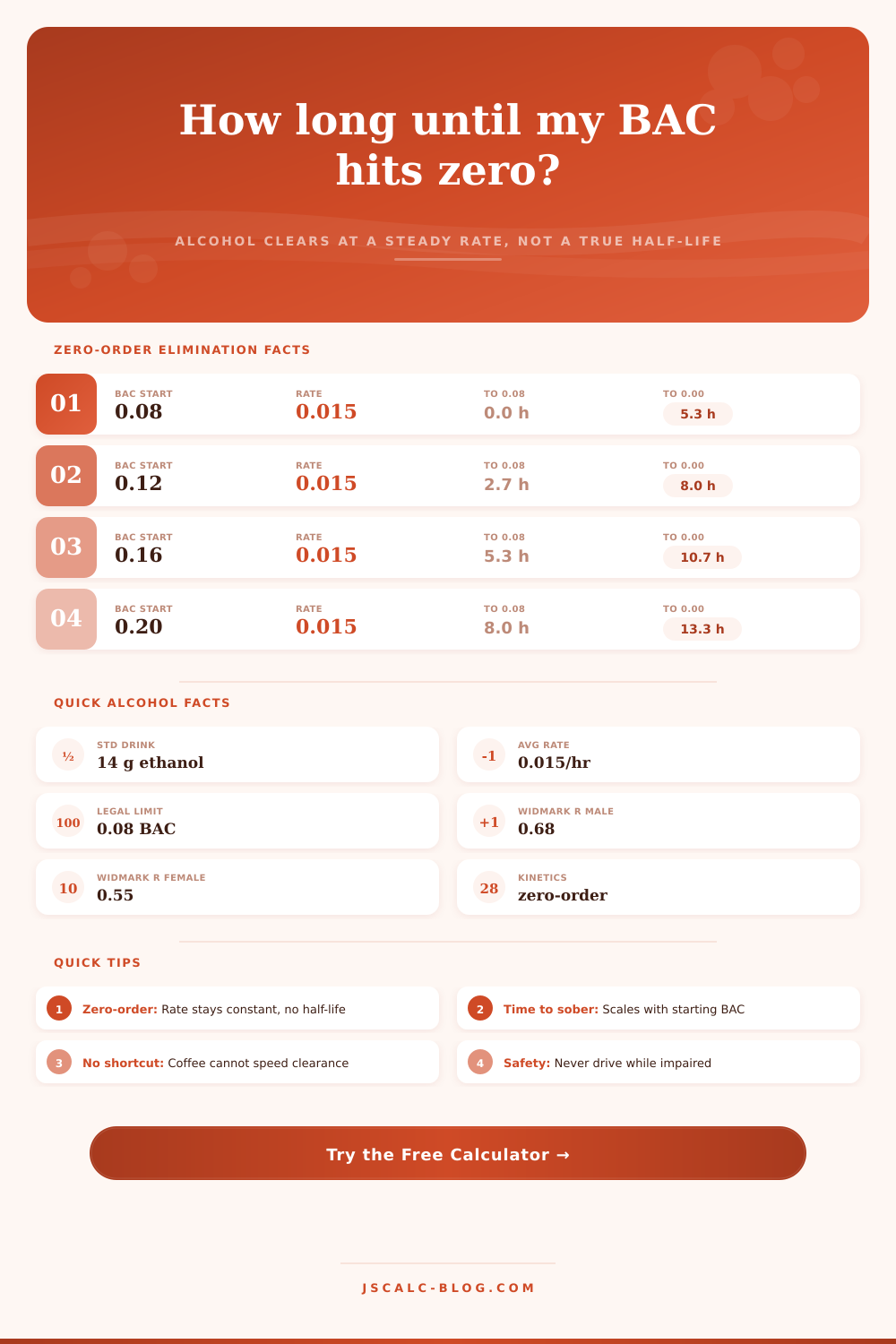
This results in a roughly-constant rate of removal (for most people, about 0.015 percent BAC/hour). It’s not a fast-draining glass of water but more like a slow leaky faucet. So if you begin with double the legal limit, it’ll take approximately double the time to sober up then someone who begins right at the limit. There’s no magical “oh, now I’m sober” threshold; your body doesn’t magically increase the rate it clears alcohol.
That’s where the calculator comes in. By taking out the guessing game, it does the linear math for you. Rather than going by what you think feels right (which isn’t always accurate), the calculator relies on proven pharmacological equations that tell you at what point you’ll have an estimated BAC lower than whatever you set as your marker. It asks for things such as your weight, gender and amount of drinks had, standard drink, mind you.
From there, it uses the Widmark formula to calculate your peak BAC by accounting for the way different bodies distribute water and then takes away the steady elimination rate per hour after your initial sip. It’s certainly not a precise science, but at least it’s an honest one.
It’s important to understand what goes into the equation rather than just pressing the button. Because there is less total body water in women compared to similarly sized men, their biological sex change the distribution factor. In other words, the same quantity of alcohol will be concentrated at a higher level in a woman’s blood stream. There is also the matter of weight, although not quite so dramatically as most people believe. Just because someone is heavy doesn’t mean that they are sobering up quicker, it’s simply that they began with a lower amount to start with. Also, everyone gets sober at roughly the same rate on elimination clock.
The page has some handy reference tables, showing the waiting period for different BAC levels. As you’ll see, this shows just why advance planning isn’t optional. The table shows that if you’re at 0.12 percent (generally considered the point where people start showing signs of being impaired, slurring their words), it’s going to take roughly eight hours to get down to zero.
You can try to eat greasy food, drink water, etc., to speed things up, but no. That will slow the absorption of alcohol but doesn’t help when the alcohol is already in your blood. Time is realy all that helps then. As much as we like to think that it’s all math, real world variables gets in the way.
Your metabolism is determined by genetics: some of us use these enzymes more efficient than others. We’re on average at.015 percent per hour, but some will be fractionally above or below that number. Liver function also gets thrown off by things like stress, fatigue, and even medications you take. So this calculated time is a best case scenario estimate, it’s never a guarantee. It should of been the floor, not the ceiling.
And that’s why it’s important to acknowledge that uncertainty, because safety is about being smart with that unknown. If there’s even a question in your mind: don’t get behind the wheel. Yes, 0.09 may seem like an insignificant jump from 0.08, but by the time you reach that number, you’re already significantly impaired. In fact, your body starts getting impaired with the very first sip.
By mapping out your ride before your first drink, you’ll take away the guessing game of “Am I good to go?” Don’t trust your mirror; trust the clock. When you’re done for the evening, all that really matters is that reliable and unchanging pace.