Coffee Half Life Calculator
Estimate how much caffeine from your coffee is still in your body, when it falls below a sleep-safe level, and when it clears to near zero using first-order half-life decay.
☕Real Coffee & Caffeine Presets
📝Caffeine & Timing Inputs
How many of the selected drink you had.
Used when drink type is set to Custom.
Average adult is about 5 hours (range 3–7).
Many aim for under 50 mg (or 100 mg) before bed.
Level treated as effectively cleared.
🔢Half-Life Formula Snapshot
📉Caffeine Decay Over Time
| Hours Since | Half-Lives | % Left | Your Dose |
|---|---|---|---|
| Enter values above to see your caffeine decay curve. | |||
☕Caffeine By Drink
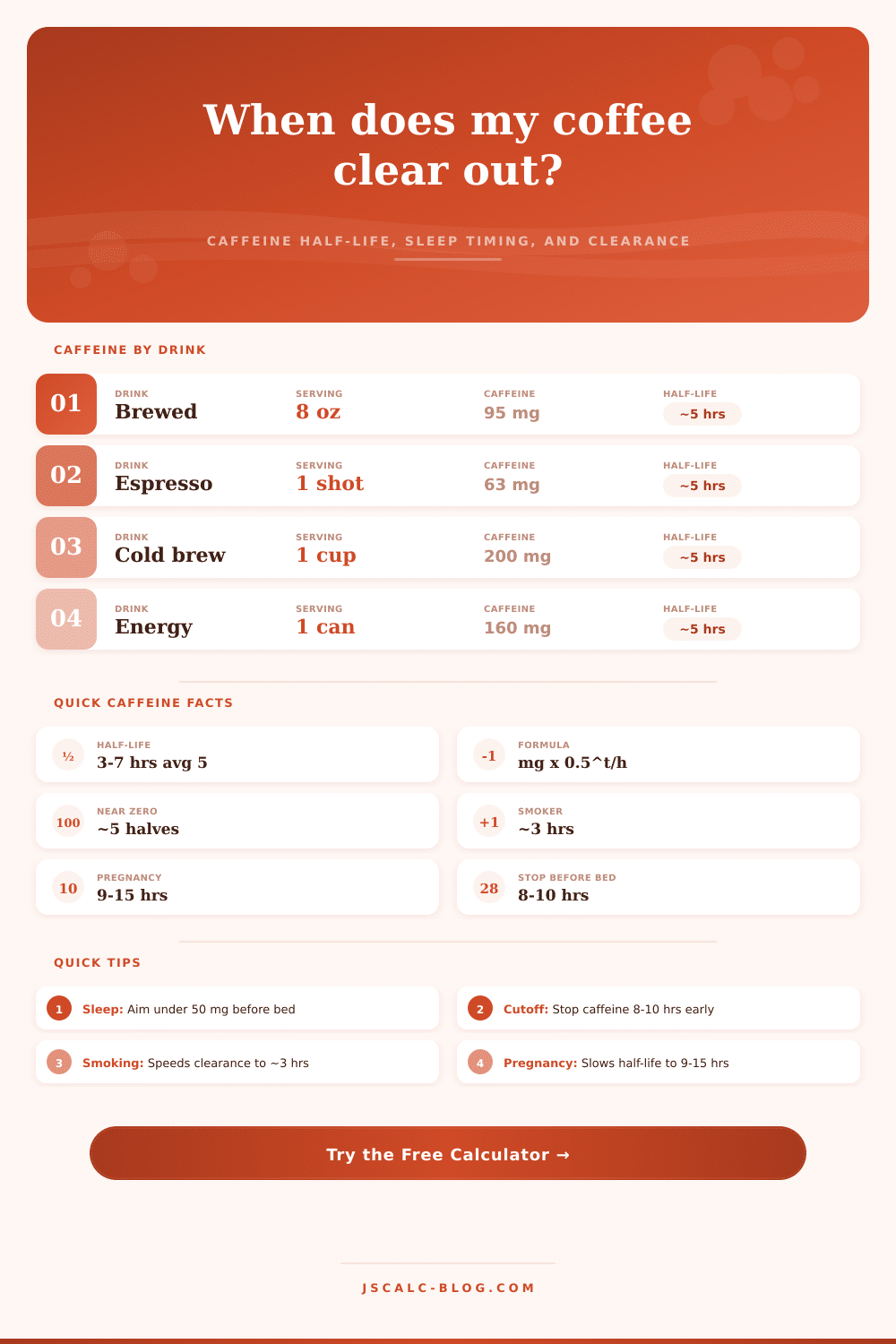
| Drink | Serving Size | Typical Caffeine | Notes |
|---|---|---|---|
| Brewed coffee | 8 oz | ~95 mg | Standard drip cup baseline |
| Espresso | 1 shot (1 oz) | ~63 mg | Concentrated, small volume |
| Drip mug | 12 oz | ~150 mg | Large travel-mug pour |
| Cold brew | 1 cup (12 oz) | ~200 mg | Long steep, high strength |
| Instant coffee | 8 oz | ~120 mg | Varies by scoop amount |
| Energy drink | 1 can (8–16 oz) | ~160 mg | Often plus added stimulants |
| Black tea | 8 oz | ~47 mg | Lower than most coffee |
🧬Half-Life By Metabolism Factor
| Factor | Effect | Half-Life | ~5 Half-Lives |
|---|---|---|---|
| Smoker | Speeds clearance | ~3 hrs | ~15 hrs |
| Heavy caffeine habit | Slightly faster | ~4 hrs | ~20 hrs |
| Average adult | Baseline | ~5 hrs | ~25 hrs |
| Older adult | Slightly slower | ~6 hrs | ~30 hrs |
| Oral contraceptives | Slows clearance | ~7–10 hrs | ~35–50 hrs |
| Pregnancy (late) | Much slower | ~9–15 hrs | ~45–75 hrs |
📊Dose Comparison Grid (mg Remaining)
| Hours Since | Half-Lives | % Left | 95 mg Cup | 160 mg Energy | 200 mg Cold Brew |
|---|---|---|---|---|---|
| 0 h | 0.0 | 100% | 95 mg | 160 mg | 200 mg |
| 2.5 h | 0.5 | 70.7% | 67 mg | 113 mg | 141 mg |
| 5 h | 1.0 | 50% | 48 mg | 80 mg | 100 mg |
| 7.5 h | 1.5 | 35.4% | 34 mg | 57 mg | 71 mg |
| 10 h | 2.0 | 25% | 24 mg | 40 mg | 50 mg |
| 15 h | 3.0 | 12.5% | 12 mg | 20 mg | 25 mg |
| 20 h | 4.0 | 6.25% | 6 mg | 10 mg | 13 mg |
| 25 h | 5.0 | 3.13% | 3 mg | 5 mg | 6 mg |
Based on a 5-hour half-life. Remaining mg = dose × 0.5^(hours / 5).
🌙Time-Of-Day Sleep Guidance
| Last Coffee | Hours To 11pm Bed | Of 200 mg Left | Sleep Impact |
|---|---|---|---|
| 7:00 am | 16 h | ~22 mg | Minimal, mostly cleared |
| 10:00 am | 13 h | ~33 mg | Low for most people |
| 1:00 pm | 10 h | ~50 mg | Borderline, watch closely |
| 3:00 pm | 8 h | ~66 mg | Can delay falling asleep |
| 6:00 pm | 5 h | ~100 mg | Likely disrupts sleep |
| 9:00 pm | 2 h | ~150 mg | Strong sleep interference |
⚙Full Formula Breakdown
📋Percent Remaining Per Half-Life
| Half-Lives | Hours At 5 h | % Remaining | 200 mg Example |
|---|---|---|---|
| 0 | 0 h | 100% | 200 mg |
| 1 | 5 h | 50% | 100 mg |
| 2 | 10 h | 25% | 50 mg |
| 3 | 15 h | 12.5% | 25 mg |
| 4 | 20 h | 6.25% | 12.5 mg |
| 5 | 25 h | 3.13% | 6.25 mg |
💡Practical Caffeine Tips
When it’s 3:00 PM and you glance at the clock, you cringe because bedtime feels like ages away. Maybe you woke up feeling groggy so you had another cup of coffee before lunch but now your bodys rebelling against you. No, caffeine doesn’t leave your body the instant the mug hits table. Instead, it lingers in your body and gradualy breaks down over time, known as first-order decay.
This means knowing the timeline enable you to put yourself to sleep more quickly then counting sheep while your heart pounds out of your chest. Use the calculator above to find out how long caffeine will last in your system so you know when to (and when not to) drink that morning java.
How Long Does Caffeine Stay in Your Body?
Caffeine’s half-life is roughly five hours in an average adult. Meaning one-half of the caffeine dose still lingers in your bloodstream five hours later. It do not drop to zero all at once. After another five hours, half of what is left have been cleared out. That’s why drinking coffee in afternoon is tricky. If you has a regular cup at lunchtime, you’ll be waking up to ~48mg of caffeine by 7:00 PM. And that’s enough to knock out most people sleep.
Use this calculator to find out how long it’ll take your body to shed enough for a good night’s sleep, depending on metabolism rate and your drink choice. The catch is that it’s a general rule (and the answer also depends heavily on metabolism). For example, the half-life window can be different based off your genetics, age, and lifestyle.
People who smoke metabolize caffeine more rapidly due to tobacco’s ability to speed up liver enzymes; typically lowering the half-life to just three hours. Women taking oral contraceptives or pregnant women might sees their half-life extended to as long as nine to fifteen hours. If that describes you, a morning coffee could of still be influencing your nervous system well into the following day. The tool provides these variations in tables so you can update default five-hour figure accordingly.
How long does caffeine last? Most folks greatly under-estimate this number. On average it’s about twenty-five hours. Why? Caffeine has a half-life of about five hours. That means that after each half-life, one-half of the original amount remain. Over time, most of the caffeine will have cleared.
But what does that mean for you? If you’re aiming for great sleep, quitting coffee at 4:00 PM probably isn’t going to do much (unless you give yourself several hours’ worth of “buffer”, ideally eight or even ten hours before lights out). Because it lasts so long, I wouldn’t recommend it. The chart below illustrates the caffeine decay pattern and when caffeine hits a level low enough not to disrupt sleep (often between forty and fifty milligrams for sleep-sensitive individual).
So what does this mean? Quitting cold turkey isn’t necessary. But don’t drink all day if you want to recover well. Learn the length of the tail (half-life) so you understand how long it takes for caffeine to leave your system. Then drink your coffee during correct window! Knowing both allows you to enjoy an afternoon cup of joe while preserving your recovery.
Caffeine becomes something you manage… No longer something that causes anxiety. It’s not “all or nothing.” It’s about managing based on hours, not just number of cups. The idea is to match your caffeine consumption to your bodys rate of clearing it out. When you get the numbers, the choice is easy: drink when you want to feel alert and stop when your body starts clearing it out. It’s simply applying some math to biology. But doing so transforms your evening experince.