Sleep Debt Calculator
Estimate missed sleep over a workday and weekend schedule, then compare the total debt with average nightly shortfall, percent of target met, and a practical recovery plan.
📌Schedule Presets
⚙Sleep Pattern Inputs
📊Comparison Grid
📋Sleep Debt Reference Cards
📑Sleep Debt Tables
| Age or Need Pattern | Common Target Range | Calculator Entry | Shortfall Example | Use When |
|---|---|---|---|---|
| Adult shorter sleeper | 7 to 7.5 hours | 7 or 7.5 | 6.5 actual = 0.5 to 1 hour | stable routine |
| Adult typical target | 7.5 to 8 hours | 7.5 or 8 | 6.5 actual = 1 to 1.5 hours | general tracking |
| Higher sleep need | 8.5 to 9 hours | 8.5 or 9 | 7 actual = 1.5 to 2 hours | heavy training or teen schedule |
| Recovery target | target plus 0.5 to 2 hours | extra field | 1 extra hour repays 1 hour | temporary catch-up plan |
| Consistent restriction | same gap every day | 7 similar days | 1 hour x 14 days = 14 hours | steady weekly pattern |
| Schedule Type | Workday Count | Weekend Count | Best Input Mode | What It Shows |
|---|---|---|---|---|
| Standard office week | 5 days | 2 days | Workday block first | weekday restriction plus weekend pattern |
| Four-day workweek | 4 days | 3 days | Workday block first | longer rest block effect |
| Six-day schedule | 6 days | 1 day | Workday block first | limited catch-up opportunity |
| Rotating or irregular | 5 or 6 days | 1 or 2 days | Balanced estimate | weighted average across the period |
| Same sleep every day | 7 days | 0 days | 7 similar days | single daily sleep pattern |
| Formula Step | Expression | Example | Output |
|---|---|---|---|
| Daily shortfall | target sleep - actual sleep | 8 - 6.5 | 1.5 hours |
| Workday debt | workday shortfall x workdays | 1.5 x 10 | 15 hours |
| Weekend debt | weekend shortfall x weekend days | 0 x 4 | 0 hours |
| Total debt | shortfalls + existing - credits | 15 + 2 - 1 | 16 hours |
| Recovery days | debt / extra sleep per night | 16 / 1 | 16 sleep nights |
| Percent met | actual sleep / target sleep | 97 / 112 | 86.6% |
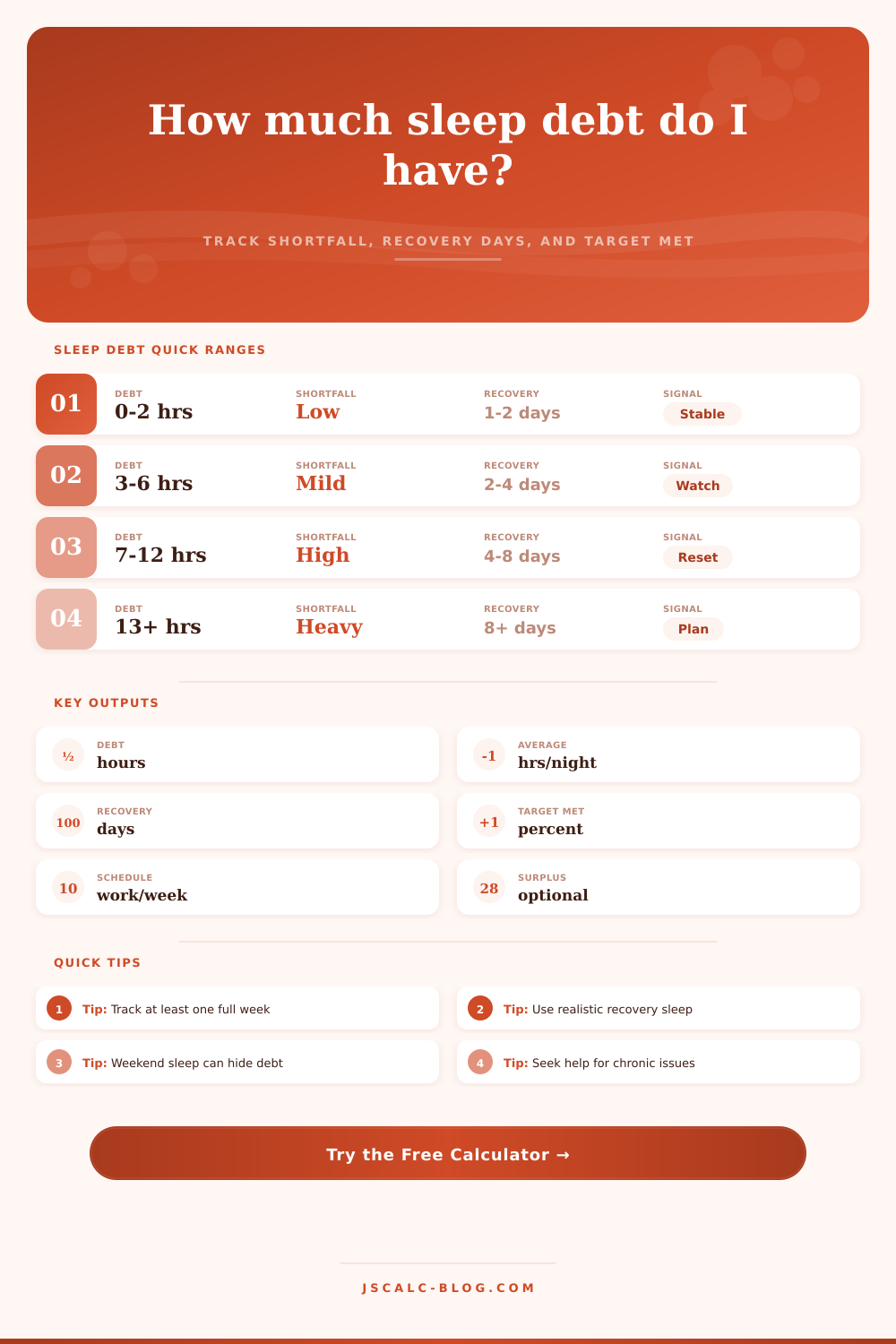
| Debt Level | Average Nightly Shortfall | Typical Recovery Pace | Calculator Signal | Practical Note |
|---|---|---|---|---|
| Low | 0 to 0.25 hour | 1 to 2 nights | near target | keep routine steady |
| Mild | 0.25 to 0.75 hour | 2 to 5 nights | small but visible | protect bedtime first |
| Moderate | 0.75 to 1.5 hours | 5 to 10 nights | needs planning | recover gradually |
| High | 1.5 to 2.5 hours | 10 or more nights | large weekly gap | reduce repeated short nights |
| Very high | 2.5+ hours | multi-week plan | heavy debt | consider professional guidance |
💡Sleep Debt Tips
We all “know” we don’t get enough sleep (most grown-ups is aware of it). And our bodies accumulates this sleep-debt, expressing itself with small but sneaky impacts to our health, day after day.
Sleep debt is your current balance of how many hours you’ve slept short than what your biology requires. You might think a long weekend nap clears the ledger, but math rarely works that way. A long nap on the weekend won’t erase the ledger.
What Is Sleep Debt and Why It Matters
To understand your actual deficit, look to pattern of your nights. To calculate this (and it’s complicated math), I built this tool here, plug in your real sleep numbers next to what your actual target should be. Eight hours isn’t the right answer for everyone; some require nine, while others may requires seven. But consistency matter.
Once you choose a target and then regularly achieve less than that (say, six and a half) the difference accumulate rapidly. Do that for ten days and you’ll have created a 15-hour deficit, about two whole nights of lost sleep. That’s more than enough to screw with your mood, your reaction time and your metabolic health.
That’s where it gets tricky… And why it’s hard to track manually. Today, work days start early and end late; weekends let us sleep in. So our sleeping patterns is lumpy, which means we average badly when viewed simply as the average.
Rather than treating all sleep time equally, calculator asks for separate work day and weekend sleep, since it’s not easy for body to translate extra weekend sleep into weekday energy. Sleeping in on the weekend doesn’t entirely cancel out the mental fogginess left behind after a five hour night on Wednesday. That missing energy still sticks around in the background, affecting your immune function and stress levels.
We plan our recoveries with unreasonable expectations: “I’m going to get back all the sleep I’ve lost; I’ll sleep 12 hours for two nights.” But biology don’t forgive us so easy. To account for this, the tool calculate how many days it will take to recover by assuming that you add some reasonable extra sleep each night, say an hour.
That’s because the nervous system requires slow repair, and rushing it just makes you groggier (sleep inertia) or less likely to maintain continuous sleep (fragmented sleep). Making small, steady changes is much better, as it gradually resets your circadian rhythm without shocking it.
It also spits out a number that’s an interesting way to measure progress: the percentage of target met. If you’re repeatedly hitting less than 85%, there’s probably something wrong in how you’re doing things. This gives you a sense of how realistic your schedule is, and where you might need to adjust.
It doesn’t mean you’ll get everything right, just that you’ll be aware of what you’re doing. A lot of folks go through life constantly over-owing. They have no idea they’re doing it because it makes them so irritable and unfocused. They chalk it up to being stressed from work, being flawed as a human, etc., while the real culprit is lack of restorative time.
If you’re feeling lost about where to begin, use the presets. There are real-life scenarios included such as shift work and student exam week. Those lifestyles comes with their own unique pressure points, and they illustrate that a slight difference in bedtime time can have a large impact on your overall debt.
Don’t expect to be debt-free each and every day (that’s unrealistic). Instead, aim to maintain control over the figure while ensuring it stays low enough so you should of be able to pay it off without crushing yourself.
So here’s the last lesson: sleep is a resource, one that needs to be planned around and tracked like any other. Because it can’t be wished away with willpower or caffeinated into submission. Eventually, it catch up to you in the form of numbers. When you plan ahead for recovery, and track how much you’re behind, you take control of your energy. And you do so by first accepting that those lost hours count.