Week Number to Date Calculator
Convert a year and week number into the actual calendar dates. Use strict ISO 8601 weeks, common US week numbering, first-full-week rules, or a custom fiscal week anchor.
📌Presets
⚙Week Inputs
📊Week Date Results
🧮Breakdown
🗓Adjacent Week Comparison
📋Weekday Table
| Day in Week | Date | Weekday | Ordinal Day | Calendar Year |
|---|
🔎ISO vs US Same Number
| System | Week Start | Week End | Week 1 Definition | Notes |
|---|
📘Reference Tables
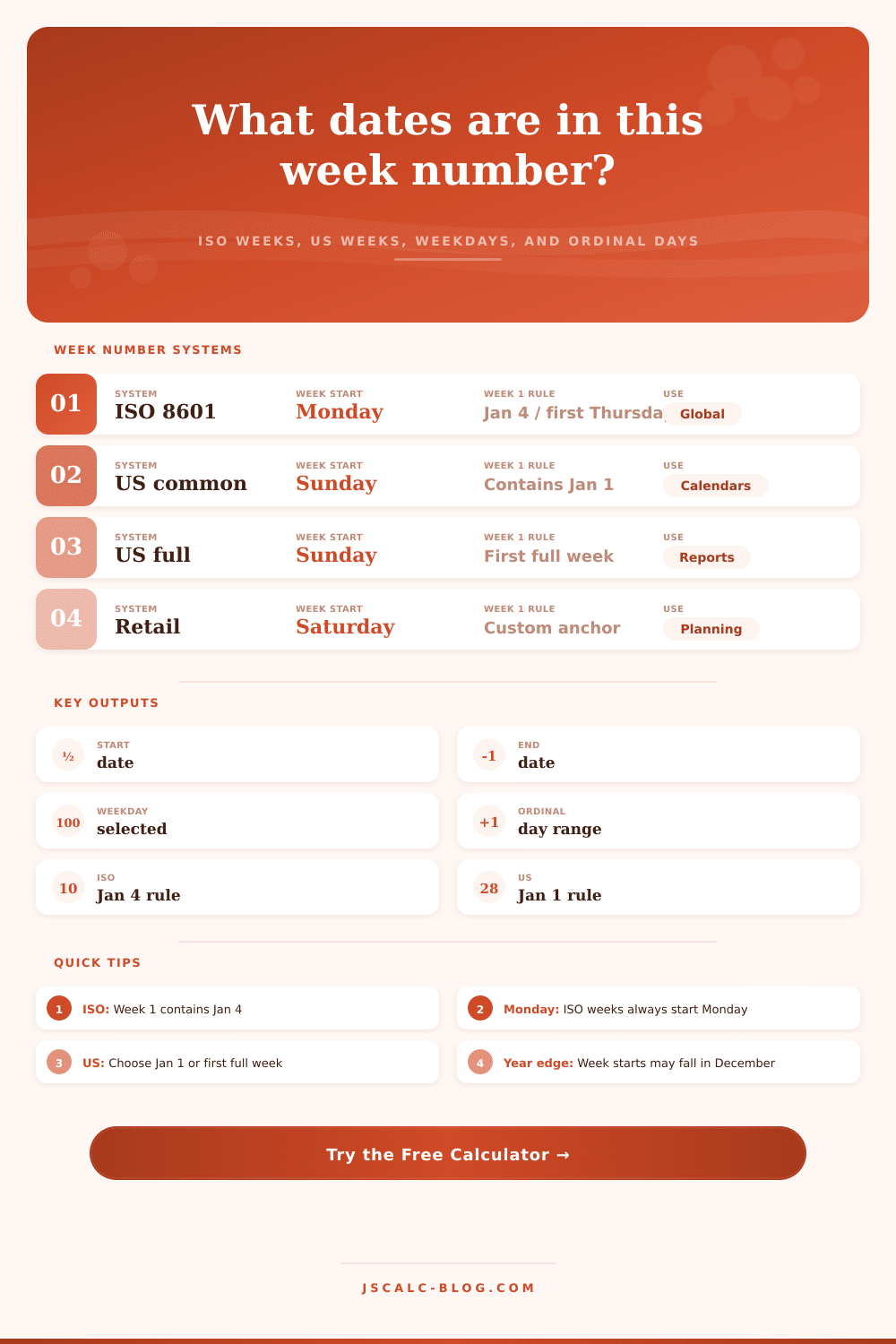
| Rule | Week Start | Week 1 Begins | Best For |
|---|---|---|---|
| ISO 8601 | Monday | Monday of the week containing Jan 4; same as first Thursday | International reporting, software, logistics, finance |
| US common | Usually Sunday | Start of the week containing Jan 1 | Wall calendars and quick US date lookups |
| First full week | User selected | First chosen week-start on or after Jan 1 | Reports that do not want December dates in week 1 |
| Custom fiscal | User selected | On, before, after, or nearest a fiscal anchor date | Retail calendars, school terms, internal operating years |
📈ISO Week Count by Year
| Condition | ISO Weeks | Reason | Example |
|---|---|---|---|
| Year starts on Thursday | 53 | Week 1 and week 53 both satisfy the first-Thursday rule | 2015, 2026, 2037 |
| Leap year starts on Wednesday | 53 | The leap day pushes the final ISO week across a Thursday | 2020, 2048 |
| Most other years | 52 | The next ISO Week 1 begins before a 53rd week can complete | 2021, 2022, 2023 |
| Edge dates | Depends | Jan 1 to Jan 3 and Dec 29 to Dec 31 can belong to a neighboring ISO week-year | Jan 1, 2021 is ISO 2020-W53 |
✅Tips
Sure, week numbers seem so exact; right up until you remember that everyone use different rules for what a week number mean. What day do you think is the first day of Week 12? Ask someone else in the office, and if you’re lucky they’ll give you a time range from somewhere between Saturday and Tuesday, where according to my spreadsheet it should of be from Monday through Sunday. It’s not your math that’s wrong; it’s just that there isn’t one agreed-upon way to count out weeks.
Depending on who you talk to (or what sort of industry), some people say we have 52 week per year, with Monday being the first day of each new week… Other people will tell you we have 53 weeks per year, and that the first day of the week falls on a Sunday… Still other people says that some systems start on a Saturday… The calculator know how to convert whatever rule book you want to play by into real-world dates you can actualy write down on a piece of paper and stick on your wall.
Why Week Numbers Are Confusing
International businesses, software, and logistics companies worldwide follow the strictest of these standards: ISO 8601. It begins on Monday (duh) and here’s where it gets interesting: ISO says the first week consist of however many days remain until next week begin. In other words, the first week is the one that include January 4. This means it is the week that includes the first Thursday of the year. This seems random at first, yet the reason is to maintain consistency from year to year. So Week 1 could start back in December the previous year. If your deadline involve January, you should realize Week 1 might have already begun as early as late December. The calendar handles this automatically. It looks for January 4 and then works backward to Monday to find the start of new year.
The tool provide two common variants, and here’s where US flexibility come in. One makes Week 1 simply the first week containing January 1st (typically Sun-Sat). The other skips ahead to wait until the first complete week following January 1st. Depending on that week, that means week dates can shift by a few days, especially around New Year. And that’s what gets people confused. They think Week 1 is static but it actually floats based off whichever rule you choose. That couple of days stacks up quickly when trying to match data between partners who use a different rule for payroll or reporting purposes.
Want to do something else? Got a custom financial year, maybe starting in November or July or February instead of January? No problem. Anchor it to whatever day you like and specify if Week 1 begin before or after or on that day. The results will provide the usual calendar dates too. Fiscal Week 5 becomes some actual Tuesday in March. It’s explained in detail in the reference table on the page, which demonstrate how the resulting start and end dates change different than your choice of anchor. It shows ordinal day ranges (which makes it clear if anything’s off). Some dates are on days of the year. For example, a week going from July 27 to August 2 covers a specific range of days in the year. You can tell whether anything is off by one if your exported data says days 207 to 213 vs days 208 to 214.
When a week bridges the end-of-year boundary, the calculator doesn’t force everything into a single range that appears incorrect; instead, it will label each day with its actual calendar year. That avoids confusing you when it lists December 30 and January 2 without any surrounding context.
But weeks within years also differ. A year may contain either 52 or 53 weeks. Why? If it is a leap year starting on Wednesday, or any year starting on Thursday, it need an extra week to cover all its days. If you look up Week 53 in such a year, the calculator will show it. This spares you from finding a date in the next year or getting no results at all.
The best way to protect yourself against an argument about calendars is this. Write down the system name on your report. If it’s US, write “US Week 31,” if not, use something like “ISO 2026-W31” or “Sunday Week 31.” That little tag ends all arguments before they begin.
Try it out by setting a preset and seeing what happens. Then tweak the inputs to match how you want things to work. You’ve got to choose the correct lens; the tool takes care of the rest.