Day Number to Date Calculator
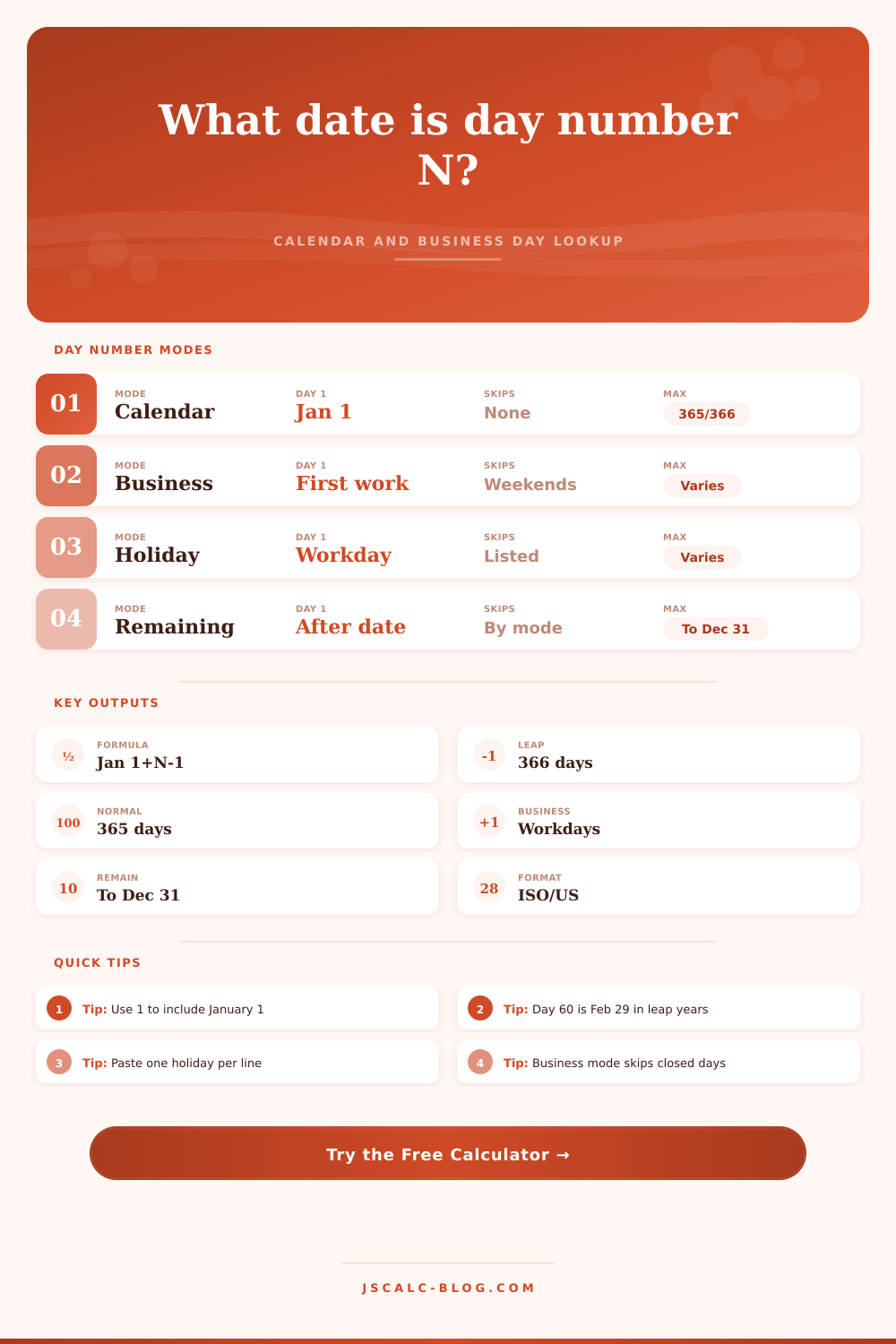
Convert a day-of-year number into a calendar date, or count the Nth business day while validating leap years, weekends, holidays, and remaining days.
Date Result
| Month | Calendar days | Starts day # | Ends day # | Target status |
|---|
| Month | Gross business days | Holiday hits | Net business days | Cumulative net |
|---|
| Day # | Calendar date | Weekday | Business date | Business skips |
|---|
| Entered date | Weekday | Status | Reason |
|---|
Pick an arbitrary day, let’s pick day 183, and ask yourself: What date is that? Unless you know whether it’s the number of calendar days (including weekends) or just work days, you don’t know. And knowing that one little detail alters everything.
Everyone thinks day 183 will be middle of year. In a normal year, it is July second. In a leap year, it moves to July first. But that move doesn’t feel like much. That changes when you are trying to calculate interest or schedule a deadline.
Why Business Days Are Different from Calendar Days
Once you feed the date into our calculator, it figures out all that math for you, saving you from having to remember whether each past date you want to check was a leap year. That’s the simple part. The tricky thing comes when you change calendar days to business days. A standard year has three hundred sixty-five day, but most of us don’t work all of them. We leave out the weekends and then there is holidays too. Maybe you’re on a four-day work week. In that case, day one-hundred doesn’t fall on calendar day one-hundred. You’re not looking at how much time passes, your looking at how many days are available.
Day number one-hundred in the calendar year falls on April ninth. Day number one-hundred in the business year could fall on third week of May or June. It depends on what days you consider “open” in your office and how many holidays you want to exclude. This is where the tool allows you to set your own workweek pattern. Want it to be Monday through Friday? Sure. How about Sunday through Thursday? That works. Or maybe you’ve got some kind of special rotation that your industry uses; no problem. Use whatever makes sense for you.
Take the holiday list. Paste in the normal set of federal holidays. Did you do it right? Except that those holidays are relevant only if they happen to fall on a day that you’d otherwise would of worked. What if Christmas falls on a Saturday? You don’t lose any business days. You simply ignore it, even though you accounted for it. The calculator handles this for you. It will prevent double counting while still ensuring your business day count represent true workdays. Most folks who attempt this by hand fail to realize this. They’ll blindly subtract holidays regardless of whether those holidays already corresponded to weekends.
But why is all this accuracy important? For project managers, five calendar days delayed isn’t the same as five business days delayed. The former encompasses two weekends in a single week. The latter doesn’t quite stretch to a full week. For financiers, it’s the difference between accruing interest. For educators, it’s the one hundred eightieth school day, a milestone that often triggers policy changes.
And while I’ve only discussed these three examples, they barely scratch the surface: this accuracy will also help you track when holidays shift dates or even when a leap year changes the whole second half of the calendar by a single day. It’ll enable you to track when holidays shift dates or even when a leap year changes the whole second half of the calender by a single day.
That’s what the reference table on the page is designed for: you look at some nearby numbers and dates, and you start seeing the pattern. Look there and see where a holiday moves a date into the following week. See here and realize that a leap year actualy pushed every day in the second half of the calendar ahead by one day. The other thing to check is the output of those remaining days. How many days are left in the year? Context adds a sense of urgency. Are there one-hundred sixty or so days left if you’re on day two-hundred? Or do you have much fewer days in your runway based off if you’re on day two-hundred in business days?
The tool displays both views side-by-side. You can see exactly how many business days is in January and in February. And it’ll help you plan around times of high-intensity. Abstract numbers becomes concrete schedules.
One date isn’t the best use of this tool. The rhythm of your year is. Want to plan a vacation? A product launch? Just want to know what day the hundredth day at work is? Knowing when is less important than knowing the context. The calculator provides that context. The holidays make sense now. Leap years don’t seem so crazy now. Now you’re forced to consider which days do… And don’t; count. And you get a clear answer that you know is correct.
So the next time somebody asks what day is day number two hundred? Don’t guess. Know.