Conception Date Calculator
Estimate a likely conception date and date range from a last menstrual period, estimated due date, ultrasound gestational age, or known ovulation date.
Estimated Conception Results
LMP Estimate
Uses LMP + cycle-adjusted ovulation day.
Due-Date Reverse
Uses EDD - 266 days.
Fertile Window
Estimated ovulation window around the anchor date.
Possible Date
Checks the optional comparison date.
| Method | Anchor Used | Conception Estimate | Due Date | Notes |
|---|---|---|---|---|
| Run the calculator to compare methods. | ||||
| Cycle Length | Ovulation Day | Conception From LMP | Due Date From LMP | Shift vs 28 Days |
|---|---|---|---|---|
| Cycle comparison appears after calculation. | ||||
| Known Information | Standard Estimate | Conception Formula | Due Date Formula | Accuracy Note |
|---|---|---|---|---|
| First day of LMP | 40 weeks from LMP | LMP + 14 days for a 28-day cycle | LMP + 280 days | Best when cycles are regular and LMP is certain. |
| Known EDD | Reverse pregnancy wheel | EDD - 266 days | Entered EDD | Useful when the due date was already confirmed. |
| Ultrasound GA | Scan date minus gestational age | LMP-equivalent + 14 days | LMP-equivalent + 280 days | Early scans are usually stronger than late scans. |
| Known ovulation | Ovulation as conception center | Entered ovulation date | Ovulation + 266 days | Still a range because fertilization can vary. |
| Long cycle | Ovulation later than day 14 | LMP + 14 + cycle offset | LMP + 280 + cycle offset | A 35-day cycle shifts about 7 days later. |
| Short cycle | Ovulation earlier than day 14 | LMP + 14 + cycle offset | LMP + 280 + cycle offset | A 24-day cycle shifts about 4 days earlier. |
| Output | Formula | Default Days | Cycle Adjustment | Interpretation |
|---|---|---|---|---|
| Due date from LMP | LMP + 280 days | 280 | Add cycle length - 28 | Standard 40-week estimate. |
| Conception from EDD | EDD - 266 days | 266 | Already included if EDD is confirmed | Reverse estimate, not proof of a specific day. |
| Conception from LMP | LMP + ovulation day | 14 | Longer cycles move later | Approximates ovulation and fertilization. |
| Ultrasound LMP equivalent | Scan date - GA days | weeks x 7 + days | No separate cycle offset | Uses measured gestational age as the anchor. |
| Likely range | Estimate plus and minus buffer | 2 to 7 | User selected | Shows uncertainty instead of false certainty. |
| Fertile window | Ovulation - prior fertile days to +1 day | 5 before, 1 after | Centered on estimate | Useful for context, not a paternity answer. |
Unfortunately, it’s less than straight-up science to find the day your life started; it’s often part detective work. Maybe you know exactly when you spotted your period, or maybe you has an ultrasound report with a due date all circled for you. Or maybe you barely even remember what weekend it was but hope that if you do the math, it’ll come up in your favor. Biology doesn’t fit neatly into calendar boxes because fertilization take time and ovulation shifts each month. The average pregnancy timeline isn’t always going to line up with your own body so it helps to think about finding a window instead, rather than one particular day.
Once you give it your anchor points, the tool above will handle the math and turn these squishy biological variables into something that makes sense, a range you can easly wrap your head around.
Why Pregnancy Dates Are Estimates
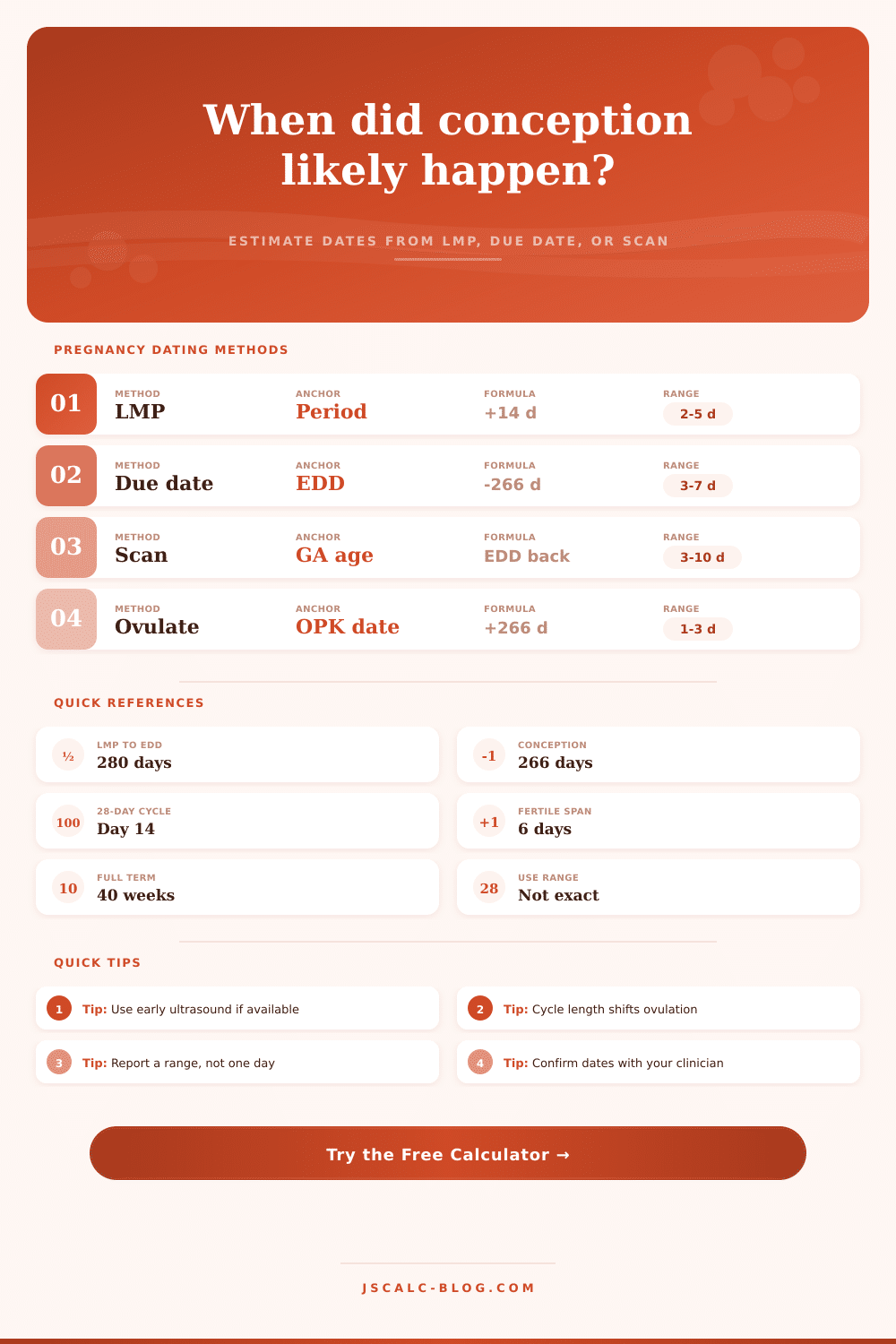
The other is the last menstrual period, which are typically the simplest date to recall. To calculate the due date, medical standards takes the first day of your period and add two hundred eighty days. They do this based off the assumption of a textbook twenty-eight-day cycle where ovulation occurs exactly on day fourteen. That’s a helpful fiction. Cycles can vary widely. Yours might not be the same. If yours is longer (for example, if it’s thirty-five days), then you probably didn’t ovulate until about a week after the standard model suggest. And if yours is shorter, you did. Because ovulation varies by up to seven days, it change everything that follows throughout early development. To account for this, the calculator lets you enter your average cycle length, which will adjust estimate of when you conceived, and therefore adjust the expected due date accordingly.
A second type of anchor is provided by ultrasound scans which use direct measurement of fetus instead of calendar arithmetic. In general, first-trimester scans are the most reliable because before the development of genetic difference among embryos, they all grows at similar rates. Any baby that is larger or smaller than average will naturaly vary over time and later scans may not provide accurate dates. Entering the gestational age calculated from the scan into the form causes it to work backwards: it calculates what the equivalent first-day-of-period date would of been. By doing this, it lets you compare information from the scan with your recalled period date. Doctors generally assume that if these two anchors is off by more than a few days, then the scan is the correct one.
Likewise, if you have a firm estimate on when your baby will be born, you may want to know when you conceived (and vice versa), and again, it’s easy to do mathematically. Since a typical pregnancy lasts two hundred sixty-six days, just subtract that number from your estimated due date to find the window when you likely conceived: If your estimated due date is May 1st, you could have conceived within a window found by subtracting two hundred sixty-six days from that date, give or take. (Note: This number is two weeks different than two hundred eighty because it includes the pre-ovulation part of a “normal” cycle.)
This isn’t a one-day answer. This isn’t even just a range of days; it’s a whole range. And that’s by design. An egg lasts up to twenty-four hours. The sperm lasts up to five. That means fertilization can absorbs anytime during their fertile span. So the calculator assumes some leeway on either side of the assumed ovulation day (that’s why it also tells you to add two days). Why not make the buffer smaller? Well, if the buffer were tiny, then we’d all be falsely confident. It is better to be realistic: Nature doesn’t always work like clockwork.
The point is that people are looking for an answer, something definitive to their questions like “how far along am I” or “who’s the daddy.” A calculator gives you probability, not proof. Think of it more as guidance, not judgment. The comparison tables on the page shows how one set of inputs compares to another, showing where they match and where they do not. Use that as material for discussions with your healthcare provider. Let them explain what those numbers mean in the context of your complete medical history.
The dates on your calendar aren’t laws; they are milestones in pregnancy dating. It’s an estimate, not a measurement. When you understand the way these windows are built, then you have control over this information. And the thing about them is, you work with the variance, you don’t fight against it; you don’t try to pin down the perfect day. You create a realistic picture of the timeline, one that respects the complexity of how we begin life. This gives you the clarity that replaces the stress from guessing.