Flight Duration From Time Zones Calculator
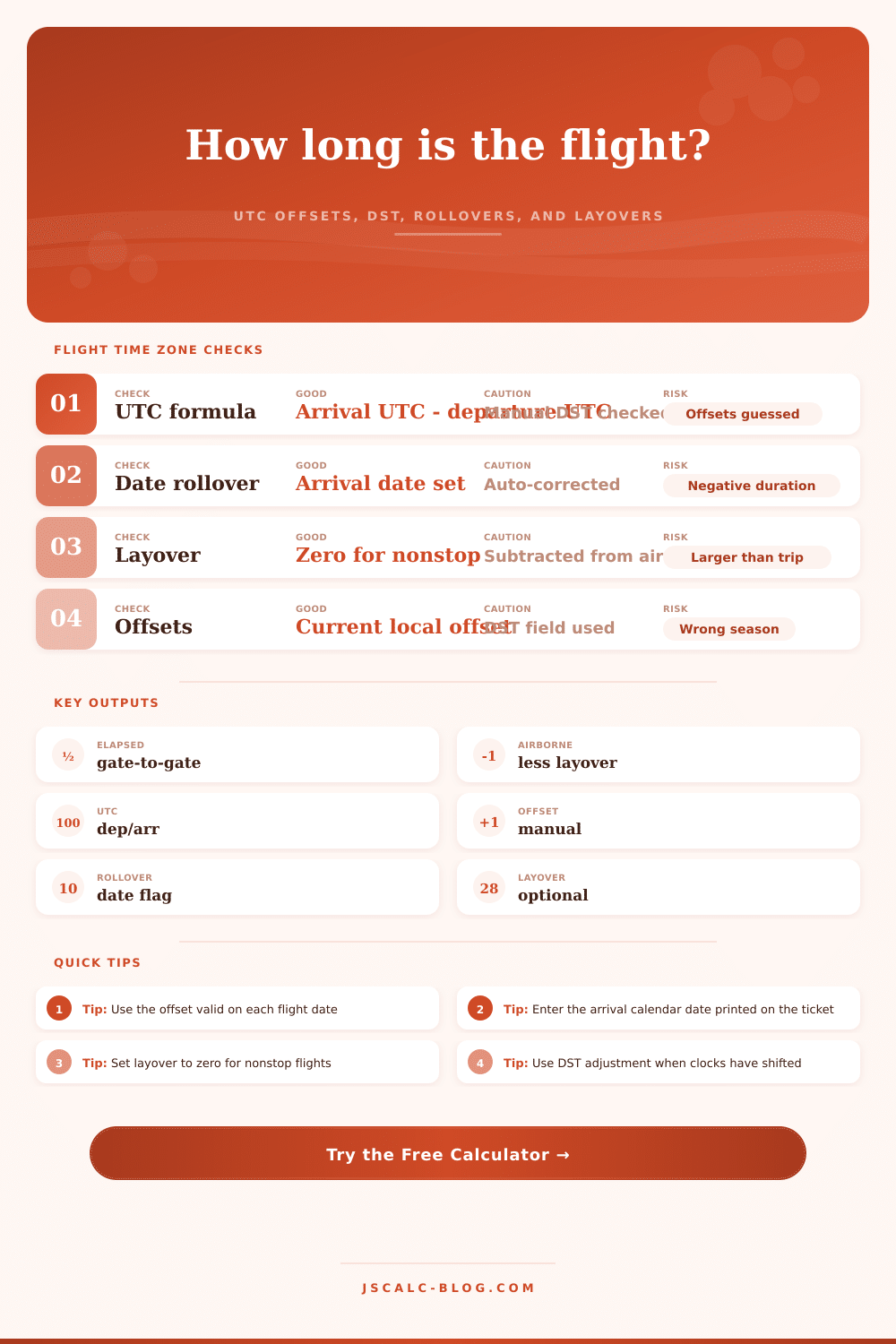
Convert local departure and arrival times into UTC, then subtract departure UTC from arrival UTC to estimate elapsed flight time across time zones, DST changes, date rollovers, and optional layovers.
🗺Route presets
✈Flight inputs
Example: New York standard time is UTC-05:00. Add +60 DST below when applicable.
Use the destination offset for the arrival date, not the departure date.
Shown separately so elapsed duration is not confused with airborne time.
Flight duration result
📊Route snapshot
🔄Comparison grid
Scenario check
Scenario check
Airborne check
Offset sensitivity
📋Calculation tables
| Event | Local date/time | Effective offset | UTC date/time | Note |
|---|---|---|---|---|
| Calculate to build the timeline. | ||||
| Offset component | Departure | Arrival | Difference |
|---|---|---|---|
| Offset details will appear here. | |||
| Duration type | Minutes | Hours:minutes | Decimal hours | Meaning |
|---|---|---|---|---|
| Duration details will appear here. | ||||
| Reference route | Common timezone issue | What to verify | Calculator handling |
|---|---|---|---|
| New York to London | Overnight eastbound arrival | Both sides may be in DST on different dates | Separate departure and arrival DST fields |
| Los Angeles to Tokyo | Arrival often two calendar dates later locally | Arrival date printed on ticket | UTC conversion plus rollover flag |
| Sydney to Los Angeles | Local arrival may appear earlier than departure | International Date Line crossing | UTC formula keeps elapsed time positive |
| Delhi to Europe | Half-hour origin offset | UTC+05:30, not +05:00 | Offset selector includes 30-minute zones |
| Dubai to Singapore | No DST at either endpoint | Offset is usually stable | DST can remain zero |
🧭Flight duration tips
A flight itinerary looks like this: You’re leaving Los Angeles for Tokyo on a flight that departs at 11:00 PM and arrives at 5:00 PM the following day. If you simply look at your watch, you see an eighteen-hour trip. But it isnt an eighteen hour trip. It’s a seven-and-a-half hour flight. You crossed several time zones including International Date Line. The math doesn’t lie; your watch does.
People approach time zones with a naive view: “New York is five hours behind London, so I’ll just add five.” This gets you through a phone call, but not travel. The issue isn’t that clocks simply move (they leap). Different countries enters and exit Daylight Saving Time on different dates. Half-hour offsets (as seen in India) disrupt the tidy one-hour mental model of offsets. Mix in date rollover, overnight flights, and DST timing differences, and your brain short-circuits. Next thing you know, you’re sitting at a gate waiting for a flight that departed three hours ago… or celebrating an arrival that hasn’t even taken place yet.
How UTC Helps With Travel Time
It converts it all into Coordinated Universal Time first and then runs the math, that’s the important part. Because after you put in the departure and the arrival in UTC terms, subtracting them is simple. No need to wonder if they flipped their clocks at the same moment on some Tuesday in London or Los Angeles. The converter does that for you, leaving you with just one number (the result) and something else to think about.
Something else, like the time you actualy spent airborne vs. The total time elapsed. Your time in the air is very different than your time on the clock on the wall. Total time? Maybe it’s going to take fourteen hours with a connection in Dubai. But that doesn’t mean you’re going to be flying for fourteen hours; maybe two of those hours will be spent standing around a baggage carousel. With this tool, you can subtract out layover time and add a buffer for things like deplaning and taxiing.
Why does it matter? If you are connecting to another flight or meeting a driver in the arrivals hall, you want to know how much time you’ll actualy spend in the sky, rather than simply how long you’ll spend in transit. The tool also points out common gotchas with preset routes. It’ll show me if I’m going backwards in time, like if I fly from Sydney to Los Angeles.” That sounds fine because you leave on Monday and arrive on Monday. However, you’ve actually been in the air for fourteen hours, so you are really flying forward through time. Then UTC clears up the confusion about which date is which when viewed locally. By checking just UTC, we see the truth.
To help visualize all of this, the page has a reference table that explains which routes need what kind of check, such as “DST check” (New York-London flights must do one) or “precise offset check” (Europe-Delhi flights will have you confused between India’s UTC plus five and a half hours and easy to think that’s a full hour). The other gotcha is getting the offset correct. And by “offset,” I mean the one that applied on the day you traveled. It’s possible the departure offset will differ from the arrival offset if you leave in January but fly home in March. The tool requires you manually input each of them. There is no guessing allowed.
At first this seem annoying because it’s so manual. However, it avoids errors that occur when a program assumes standard time rules that don’t apply to your trip.
But what about the date? This one is just as critical. You cannot type in whatever date you feel like; you must put in the actual date shown on your ticket. So if your ticket shows Tuesday as the arrival date, then you type in Tuesday, even if you mentally feel like you’re still on Monday. The tool will then adjust based off that date to provide correct UTC timestamp for that day. Not doing so will result in an incorrect duration calculation. This creates a difference of exactly 24 hours, which can make a big difference if you have a close connection to catch.
When UTC becomes the common frame of reference, the insanity of international travel boils down to a simple mathematical equation; no more “losing” or “gaining” hours, no more wondering if you’ll gain time during flight, just pure knowledge: How much longer until I get there? The work is done by the calculator; now you can pack your suitcase instead of arguing with your wristwatch over which way is up. It makes traveling clearer. By the time you arrive, you’re prepared for whatever happens next.