Pool pH Calculator: Muriatic Acid
Estimate how much muriatic acid (31.45% / 20 Baume) is needed to lower swimming pool pH and total alkalinity, scaled by water volume, current pH, target pH, and the alkalinity buffer. Results in fl oz, cups, and mL.
🏊Real Pool Presets
📝Pool & Water Chemistry
Length × width × average depth × 7.5 gives gallons for a rectangular pool.
Ideal swimming range is 7.4 to 7.6.
Alkalinity is the pH buffer. Higher TA needs more acid.
Used only when dosing goal is lower alkalinity.
🔢Model Snapshot
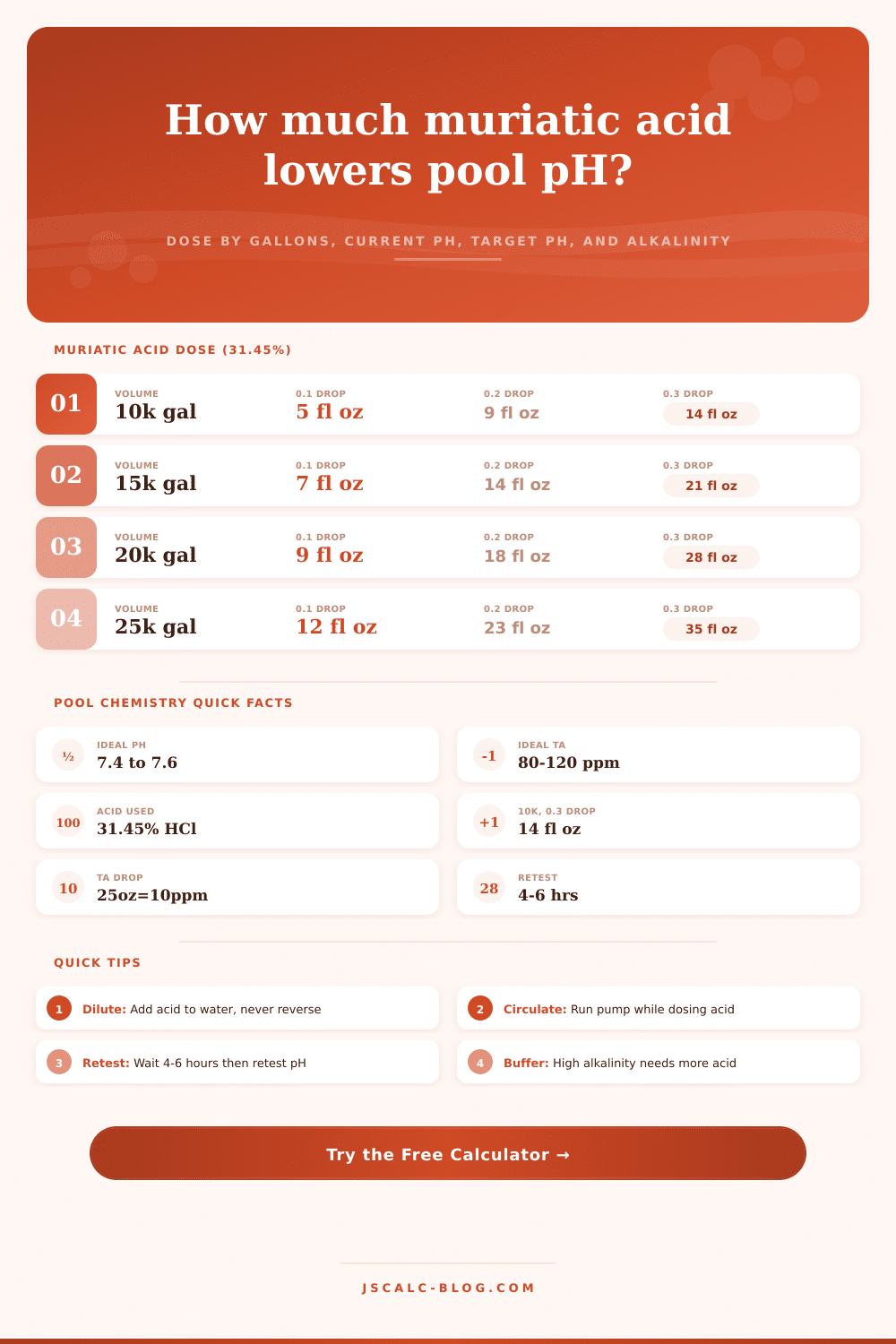
📊Muriatic Acid Dose by Volume & pH Drop
| Pool Volume | 0.1 pH Drop | 0.2 pH Drop | 0.3 pH Drop | 0.4 pH Drop | 0.5 pH Drop |
|---|---|---|---|---|---|
| 5,000 gal | 2.3 fl oz | 4.6 fl oz | 6.9 fl oz | 9.2 fl oz | 11.5 fl oz |
| 8,000 gal | 3.7 fl oz | 7.4 fl oz | 11 fl oz | 15 fl oz | 18 fl oz |
| 10,000 gal | 4.6 fl oz | 9.2 fl oz | 14 fl oz | 18 fl oz | 23 fl oz |
| 15,000 gal | 6.9 fl oz | 14 fl oz | 21 fl oz | 28 fl oz | 35 fl oz |
| 20,000 gal | 9.2 fl oz | 18 fl oz | 28 fl oz | 37 fl oz | 46 fl oz |
| 25,000 gal | 12 fl oz | 23 fl oz | 35 fl oz | 46 fl oz | 58 fl oz |
Values shown for 31.45% acid at total alkalinity near 100 ppm. Higher alkalinity raises the dose; the calculator adjusts automatically.
💧Alkalinity Reduction by Acid Volume
| Muriatic Acid (per 10k gal) | Approx TA Drop | Approx pH Effect | Notes |
|---|---|---|---|
| 12 fl oz | ~5 ppm | ~0.25 down | Gentle single dose |
| 25 fl oz | ~10 ppm | ~0.5 down | Common TA correction |
| 50 fl oz | ~20 ppm | Large drop | Split into two doses |
| 75 fl oz | ~30 ppm | Very large | Dose, aerate, retest |
| 100 fl oz | ~40 ppm | Extreme | Over several days |
Lowering pH and lowering alkalinity happen together with the same acid. Aerating the water raises pH back up while alkalinity stays low.
✅Ideal Pool Chemistry Ranges
| Parameter | Ideal Range | If Too High | Correction |
|---|---|---|---|
| pH | 7.4 to 7.6 | Scale, cloudy water | Add muriatic acid |
| Total alkalinity | 80 to 120 ppm | pH drifts up, cloudy | Add muriatic acid |
| Free chlorine | 1 to 3 ppm | Strong odor, irritation | Stop adding, wait |
| Calcium hardness | 200 to 400 ppm | Scaling, cloudiness | Partial drain, refill |
| Cyanuric acid | 30 to 50 ppm | Weak chlorine | Partial drain, refill |
⚠Muriatic Acid Safety Reference
| Practice | Do This | Avoid This |
|---|---|---|
| Mixing order | Add acid into water | Never water into acid |
| Circulation | Run pump 30+ min | Dosing a still pool |
| Pouring spot | Deep end, slowly | Near skimmer or liner |
| Protection | Gloves and goggles | Bare skin, no eyewear |
| Other chemicals | Dose separately | Mixing with chlorine |
| Swim wait | Retest after 4-6 hrs | Swimming right after |
⚙Full Dosing Breakdown
📋Muriatic Acid Reference Values
| Item | Common Value | How It Is Used | Effect |
|---|---|---|---|
| Standard strength | 31.45% / 20 Baume | Reference for the model | Baseline dose |
| 1 cup | 8 fl oz = 237 mL | Easy pour measure | Splits a large dose |
| 1 quart | 32 fl oz = 946 mL | Bulk correction | Big pH and TA drop |
| 0.1 pH step | ~4.6 fl oz / 10k gal | Fine pH tuning | ~2 ppm TA drop |
| 10 ppm TA step | ~25 fl oz / 10k gal | Alkalinity control | ~0.5 pH drop |
💡Practical Dosing Tips
There’s a certain nervousness when it comes time to check the pool water. You stick test strip in, read results, and instead of getting directions to paradise, you see a treasure map leading straight to trouble. The pH is high, maybe an 8 or even higher. Now you know that the chlorine doesn’t work very well at all anymore. Instead of cleaning anything, it just sits there in water.
This is why muriatic acid is such a valuabel tool for balancing the pool water. After plugging in current values and pool size on the calculator (above), it do all the math for you, telling you exactly how many cups or fluid ounces you should of add to return things to safe range. That eliminates all guesswork, no more trying to do conversions and coefficients.
How to Use Muriatic Acid Safely
But it’s not scary once you understand what pH is. It indicate how aggressive or corrosive your water is. As it rise, it starts building scale on your equipment and walls, making that clear blue water cloudy.
But dropping it requires precision… Acid isn’t as easy as adding a little sugar to your coffee. A little go a long way, and you really have to be precise when adding it especially if you ignore total alkalinity. That buffer part doesn’t want to change. Your alkalinity could be super high, and then the water is fighting against you trying to drop pH. To get a significant impact, you’ll have to add more acid then somebody with low alkalinity.
The tool takes that into account, allowing you to input that second value. So instead of just guessing based off a generic rule of thumb, the dose reflects your particular water chemistry.
The problem with most people who own pools: They dump all calculated amount immediately. This is not necessarily the best idea. Letting the system acclimate to small amounts of acid over time are better. If you have a plaster surface or even a vinyl liner, pouring an acidic solution in one place will be harmful by creating localized hot spots of super-acidity which can destroy that surface.
Always dilute the acid in water first then pour it slowly near a return jet so the water flow can spread it around. Never add water to acid. Always add acid to water. Why? Adding acid to water result in a chemical reaction that produces heat. If you reverse the process, you risk splashing that can damage your eyes and skin.
There is also confusion about how pH and alkalinity relate. They tend to move in opposite directions. Lowering one tends to lower the other somewhat, but not completely. This means you may have to raise your alkalinity by aerating water after lowering the pH if it is realy resisting. Bubbling air and running fountains increases pH but doesn’t change alkalinity very much. So there’s a balance between the two, keeping one another in check.
The page has a chart showing just how much alkalinity goes down when you add any given amount of acid (in roughly ten parts per million increments), which can help you expect those side effects in advance. One reason why salt water pools have an increasing pH problem is that generator uses up alkalinity to generate chlorine. But it has a tendency to increase your pH over time. In a salt system, you’ll add acid more regularly than if you were keeping a traditional chlorinated pool. It is just part of the rhythm of maintaining a salt water pool.
Choose the right strength of acid and this calculator works for salt water pools as well. Most places sell the standard 30% or 31% muriatic acid. Some locations stock a lower (safer to handle) version of acid. Whatever version of the bottle you pick up, make sure you adjust the % setting so the volume is still accurat.
The last ingredient for good water chemistry is patience. When you dose, turn on your pump and allow it to circulate the treatment for a few hours. Resist testing immediately; it’s tempting but you’ll get skewed results until the acid mixes thoroughy with all the water. If you give it time, you avoid overcorrecting and ending up with oscillating pH levels that make everybody frustrated.
Achieving the correct mix ensures happy swimmers and clear water. You will no longer worry about clouded eyes or chemical burns.