Molarity of a Solution Calculator
Find molarity with M = moles of solute divided by liters of solution, solve for moles or volume when you know the other two, and prepare dilutions from a stock using C1V1 = C2V2 to get the exact stock volume and diluent to add.
🧪Choose a Mode
🎯Real Solution Prep Presets
📝Solution Inputs
Pick the unknown; enter the other two values below.
Amount of substance dissolved, in moles.
Used when you solve for moles or volume.
Total final solution volume, not just solvent.
Applies to the volume field above.
Concentration of the concentrated stock you start from.
Final working concentration you want.
Total volume of diluted solution to make.
Unit for V2 and the reported stock and diluent volumes.
Controls rounding on every result card.
🔢Formula Snapshot
📋Molarity Definition Examples
| Moles of Solute | Volume of Solution | Molarity M = n / V | Reads As |
|---|---|---|---|
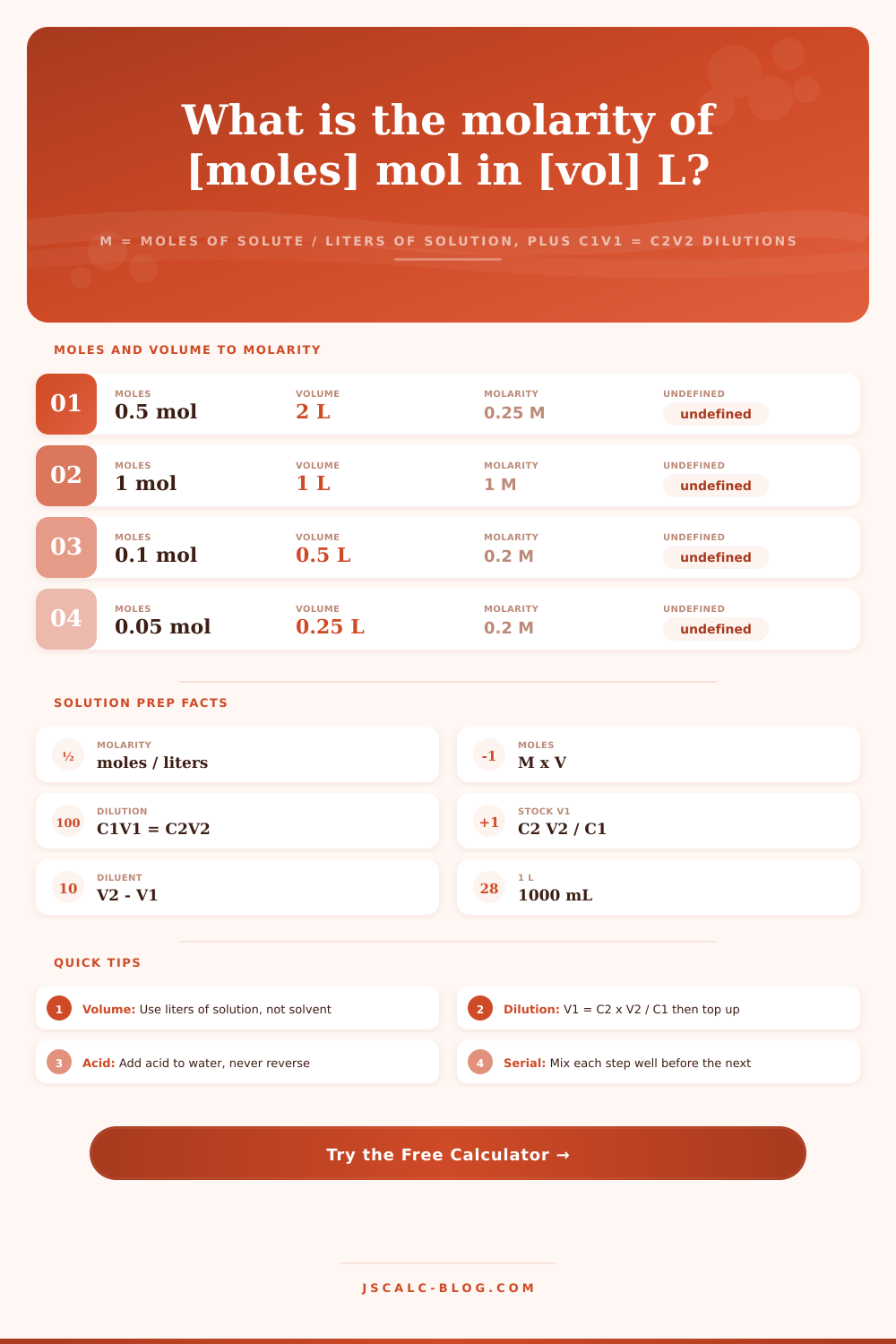
| 0.5 mol | 2 L | 0.25 M | Quarter molar |
| 1 mol | 1 L | 1 M | One molar |
| 1 mol | 0.5 L | 2 M | Two molar |
| 0.1 mol | 0.5 L | 0.2 M | 200 mM |
| 0.05 mol | 0.25 L | 0.2 M | 200 mM |
| 0.9 mol | 1 L | 0.9 M | 900 mM |
| 0.005 mol | 0.1 L | 0.05 M | 50 mM |
| 2 mol | 4 L | 0.5 M | Half molar |
📊Dilution Factor Chart
| Dilution Factor | Ratio (stock : final) | Stock in 100 mL | Diluent in 100 mL | Example |
|---|---|---|---|---|
| 2x | 1 : 2 | 50 mL | 50 mL | 10 M to 5 M |
| 5x | 1 : 5 | 20 mL | 80 mL | 10 M to 2 M |
| 10x | 1 : 10 | 10 mL | 90 mL | 10 M to 1 M |
| 20x | 1 : 20 | 5 mL | 95 mL | 1 M to 50 mM |
| 50x | 1 : 50 | 2 mL | 98 mL | 1 M to 20 mM |
| 100x | 1 : 100 | 1 mL | 99 mL | 1 M to 10 mM |
| 1000x | 1 : 1000 | 0.1 mL | 99.9 mL | 1 M to 1 mM |
🧬Common Stock to Working Dilutions
| Reagent | Stock | Working | Dilution | Per 1 L Working |
|---|---|---|---|---|
| PBS phosphate saline | 10x | 1x | 10-fold | 100 mL stock + 900 mL water |
| TAE electrophoresis | 50x | 1x | 50-fold | 20 mL stock + 980 mL water |
| TBE electrophoresis | 10x | 1x | 10-fold | 100 mL stock + 900 mL water |
| Tris buffer | 1 M | 50 mM | 20-fold | 50 mL stock + 950 mL water |
| HCl acid | 6 M | 1 M | 6-fold | 167 mL stock + 833 mL water |
| NaOH base | 10 M | 0.1 M | 100-fold | 10 mL stock + 990 mL water |
| EDTA chelator | 0.5 M | 10 mM | 50-fold | 20 mL stock + 980 mL water |
📏Volume and Concentration Unit Conversions
| Unit | Equals | In Base Unit | Note |
|---|---|---|---|
| 1 L | 1000 mL | 1 L | Liter of solution |
| 1 mL | 0.001 L | 0.001 L | Milliliter |
| 1 M | 1 mol/L | 1 mol/L | Molar |
| 1 mM | 0.001 M | 0.001 mol/L | Millimolar |
| 1 µM | 0.001 mM | 0.000001 mol/L | Micromolar |
| 1 mmol | 0.001 mol | 0.001 mol | Millimole |
🗃Stock to Target Dilution Comparison Grid
| Stock C1 | Target C2 | Final V2 | Stock V1 Needed | Diluent to Add | Dilution Factor |
|---|---|---|---|---|---|
| 10 M | 1 M | 100 mL | 10 mL | 90 mL | 10x |
| 10 M | 0.1 M | 1000 mL | 10 mL | 990 mL | 100x |
| 6 M | 1 M | 500 mL | 83.3 mL | 416.7 mL | 6x |
| 5 M | 0.5 M | 250 mL | 25 mL | 225 mL | 10x |
| 1 M | 50 mM | 1000 mL | 50 mL | 950 mL | 20x |
| 1 M | 10 mM | 500 mL | 5 mL | 495 mL | 100x |
| 0.5 M | 10 mM | 1000 mL | 20 mL | 980 mL | 50x |
| 2 M | 0.2 M | 500 mL | 50 mL | 450 mL | 10x |
| 10x PBS | 1x PBS | 1000 mL | 100 mL | 900 mL | 10x |
| 50x TAE | 1x TAE | 1000 mL | 20 mL | 980 mL | 50x |
⚙Formula Breakdown
💡Solution Prep Safety Tips
It’s important to realize that volume is something that isn’t a set amount. It’s something that can be negotiated. Once you view concentration this way, you understand it better. Understanding molarity comes down to knowing what each number mean in a beaker of glass. The math gets done for you by using the molarity calculator. Molarity = moles of solute/liters of solution.
That sounds fairly straight forward until you’re at the lab bench holding a graduated cylinder and a scale. You’re attempting to create an exact buffer for your enzyme assay. And that assay won’t tolerate any sloppy calculation. The key here is understanding exactly what is being measured. In other words, focus less on the ingredients and more on final state.
How to Mix Solutions Correctly
This is where most people go wrong: they mix up their solution volume with their solvent volume. No, you don’t take a liter of water, add a mole of salt, and say “molar solution.” That’s not how it works. You add the salt (or whatever) to less water then top it off until the volume reaches the one-liter marker. Solutes occupy some volume, and failing to account for that will throw off your concentration by several percent.
That might sound like nothing, but in biology, that’s the difference between an active protein and a denatured mess. The beauty of the calculator is that it avoids that misunderstanding by allowing you to enter total volume and moles directly into the equation. This guarantees you are actualy solving for final product instead of guessing what started the reaction.
In reality, we don’t usually weigh out a dry powder for each and every experiment in real lab. Instead, we take a concentrated stock solution and dilute that down into something that’s usable. That’s when equation C1V1 = C2V2 kicks in. What’s going on here is conservation of mass. You’re only adding empty solvent (not more solute), so you need to have as many moles in the final diluted volume as there were in initial aliquot. If you rearrange that, you get the volume of stock required (V1) by multiplying the final volume by the desired concentration and then dividing by the stock concentration.
It is simple and elegant, yet it will trip people up if they are not paying close attention to their units. For example, let’s say I have a 10 M stock that I want to use for my experiment, but I only require 100 milliliters at a 1 M concentration. What does this mean? Well, it means I has to dilute it. The math says: “Take out 10 milliliters of the strong stuff and add 90 milliliters of water.” This represents a tenfold dilution. In other words, your final concentration will be one tenth of the original.
If you mistakenly pipette out 90 milliliters of stock, well, then you’re in for a terrible reaction more then having a working buffer. That’s why the tool can help prevent those kinds of errors. It breaks it all down for you, showing you exactly what volume of stock to measure out and how much diluent to add. You won’t have to do any kind of mental division with a pipette held above a sink.
The only thing that nobody’s formula will solve for you is safety. And with dangerous substances such as sulfuric or hydrochloric acid, be sure to put it in water first. Never ever do the reverse. That process generates a lot of heat, which is called an exothermic reaction. This heat can literally boil the mixture and spew out scalding, caustic stuff on your fingers if you fill a cup of water and dump it into concentrated acid. Dumping acid into water lets all that heat dissipate safely in the greater volume of water. This is a little tip that could of saved a career.
The other way you can protect yourself from pipetting error is with serial dilutions. You can’t measure one milliliter of stock for one liter of final solution, as the relative error would be huge if your pipette were just a bit off. By breaking it down into a few more manageable steps, perhaps two or three, you keep volume small enough where accuracy is maintained. Incomplete mixing will mess up the whole series, so mix well at each step before proceeding.
The reference tables on the page shows you some common dilution factors, which should give you an idea of how these ratios scale (so you don’t have to work it out from scratch each time). So how much do you prepare? The answer is both useful and exact. On one hand, you desire that your numbers are correct; on the other, you require your preparations to be repeatable and safe.
Put simply, if there is an equation for preparing solutions by dilution (the dilution rule) and another for calculating the molarities of reagents (the basic definition of molarity), why not combine them in a single location? From a complicated electrophoresis buffer to a simple saline wash, having a handle on your liters and moles provides experimental control. Work backwards from your target concentration to the stock solution. Accept the physics of liquid-to-liquid mixing. Convert theoretical chemistry into predictable outcomes.