Mass to Molarity Calculator
Weighed out some solid and need the concentration? Enter the mass of solute in grams, its molecular weight, and the solution volume to get molarity in mol/L. You can also flip the calculation to solve for the mass to weigh or the volume to make.
🧪Quick Compound Presets
⚖Solution Inputs
Molarity uses M = (mass / MW) / volume. The other modes rearrange the same relationship.
Formula weight of the solute. Pick a compound above or type any value.
Grams or milligrams of dry solid on the balance.
Used when solving for the mass to weigh or the volume to make.
Final volume of the finished solution.
Scales the mass to weigh for reagents below 100% pure.
🔢Formula Snapshot
📋Common Compound Molecular Weights
| Compound | Formula | Molecular Weight | Mass for 1 L of 1 M |
|---|---|---|---|
| Sodium chloride | NaCl | 58.44 g/mol | 58.44 g |
| Glucose (dextrose) | C6H12O6 | 180.16 g/mol | 180.16 g |
| Tris base | C4H11NO3 | 121.14 g/mol | 121.14 g |
| EDTA (free acid) | C10H16N2O8 | 292.24 g/mol | 292.24 g |
| Sodium hydroxide | NaOH | 40.00 g/mol | 40.00 g |
| Potassium chloride | KCl | 74.55 g/mol | 74.55 g |
| Calcium chloride | CaCl2 | 110.98 g/mol | 110.98 g |
| Sucrose | C12H22O11 | 342.30 g/mol | 342.30 g |
| Hydrochloric acid | HCl | 36.46 g/mol | 36.46 g |
💧Molarity from 1 Gram Dissolved to 1 Litre
| Compound | MW (g/mol) | 1 g in 1 L | 5 g in 1 L | 10 g in 1 L |
|---|---|---|---|---|
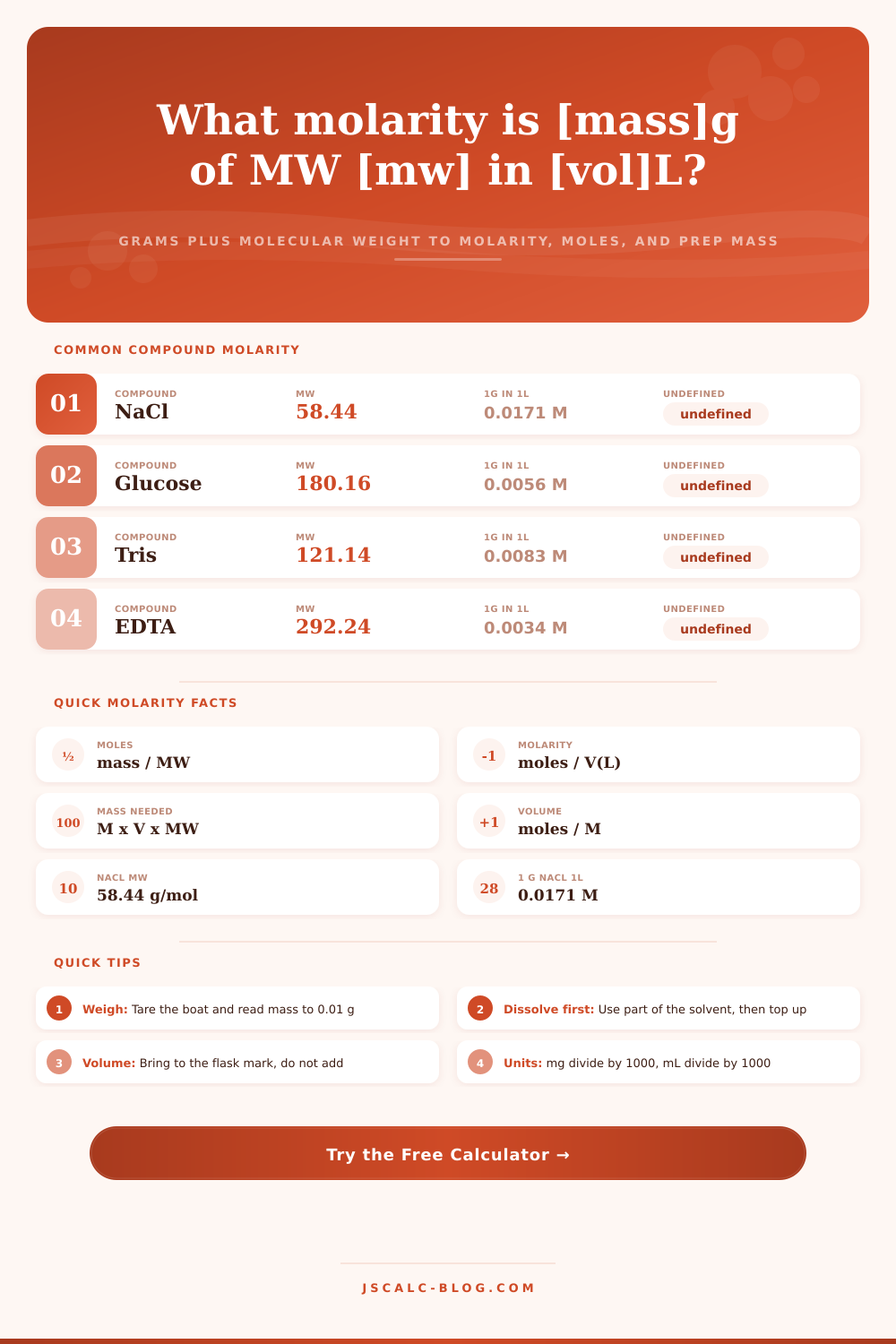
| NaCl | 58.44 | 0.0171 M | 0.0856 M | 0.1711 M |
| Glucose | 180.16 | 0.0056 M | 0.0278 M | 0.0555 M |
| Tris | 121.14 | 0.0083 M | 0.0413 M | 0.0826 M |
| EDTA | 292.24 | 0.0034 M | 0.0171 M | 0.0342 M |
| NaOH | 40.00 | 0.0250 M | 0.1250 M | 0.2500 M |
| KCl | 74.55 | 0.0134 M | 0.0671 M | 0.1341 M |
| CaCl2 | 110.98 | 0.0090 M | 0.0451 M | 0.0901 M |
| Sucrose | 342.30 | 0.0029 M | 0.0146 M | 0.0292 M |
📏Unit Conversions Used Here
| Quantity | From | To | Conversion |
|---|---|---|---|
| Mass | milligrams (mg) | grams (g) | divide by 1000 |
| Mass | grams (g) | milligrams (mg) | multiply by 1000 |
| Volume | millilitres (mL) | litres (L) | divide by 1000 |
| Volume | litres (L) | millilitres (mL) | multiply by 1000 |
| Concentration | molarity (M) | millimolar (mM) | multiply by 1000 |
| Amount | moles (mol) | millimoles (mmol) | multiply by 1000 |
🧬Molarity Prep Quick Guide (NaCl, MW 58.44)
| Target Molarity | Volume | Moles Needed | Mass to Weigh | Note |
|---|---|---|---|---|
| 0.10 M | 1 L | 0.100 mol | 5.84 g | Dilute working stock |
| 0.15 M | 1 L | 0.150 mol | 8.77 g | Near physiological saline |
| 0.50 M | 1 L | 0.500 mol | 29.22 g | Common bench stock |
| 1.00 M | 1 L | 1.000 mol | 58.44 g | One-molar reference |
| 1.00 M | 500 mL | 0.500 mol | 29.22 g | Half-litre batch |
| 2.00 M | 250 mL | 0.500 mol | 29.22 g | Concentrated small prep |
| 5.00 M | 100 mL | 0.500 mol | 29.22 g | Near NaCl saturation |
📊Comparison Grid – Molarity by Mass Dissolved to 1 Litre
| Compound | MW (g/mol) | 1 g → M | 5 g → M | 10 g → M | 25 g → M | Moles per Gram |
|---|---|---|---|---|---|---|
| Sodium chloride | 58.44 | 0.0171 M | 0.0856 M | 0.1711 M | 0.4278 M | 0.01711 mol |
| Glucose | 180.16 | 0.0056 M | 0.0278 M | 0.0555 M | 0.1388 M | 0.00555 mol |
| Tris base | 121.14 | 0.0083 M | 0.0413 M | 0.0826 M | 0.2064 M | 0.00826 mol |
| EDTA | 292.24 | 0.0034 M | 0.0171 M | 0.0342 M | 0.0855 M | 0.00342 mol |
| Sodium hydroxide | 40.00 | 0.0250 M | 0.1250 M | 0.2500 M | 0.6250 M | 0.02500 mol |
| Potassium chloride | 74.55 | 0.0134 M | 0.0671 M | 0.1341 M | 0.3354 M | 0.01341 mol |
| Calcium chloride | 110.98 | 0.0090 M | 0.0451 M | 0.0901 M | 0.2253 M | 0.00901 mol |
| Sucrose | 342.30 | 0.0029 M | 0.0146 M | 0.0292 M | 0.0730 M | 0.00292 mol |
| Hydrochloric acid | 36.46 | 0.0274 M | 0.1371 M | 0.2743 M | 0.6857 M | 0.02743 mol |
⚙Full Formula Breakdown
💡Practical Weighing & Dissolving Tips
Built by JSCalc-Blog.com – a fast, free mass to molarity calculator for the lab bench, classroom, and study desk.
But how do we know? That is where every solution prep starts. You take your solid, drop it on balance, read mass, and then calculate how much of the final solution you have prepared. This is exactly what calculator at the top handles. It take the mass of solute, molecular weight, total volume, and does the math for you.
Most folks has no idea how to do this part so they end up doing it in there head. This will give them an immediate answer to one of the most common questions in the lab: “How concentrated is my solution? The problem with it all is that most folks believe that they are counting amount of whatever it was that they put into the thing. They aren’t. What you measure (the molarity) is number of moles of solute for each liter of solution.
## How to Use the Molarity Calculator
Two things is easy to mix up there: 1) Moles of solute/Liter of solution and 2) Grams of solute/Liter of solution. In other words, we go from mass (grams) to moles, then we divide moles by volume (liters). If you wish to go straight from your balance reading to a concentration, then you could combine these two steps into one expression.
To make that concrete: take 58.44 g of sodium chloride (molecular weight = 58.44), dissolve in water, then make up to a final volume of one liter. One mole. One molarity. A very nice result. This is why sodium chloride is often used as an example in teaching. Sodium chloride is useful because its grams per liter at a molarity of one are the same as its molecular weight.
In practice, lab wants molarity but seldom gives you all three inputs. Instead, they tell you how concentrated they want solution and ask how much you should weighs. That’s where the calculator does its reverse magic. Pick mass for the unknown variable; type in the volume and target molarity and it will give you exact weight to place on scale.
For instance, I have to make a liter of 0.5 M NaCl. It says weigh out 29.22 grams. Dissolve it up and fill to one-liter line. What if I’m given a fixed mass and want to hit specific molarity? Then you simply solve for volume. The calculator hides math behind the interface, letting you focus on the chemistry itself.
The bridge between moles and grams is molecular weight. One wrong move here, all numbers are wrong. To make this easier, tool pre-sets some common lab compounds: EDTA, Tris, Glucose…etc. Simply choose the compound and molecular weight is filled out for you. No more copy-pasting from chemical formulas! When using salt solutions with water of hydration, always enter the molecular weight of what is on the bottle. A little extra water makes a big difference in how much it weighs.
Here’s where most people go wrong when pulling an old notebook value. The most frequent cause of a solution being ten or a thousand times off is because you made an error with your units. With this calculator, you can type in both volume (in either milliliters or liters) and mass (in either milligrams or grams). It will convert everything into base units, use the formula, and then give you result in the units you entered.
There are only two rules: to change milligrams to grams, divide by a thousand. To change milliliters to liters, divide by a thousand. A 500-milligram sample is 0.5 grams. A 250-milliliter flask is 0.25 liters. When you get a number out of whack, odds are very high that you messed up the units.
Besides using correct number, two habits ensure accuracy during preparation: weighing accurately to 0.01 grams or better and taring the weigh boat. Read it off and check mass against target value before you dissolve. A fraction of a gram will make a big difference for a low molecular weight solute’s molarity.
Top up the solution after dissolving. If you add the solid to the whole volume of solvent you’ll overshoot the mark because solids takes up room too. First add the solid to about 70 percent of desired solvent, stir till dissolved, then bring up to volume.
You’ll see some reference tables below the calculator to illustrate what 1,5, and 10 grams in one liter give you in terms of molarity. The grids also provide a quick glance at how a light substance such as sodium hydroxide results in much higher molarity than a heavier substance such as sucrose. Use these to build intuition for your next prep and check your work visually.
Molarity = moles/volume, but thinking about it as a “ratio” of space instead of weight can save you both time and reagent. Return to top and plug your own numbers into the calculator.