pH Change Calculator
Enter an initial and final pH to find the change in pH and the fold-change in hydrogen-ion concentration. Each whole pH unit means a 10× shift in [H⁺], so this shows how many times more or less acidic a solution becomes.
🧪Real pH Change Presets
📝pH Inputs
Starting pH before the change.
Used in compare mode.
Times more acidic (target mode).
🔢Formula Snapshot
ΔFold-Change Per pH Unit
| Delta pH | Fold-Change in H⁺ | Direction | Percent Change H⁺ | Plain Meaning |
|---|---|---|---|---|
| −3 | 1000× | pH down | +99900% | 1000× more acidic |
| −2 | 100× | pH down | +9900% | 100× more acidic |
| −1 | 10× | pH down | +900% | 10× more acidic |
| −0.5 | 3.16× | pH down | +216% | Roughly 3× more acidic |
| 0 | 1× | no change | 0% | Same acidity |
| +0.5 | 0.316× | pH up | −68% | About one third as acidic |
| +1 | 0.1× | pH up | −90% | 10× less acidic |
| +2 | 0.01× | pH up | −99% | 100× less acidic |
| +3 | 0.001× | pH up | −99.9% | 1000× less acidic |
📊pH to [H⁺], [OH⁻] and pOH
| pH | [H⁺] mol/L | pOH | [OH⁻] mol/L | Nature |
|---|---|---|---|---|
| 0 | 1 (10^0) | 14 | 1 × 10^-14 | Strong acid |
| 2 | 1 × 10^-2 | 12 | 1 × 10^-12 | Acidic |
| 4 | 1 × 10^-4 | 10 | 1 × 10^-10 | Acidic |
| 6 | 1 × 10^-6 | 8 | 1 × 10^-8 | Weakly acidic |
| 7 | 1 × 10^-7 | 7 | 1 × 10^-7 | Neutral |
| 8 | 1 × 10^-8 | 6 | 1 × 10^-6 | Weakly basic |
| 10 | 1 × 10^-10 | 4 | 1 × 10^-4 | Basic |
| 12 | 1 × 10^-12 | 2 | 1 × 10^-2 | Strong base |
| 14 | 1 × 10^-14 | 0 | 1 (10^0) | Strong base |
🧴Common Substance pH Reference
| Substance | Typical pH | [H⁺] mol/L | vs Neutral (pH 7) |
|---|---|---|---|
| Battery acid | 0.5 | 3.2 × 10^-1 | 3,160,000× more acidic |
| Stomach acid | 2.0 | 1 × 10^-2 | 100,000× more acidic |
| Lemon juice | 2.4 | 4.0 × 10^-3 | 40,000× more acidic |
| Cola / vinegar | 2.9 | 1.3 × 10^-3 | 12,600× more acidic |
| Black coffee | 5.0 | 1 × 10^-5 | 100× more acidic |
| Milk | 6.6 | 2.5 × 10^-7 | 2.5× more acidic |
| Pure water | 7.0 | 1 × 10^-7 | Neutral baseline |
| Human blood | 7.4 | 4.0 × 10^-8 | 2.5× less acidic |
| Baking soda | 8.3 | 5.0 × 10^-9 | 20× less acidic |
| Household bleach | 12.5 | 3.2 × 10^-13 | 316,000× less acidic |
📈pH Change vs Fold-Change Grid
| pH Move | Delta pH | Fold in H⁺ | Times More/Less Acidic | H⁺ Percent Change | Example |
|---|---|---|---|---|---|
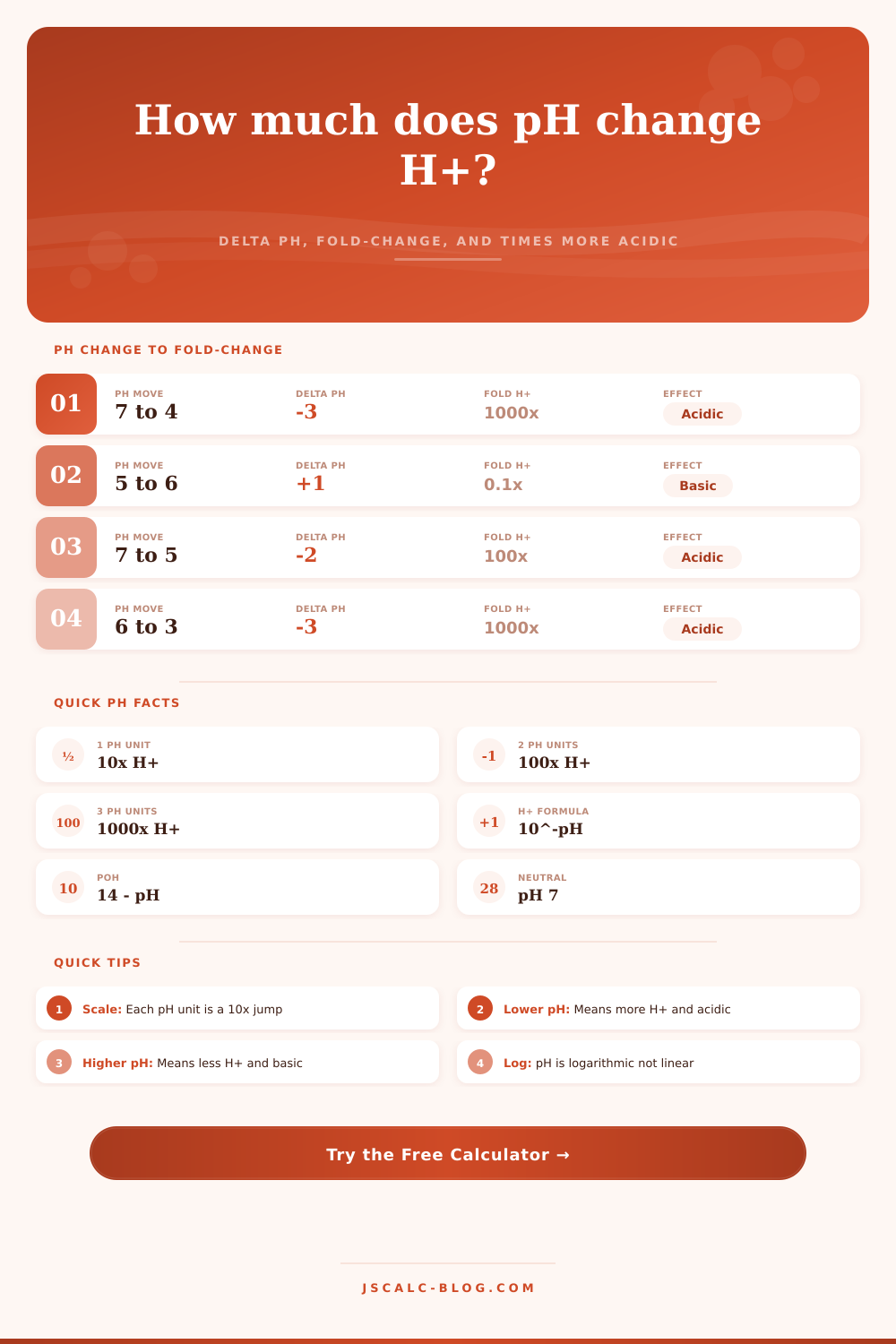
| 7 → 4 | −3.0 | 1000× | 1000× more acidic | +99900% | Water to acid |
| 7 → 5 | −2.0 | 100× | 100× more acidic | +9900% | Water to coffee |
| 7 → 6 | −1.0 | 10× | 10× more acidic | +900% | Water to milk |
| 7.4 → 7.2 | −0.2 | 1.58× | 1.58× more acidic | +58% | Blood acidosis |
| 5 → 6 | +1.0 | 0.1× | 10× less acidic | −90% | Coffee to milk |
| 4 → 7 | +3.0 | 0.001× | 1000× less acidic | −99.9% | Acid to water |
| 2 → 3 | +1.0 | 0.1× | 10× less acidic | −90% | Stomach dilute |
| 5.6 → 4.2 | −1.4 | 25.1× | 25× more acidic | +2412% | Rain to acid rain |
⚙Full Formula Breakdown
📋Reference Values
| Term | Definition | Formula | Note |
|---|---|---|---|
| pH | Acidity measure | −log10[H⁺] | Lower means more acidic |
| [H⁺] | Hydrogen ion conc. | 10^(−pH) | Units mol/L |
| ΔpH | pH change | pH final − pH initial | Sign shows direction |
| Fold-change | H⁺ ratio | 10^(ΔpH magnitude) | Each unit is 10× |
| pOH | Basicity measure | pKw − pH | 14 at 25°C |
| [OH⁻] | Hydroxide conc. | 10^(−pOH) | Units mol/L |
💡Practical pH Change Tips
Because the pH scale is written with whole numbers ranging from zero to fourteen, it’s easy to assume that the scale is linear. That kind of thinking are dangerous. The pH scale is logarithmic. Each number on the scale correspond to a 10-fold difference in hydrogen ion concentration. So while a pH 6 solution isn’t merely “a little more” acidic than a pH 7 solution, it’s 10X more concentrated with H+ ions. If a pH 4 solution were only three times stronger than a pH 7 solution, then it wouldn’t be called pH 4… It would be called pH 8. But that’s not true; a pH 4 is a thousand (yes: THOUSAND) times more concentrated with H+ ions than a pH 7.
So there you have it: your calculator tool. It connects the way we think about things linearly and the way chemistry realy works. By using this tool, you can take a simple before-and-after difference in pH and convert it to a real-world ratio, expressed as fold change. A common problem with most folks is seeing a fold change expressed as a number; What does it realy mean? How will it affect my lab experiment or the chemistry of water I am working on?
Understanding the pH Scale
Say you’re treating a swimming pool or tweaking the nutrient solution in your hydroponics setup. Knowing that the pH dropped (or rose) by one unit can help you know how to adjust things. However, when you know it changed by ten times its original level of acidity, you know just how much base to add to neutralize the change. This is important. The above calculator does the math for you after you enter your starting and ending points. You don’t have to do any power-of-ten mental gymnastics. It simply reports the ratio of how much more or less acidic the final solution was then the starting solution. That’s the key thing to know in order to safely make an adjustment.
As it turns out, though, the inputs are not as obvious as they seem at first glance. Yes, you enter starting pH and target pH, but then what? The tool calculates the delta (a.k.a. The difference) between them. That’s all fine. But then it feeds the delta value back into the log equation to determine the concentration multiplier. In target mode, if you want a certain fold-change, perhaps you want to dilute your acid so it is one hundred times less concentrated, you can work backwards from there. Tell it how much of a change you’re looking for (i.e., the reduction factor), and it will calculate the corresponding shift in pH. It’s reversible in this way, which is extremely useful when you don’t necessarily know what pH number you want, but do have some idea about what concentration you want.
The other frequently overlooked variable that can cause headaches when something goes wrong is temperature. Water does not always have a pH of seven (it’s neutral). That all depends on the ion product of water and how that changes with heat. The pH of neutral water actualy decreases as its temperature increases even though it remains chemically neutral. To account for this the tool allows you to choose various Kw values according to the temperature of the solution. Working with biological solutions at body temp or hot industrial water will throw off any notion of what is considered acidic if you assume the default neutral point. By adjusting for temperature change, you’re getting a better sense of true hydrogen ion activity as opposed to some faulty baseline assumption.
That’s an abstract bit of math brought down to earth by real world example. Take human blood for instance. Blood must be very precisely maintained within a narrow range; between pH 7.35 and 7.45. At first glance, a difference of only 0.2 units might not seem like much. But that little adjustment means a whopping 58 percent change in terms of hydrogen ions. That’s what makes acidosis such a lethal condition. Even slight adjustments in H+ are increased greatly on this logarithmic scale and cannot be tolerated by our bodies.
The reference tables provided with the tool make these comparisons clear. The tool connects items like bleach or lemon juice to their ion concentrations compared to neutral water. The reason for common errors is that pH is treated as if it were a linear phenomenon. You think if you mix two acids then the resulting pH will be somewhere between them. That’s wrong. You’re not averaging numbers, you’re averaging concentrations. Adding more of a strong acid doesn’t add twice the pH. It adds to the concentration, which increase by a certain amount depending on your starting point. That’s why people make deadly dosing mistakes, and wrongly predict what reactions will do.
Keeping the ratio simple takes the mystery out of the tool. In the end, what we’ve learned about pH change is this: Respect it, because the scale has enormous strength. That little mark on the dial means a gigantic change in chemistry. Whether you’re tweaking your soil to make it friendly for plants or adjusting an industrial waste load before dumping it into a river, you must understand that twice as big a number isn’t simply double; it is a hundred percent more. When this happens again and again, it makes the difference between life and death. Keep exponential growth in mind every time you see a pH meter. Let the chemistry get away with its lies; don’t let the numbers do so.