pH Temperature Correction Calculator
Correct a pH meter reading taken at any solution temperature back to a 25°C reference. The tool applies the Nernstian electrode slope pivoting around isopotential pH 7 and an optional solution temperature coefficient.
🧪Real Sample Presets
📝Reading Inputs
The pH the meter shows at the sample temperature.
Temperature of the sample when measured.
Target temperature to report at, usually 25°C.
ATC corrects the mV-to-pH slope inside the meter.
How the true pH of this sample shifts per degree.
Standard glass electrodes pivot at pH 7.00.
🔢Nernst Slope Snapshot
🌡Nernst Slope By Temperature
| Temperature | Slope S(T) mV/pH | Slope Factor 298.15/T | vs 59.16 mV |
|---|---|---|---|
| 0°C (273.15 K) | 54.20 | 1.0915 | -4.96 mV |
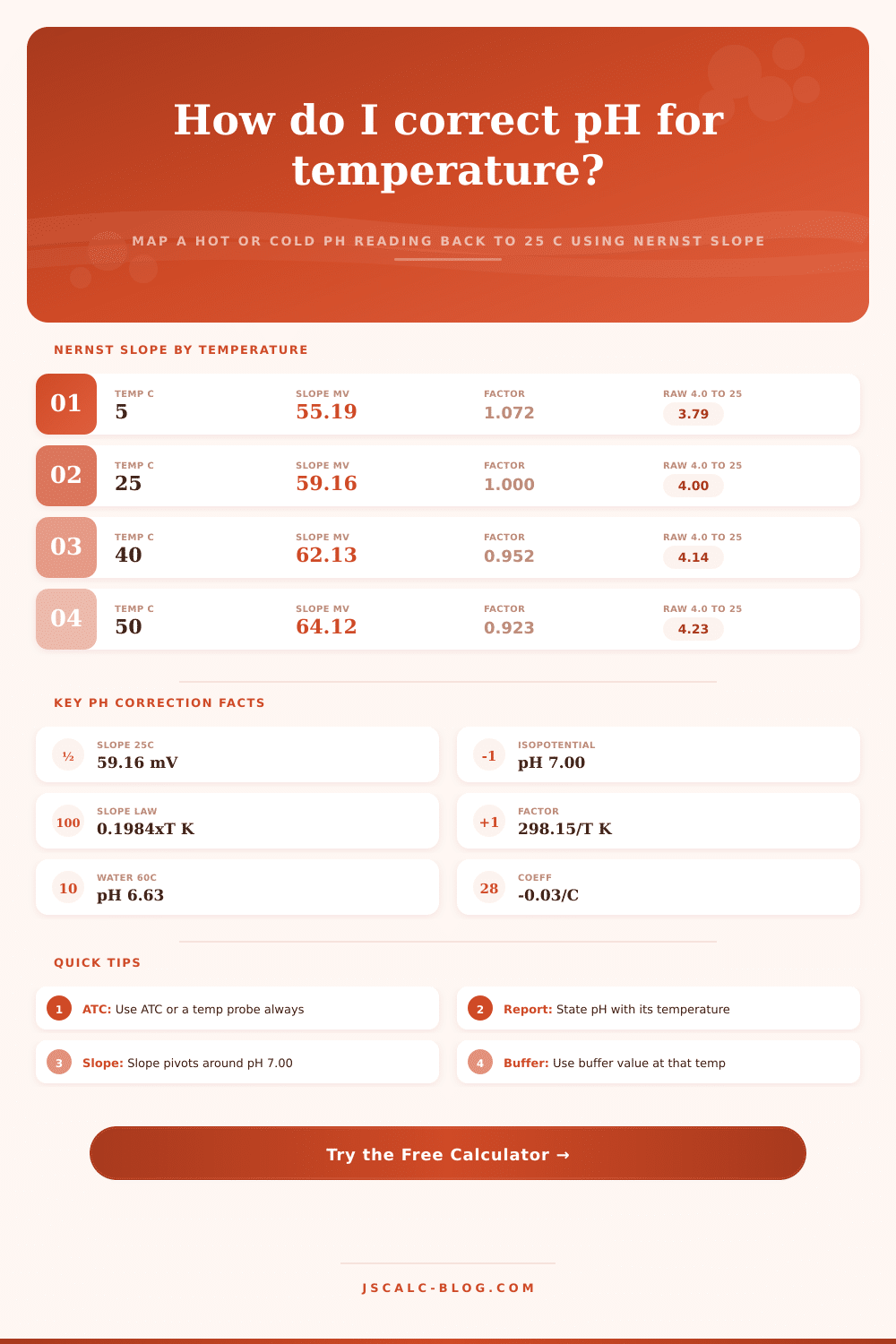
| 5°C (278.15 K) | 55.19 | 1.0719 | -3.97 mV |
| 10°C (283.15 K) | 56.18 | 1.0530 | -2.98 mV |
| 20°C (293.15 K) | 58.17 | 1.0171 | -0.99 mV |
| 25°C (298.15 K) | 59.16 | 1.0000 | 0.00 mV |
| 30°C (303.15 K) | 60.15 | 0.9835 | +0.99 mV |
| 40°C (313.15 K) | 62.13 | 0.9521 | +2.97 mV |
| 50°C (323.15 K) | 64.12 | 0.9226 | +4.96 mV |
| 60°C (333.15 K) | 66.10 | 0.8949 | +6.94 mV |
| 80°C (353.15 K) | 70.07 | 0.8443 | +10.91 mV |
🧴Buffer pH vs Temperature
| Temp °C | 4.01 Buffer | 6.86 Buffer | 7.00 Buffer | 9.18 Buffer | 10.01 Buffer |
|---|---|---|---|---|---|
| 5°C | 4.00 | 6.95 | 7.09 | 9.39 | 10.25 |
| 10°C | 4.00 | 6.92 | 7.06 | 9.33 | 10.18 |
| 20°C | 4.00 | 6.88 | 7.02 | 9.23 | 10.06 |
| 25°C | 4.01 | 6.86 | 7.00 | 9.18 | 10.01 |
| 30°C | 4.01 | 6.85 | 6.99 | 9.14 | 9.97 |
| 40°C | 4.03 | 6.84 | 6.97 | 9.07 | 9.89 |
| 50°C | 4.06 | 6.83 | 6.97 | 9.01 | 9.83 |
| 60°C | 4.09 | 6.84 | 6.98 | 8.96 | 9.77 |
💧Temp Coefficient By Solution
| Solution Type | Coefficient pH/°C | Direction | Note |
|---|---|---|---|
| Pure / DI water | -0.0175 | Falls when hot | pH 7.00 at 25 to ~6.63 at 60 |
| Neutral buffer pH 7 | -0.0010 | Very stable | Well buffered near neutral |
| Acid buffer pH 4 | +0.0020 | Slight rise | Small positive coefficient |
| Alkaline buffer pH 10 | -0.0090 | Falls when hot | Larger negative shift |
| Natural / surface water | -0.0030 | Falls when hot | Typical field default |
| Boiler / feed water | -0.0300 | Strong drop | High-purity, big swing |
⚖ATC vs Manual Correction
| Aspect | ATC (Automatic) | Manual / No ATC | What To Do |
|---|---|---|---|
| Slope handling | Meter uses S(T) | Meter assumes 59.16 | Apply slope factor |
| Probe needed | Temp sensor built in | Read temp separately | Log solution temp |
| Solution shift | Not corrected | Not corrected | Use coefficient |
| Best accuracy | Near pH 7 | Fine only at 25°C | Calibrate at temp |
| Reporting | Still state temp | Always state temp | pH @ °C |
🗂Temperature Correction Comparison Grid
| Temp °C | Kelvin | Slope mV/pH | Slope Factor | Raw 4.00 to 25 | Raw 9.00 to 25 |
|---|---|---|---|---|---|
| 0°C | 273.15 | 54.20 | 1.0915 | 3.73 | 9.18 |
| 5°C | 278.15 | 55.19 | 1.0719 | 3.78 | 9.14 |
| 10°C | 283.15 | 56.18 | 1.0530 | 3.84 | 9.11 |
| 20°C | 293.15 | 58.17 | 1.0171 | 3.95 | 9.03 |
| 25°C | 298.15 | 59.16 | 1.0000 | 4.00 | 9.00 |
| 30°C | 303.15 | 60.15 | 0.9835 | 4.05 | 8.97 |
| 40°C | 313.15 | 62.13 | 0.9521 | 4.14 | 8.90 |
| 50°C | 323.15 | 64.12 | 0.9226 | 4.23 | 8.85 |
| 60°C | 333.15 | 66.10 | 0.8949 | 4.32 | 8.79 |
| 80°C | 353.15 | 70.07 | 0.8443 | 4.47 | 8.69 |
⚙Full Formula Breakdown
📋Correction Reference Values
| Item | Typical Value | How It Is Used | Effect On Result |
|---|---|---|---|
| Theoretical slope | 59.16 mV/pH | Reference at 25°C | Baseline for factor |
| Slope constant | 0.19841 mV/K | S(T) = var × T(K) | Sets slope vs temp |
| Isopotential pH | 7.00 | Pivot for rescale | No shift at pH 7 |
| Solution coefficient | -0.003 to -0.03 | Shift × delta temp | Adjusts true pH |
| Reference temp | 25°C | Report target | Sets correction goal |
💡Practical pH Correction Tips
This is a typical scenario: You put a probe into some hot water from your boiler. Your meter indicate 4.2. You look at it, like “Oh good,” your water is acidic enough for this application. Then you remember the water is boiling. Oops. That’s not only incorrect, it’s wildly misleading.
PH is incredibly temperature-sensitive, and failing to take into account the cold/hotness of your sample will result in batch spoilage in a kitchen setting or potentially terribel consequences in an industrial process. Why? It’s simple physics, but it seems to be widely misunderstood because users assume the digital number represent reality, not merely a piece of information requiring context.
Why Temperature Changes pH Readings
So why does this matter? It comes down to the Nernst equation… The equation that describes relationship between hydrogen ions (H+) and the voltage produced by glass electrodes. What a pH meter do is take these millivolts and convert them into pH units based on a slope factor. That slope factor are approximately 59 millivolts per pH unit at standard temperature of 25 degrees Celsius.
But that slope becomes larger the higher the temperature go. At 50 degrees Celsius, for example, that slope theoreticallly rockets up to around 64 millivolts. Your meter, if not temperature compensated automatically, continue to apply the 25 degree baseline. In effect, it will then underestimate the acidic nature of warm samples, while overestimating their alkaline nature.
The calculator above will crunch those numbers for you. It adjusts for this physical change and shows you what it would read at a standard reference point.
The other factor is the chemistry of the solution itself. Though pure water is neutral, its dissociation constant are affected by temperature, making pure water more acidic at higher temps. Engineers working with processes like steam systems or boiler feedwater add a temperature coefficient. This accounts for the fact that any reading must be corrected back to 25 degrees. That’s different from the electrode slope correction. The chemical correction takes into account the actual change in the fluid’s chemistry.
With pool water or wine must, for example, which may have some kind of chemical buffering capacity to them, that second correction isn’t necessarily as important. But if you’re working in an industrial process like a high-purity steam system, lack of that coefficient could lead to corrosion damage rather than safe operation.
Note that calibration is also important here. Most technicians calibrate using room temp buffers and then test samples which are either warmer or cooler than that. If they skip the temperature correction step during measurement, they aren’t adjusting for temperature! So what they are doing is comparing apples to oranges. The meter treats the probe as if it’s acting like it did at 25 degrees even though in reality it isn’t.
You do not have to memorize the Nernst constants or lug a fat handbook full of slope factors around with you. The reference table on the page spells out the change in those values over a broad range of temperatures so it is obvious just how much of an effect there is as you get away from that cozy 25-degree starting point.
So how do you know what to put in? Mostly because you understand what you’re entering. Basically you’re telling the computer to reverse engineer your electrode response based off the raw pH you entered along with the temperature of sample. Then you specify if your meter use automatic compensation. If so, the device handles it internally and you only need to adjust for the chemical solution shift. If not, then you have two adjustments. This results in a standard number which you can compare to your past numbers and/or your regulator’s limits set at standard conditions.
Remember: the pH value is not reported without the temperature! Most people don’t realize that, so they never report it. Now you can have a pH value of 7.0 which tells you exactly nothing unless you also know if it was measured in a furnace or a freezer. Reporting the conditions of any measurement will only help others reviewing your notes later know what you’re talking about.
This may seem like a tiny habit but it makes a huge difference when troubleshooting and ensuring quality control. It all boils down to respect for the variables affecting your pH reading. Water chemistry change with heat. The electrical signal from your probe also gets distorted by the heat. Unless you correct these, you’ll make a decision based on false confidence…bad news.
You should of corrected it earlier. When you apply the right corrections, you remove the temperature fluctuation “noise” and return to the truth of the solution’s state. It’s worth the additional few seconds you spend plugging in the numbers.