Essential Oil Dilution Calculator
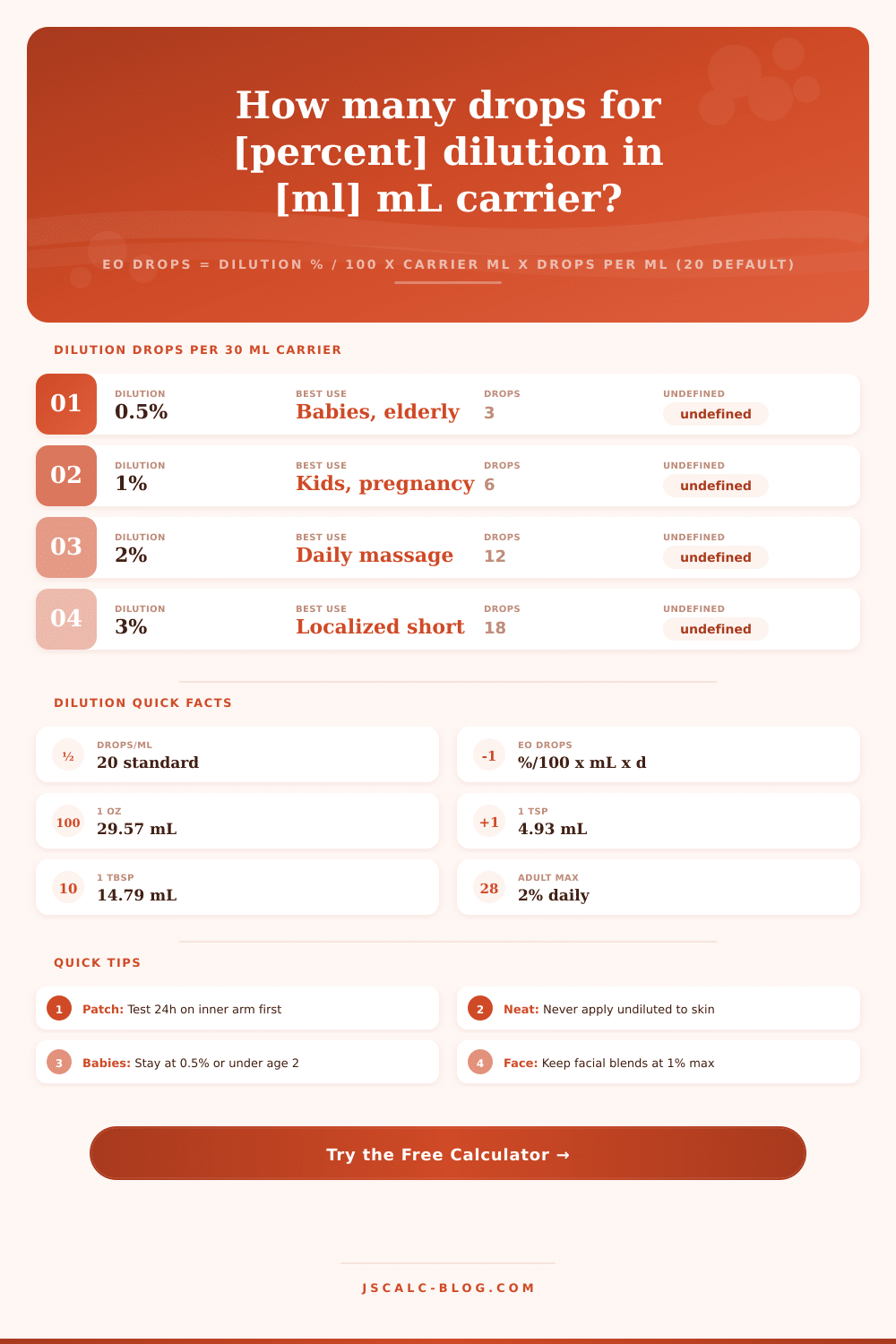
Blend aromatherapy oils safely using EO drops = dilution percent divided by 100, times the carrier volume in mL, times the drops per mL. Solve for the drops you need at a target dilution, or check the actual percentage from the drops you already added, with carrier conversions for mL, ounces, teaspoons, and tablespoons.
🌿Choose a Mode
🎯Real Aromatherapy Blend Presets
📝Blend Inputs
How much base oil, butter, or lotion your blend uses.
Converted to mL before the drops are worked out.
Pick a use to auto-fill a safe dilution, or choose Custom.
Percent of the finished blend that is essential oil.
Orifice reducers vary; 20 is the common average.
Total drops are split evenly across this many oils.
Used in percent mode to find your actual dilution.
Drops must be whole; volumes and % follow this setting.
🔢Formula Snapshot
📋Dilution by Age and Use (per 30 mL)
| Dilution | Who or What | Drops per 30 mL | Reads As |
|---|---|---|---|
| 0.25% | Very delicate facial | 1-2 drops | Ultra gentle |
| 0.5% | Babies 6-24mo, elderly | 3 drops | Sensitive skin |
| 1% | Children 2-6, pregnancy, face | 6 drops | Daily full body |
| 2% | General adult massage, lotion | 12 drops | Most common |
| 3% | Localized short term relief | 18 drops | Targeted |
| 5% | Acute localized muscle | 30 drops | Short bursts |
| 10% | Spot and roller perfume | 60 drops | Small area |
| 20% | Natural solid perfume | 120 drops | Scent only |
💉Roller Bottle Drop Chart (10 mL)
| Dilution | EO Drops in 10 mL | EO Volume | Typical Roller Use |
|---|---|---|---|
| 0.5% | 1 drop | 0.05 mL | Kids or facial roller |
| 1% | 2 drops | 0.10 mL | Gentle daily roller |
| 2% | 4 drops | 0.20 mL | Everyday body roller |
| 3% | 6 drops | 0.30 mL | Tension or headache |
| 5% | 10 drops | 0.50 mL | Sore muscle roller |
| 10% | 20 drops | 1.00 mL | Roller perfume blend |
📏Carrier Unit to Milliliter Conversions
| Carrier Unit | Equals in mL | Drops at 20/mL | Note |
|---|---|---|---|
| 1 mL | 1 mL | 20 drops | Base metric unit |
| 1 teaspoon | 4.92892 mL | about 99 drops | US tsp |
| 1 tablespoon | 14.7868 mL | about 296 drops | 3 tsp |
| 1 fluid ounce | 29.5735 mL | about 591 drops | 2 tbsp |
| 2 fluid ounces | 59.147 mL | about 1183 drops | Common lotion jar |
| 4 fluid ounces | 118.294 mL | about 2366 drops | Large bottle |
🗃EO Drops by Carrier Size and Dilution
| Carrier Size | 0.5% | 1% | 2% | 3% | 5% | 10% |
|---|---|---|---|---|---|---|
| 5 mL | 0-1 | 1 | 2 | 3 | 5 | 10 |
| 10 mL | 1 | 2 | 4 | 6 | 10 | 20 |
| 15 mL | 2 | 3 | 6 | 9 | 15 | 30 |
| 30 mL (1 oz) | 3 | 6 | 12 | 18 | 30 | 60 |
| 59 mL (2 oz) | 6 | 12 | 24 | 35 | 59 | 118 |
| 100 mL | 10 | 20 | 40 | 60 | 100 | 200 |
| 120 mL (4 oz) | 12 | 24 | 48 | 72 | 120 | 240 |
⚙Formula Breakdown
💡Safe Blending Tips
This is the dilution percentage calculator for essential oils for aromatherapy applications. It takes the mystery out of blending essential oils safely.
Each diluted solution contain only two ingredients, an ingredient with some concentration (the “essential oil”), and an ingredient that holds it (the “carrier”). The carrier might be lotion, butter, or another type of oil. The ratio of one to the other is called the “dilution percentage,” and using the proper ratio guarantees that resulting blend will heal instead of harm the skin. This calculator puts those simple ratios into practical numbers so you know exactly what goes into each of your blends at the blending table.
How to Use the Essential Oil Dilution Calculator
The remaining part of the mix are called the carrier and is expressed as a dilution percentage. So if it says 2%, then there are two percent essential oil to 98 percent carrier. Essential oils are extremely potent substances. Even small amounts such as single-digit percentages will still amount to a generous dose of those aromatic compounds when applied on the skin.
By default, the calculator uses the most common reference point. Drops per milliliter. And assumes there are 20 drops per ml. That’s reasonable enough for most blends but it depends on your bottle. The average orifice reducer dispense roughly 20 drops per milliliter. However, this can vary with thickness of the oil. Thin oils might be closer to 15 drops, while thick ones may be up to 25. You’ll get much better results choosing your own drop rate from the calculator, which means your final recipe will match what you have in your bottles different than an arbitrary average.
It’s all about the math (the primary equation): essential oil drops = (dilution percent ÷ 100) × (carrier volume in milliliters) × (drops per milliliter). A typical scenario: How many drops of essential oil go into 30 mL of carrier at 2% dilution rate? Answer: 20 drops per milliliter. So we multiply like this: (2 ÷ 100) x 30 ml x 20 drops/ml = 12 drops. It’s an everyday massage strength that works well for adults and is a popular recipe in aromatherapy. It is easy to remember and one of the most frequently used blends. The formula automatically adjust as any variable is changed. Double your carrier to 60 mL? That’s 24 drops. Want to halve your strength to a 1% facial blend? Use just 6 drops in same amount.
The tool offers two modes: one is for figuring out how much to drop (target dilution) and the other is for telling you what your dilution was after dropping something (actual dilution). You get real blending questions from both directions. The tool can handle either way, whether you are starting with a target dilution or checking what you already made. The calculator divides drops by the rate to find the volume of essential oil you are adding to the blend. That volume is then included in actual dilution calculation.
Where and how it’s used determines safe dilution. Dilutions of 0.5% are fine on sensitive skin, such as for the elderly, babies from 6 to 24 months, or for daily use on the face. 1% is good for everyday all-over use, pregnancy, kids up to 12 years old. General adult lotion and massage uses the familiar 2%. For more intense needs: 3% for localized/short term; 5% for acute musculoskeletal issues affecting a limited area; 10% for roller perfume/perfume/oily spots only. Natural perfumes can climb to 15% or higher because they are about scent rather than skin therapy. When you select a reason for using the oil, it automatically populates with the recommended percentage.
The calculator also includes an ingredient converter so you can plug in how much carrier you have. You can use whichever measurement your recipe calls for, since recipes often use different measurements. For example, a tablespoon is approximately 14.79 mL, a teaspoon is about 4.93 mL, and a fluid ounce is around 29.57 mL. If you are making a lotion that holds 2 oz, you might want to know how many drops of essential oil are needed. You would of need about 24 drops for a 2% dilution in a 2 oz lotion. And since the carrier will hold about 59 mL in a 2 oz lotion jar, the tool takes the number of drops needed at a 2% dilution and plugs those numbers together.
The ten presets include recipes that everyone turns to all the time: from a nice face serum to a potent muscle rub. A single tap will load in the whole recipe. Most recipes use more than one oil. This tool automatically divides total number of drops equally between whatever number of oils you enter. For example, if your blend calls for 12 drops of three different oils, you’ll get four drops of each. It is a small detail, but it makes the blend consistent.
There’s no magic recipe to keep you safe. There are two habits of safe blending that will do a lot more to keep your skin happy than any mix. Always patch-test a new combination. First, apply it to the inner forearm, then wait 24 hours before using it anywhere else. And never apply essential oil undiluted (known as neat), and never go beyond the safe maximum percentage by age, which means never more than 1 percent for facial blends and 0.5 percent or less for babies.
This easy-to-use chart includes safe dilutions, unit conversions, and the core formula all in one spot. This lets you blend with confidence when making a rich natural perfume or a gentle roller for a little one. Having that ratio just right is the difference between irritation and something soothing.