Molarity to Percent Calculator
Convert molarity to percent by weight per volume and weight per weight, or work the reverse, using molar mass and solution density. Includes grams of solute per 100 mL and a full conversion breakdown.
🧪Real Reagent Presets
📝Conversion Inputs
Used when direction is Molarity → Percent.
Used when direction is Percent → Molarity.
Bridges % w/v and % w/w. Water is about 1.00 g/mL.
🔢Formula Snapshot
⚙Full Conversion Breakdown
📊Common Reagent Molarity vs Percent
| Reagent | Molar Mass | Molarity | % w/v | Density | % w/w |
|---|---|---|---|---|---|
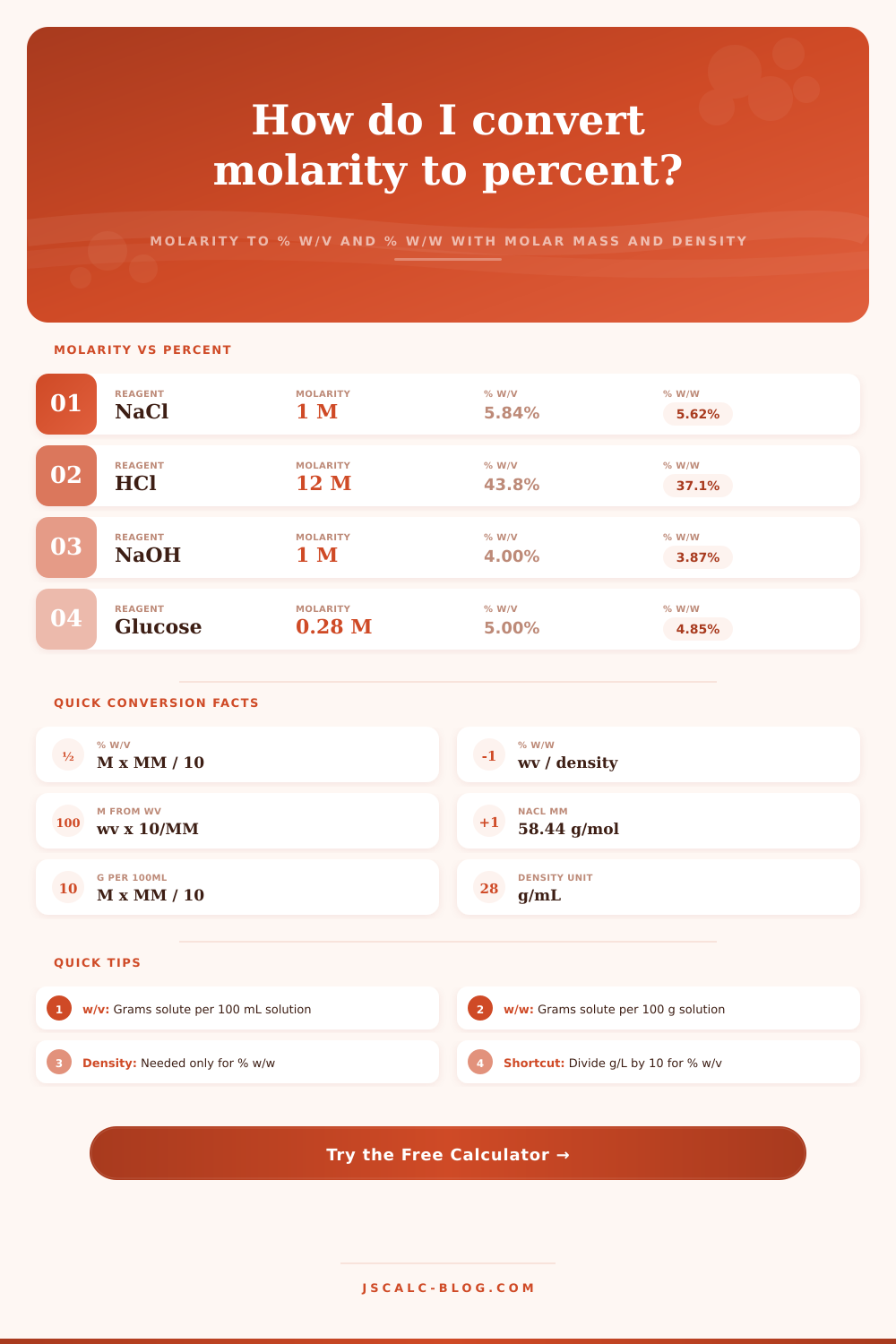
| Sodium chloride | 58.44 | 1.00 M | 5.84% | 1.04 | 5.62% |
| Hydrochloric acid | 36.46 | 12.0 M | 43.75% | 1.18 | 37.08% |
| Sodium hydroxide | 40.00 | 1.00 M | 4.00% | 1.04 | 3.85% |
| Sulfuric acid | 98.08 | 18.0 M | 176.5% | 1.84 | 95.9% |
| Glucose | 180.16 | 0.278 M | 5.00% | 1.02 | 4.90% |
| Hydrogen peroxide | 34.01 | 0.882 M | 3.00% | 1.01 | 2.97% |
| Acetic acid | 60.05 | 0.833 M | 5.00% | 1.006 | 4.97% |
| Ammonia | 17.03 | 14.5 M | 24.69% | 0.90 | 27.4% |
🗂Compound Comparison Grid
| Compound | Molar Mass | % w/v at 1 M | Density | % w/w at 1 M | M for 5% w/v |
|---|---|---|---|---|---|
| NaCl | 58.44 | 5.84% | 1.04 | 5.62% | 0.856 M |
| KCl | 74.55 | 7.46% | 1.03 | 7.24% | 0.671 M |
| NaOH | 40.00 | 4.00% | 1.04 | 3.85% | 1.250 M |
| KOH | 56.11 | 5.61% | 1.04 | 5.40% | 0.891 M |
| HCl | 36.46 | 3.65% | 1.02 | 3.58% | 1.371 M |
| Glucose | 180.16 | 18.02% | 1.06 | 17.00% | 0.278 M |
| Sucrose | 342.30 | 34.23% | 1.08 | 31.69% | 0.146 M |
| CaCl2 | 110.98 | 11.10% | 1.05 | 10.57% | 0.451 M |
| MgSO4 | 120.37 | 12.04% | 1.05 | 11.46% | 0.415 M |
| Acetic acid | 60.05 | 6.01% | 1.01 | 5.95% | 0.833 M |
🧴Density of Common Solutions
| Solution | Concentration | Density g/mL | Note |
|---|---|---|---|
| Pure water | 0% | 1.000 | Reference at 20 C |
| Saline | 0.9% w/v | 1.005 | Physiological |
| NaCl brine | 10% w/w | 1.071 | Table salt |
| Sodium hydroxide | 10% w/w | 1.109 | Caustic soda |
| Sulfuric acid | 98% w/w | 1.840 | Concentrated |
| Hydrochloric acid | 37% w/w | 1.180 | Fuming |
| Nitric acid | 70% w/w | 1.413 | Concentrated |
| Ammonia | 28% w/w | 0.898 | Lighter than water |
| Ethanol | 70% v/v | 0.885 | Sanitizer grade |
📋% w/v vs % w/w and Molar Masses
| Basis | Definition | Needs Density? | Convert To Other |
|---|---|---|---|
| % w/v | g solute / 100 mL solution | No for molarity | % w/w = % w/v ÷ density |
| % w/w | g solute / 100 g solution | Yes | % w/v = % w/w × density |
| g/L | g solute / 1 liter solution | No | % w/v = g/L ÷ 10 |
| Molarity | mol solute / 1 liter solution | No for w/v | g/L = M × molar mass |
| NaCl MM | 22.99 + 35.45 | n/a | = 58.44 g/mol |
| H2SO4 MM | 2 + 32.06 + 64 | n/a | = 98.08 g/mol |
💡Practical Conversion Tips
Ah, yes,” you say, “the thirty-seven percent hydrochloric acid, whose label only vaguely describes how many moles of reactants is present in the bottle.” If you’re an operator, technician, or chemistry student tasked with precise measurements, you know what I mean; percentages are fine for cleaning and cooking, but when it comes to stoichiometry, you can’t count molecules with them. That’s where molarity comes in: It counts the number of particles, not the weight of each one. It is tricky to switch between these two systems without a way to translate them. The calculator on this page fills that gap.
Now you can do chemistry without math. This come down to the distinction between mass vs. Volume. How much salt would be needed to make a one molar solution of sodium chloride? You’d want to take fifty-eight point four four grams of salt and dissolve it into enough water to make one liter of final solution.
Why Density Matters in Chemistry Calculations
That sounds simple enough until you think about what weight percentage would be by volume. It turns out to be approximately five point eight percent. This assumes you know how to get the molar mass and understand that salt water has higher density than pure water. And most folks just pull numbers from some chart or previous estimates which they guessed at. But there’s no reason to do that because the math is certain given appropriate inputs.
The connection between mass-based and volume-based percentages are expressed by density. In other words, weight per volume percent is a linear relationship of grams divided by 100 mL. It doesn’t care about how dense your solution has became. Weight per weight percent must be calculated with knowledge of the weight of the entire mixture. When you mix water with sugar, more mass doesn’t result in more volume. Why? This is because molecules pack together. You need to know density to get an accurate weight-per-weight calculation.
If you don’t account for it in concentrated solutions like brine or acid, your results will be off by several percentage points; this screws up both product formulations and titration curves. Sulfuric acid at 95% by weight is very different than sulfuric acid at 95% by volume because the liquid is nearly twice as dense as water. Ninety five percent by volume isn’t even close to ninety five percent by weight; that makes a difference when you’re dealing with a highly toxic substance like sulfuric acid, don’t treat those terms interchangeably.
The calculator takes that into account automatically because it knows typical densities for popular reagents from a built-in list. If your conditions aren’t typical (e.g. If you use a non-standard solution or need to set a specific buffer, enter actual densities manually. This gives you results that fit the real world instead of the theoretical world presented in textbooks.
Industrial protocols uses weight percent to weigh out bulk amounts of chemicals but academic labs usually want molarity since their experiments involves moles of particles. You need a way to convert between them that’s consistent so results from different facilities and teams will be repeatable. Common reagents (sodium hydroxide, hydrochloric acid) has different concentrations based off which scale you’re using as shown in the reference tables. Seeing both side-by-side helps develop an intuitive sense for when slight changes in density make a difference or when it doesn’t matter.
You must know just what you have, know precisely what went into a solution, and communicate clearly with coworkers. Whether it’s mixing up buffer solutions for enzyme work or preparing saline for a medical procedure, knowing exactly how much of the solute you’ve got there makes things safe and efficient. You won’t have to pull molar masses from memory, search through density tables, or wonder if your assumptions about this solution’s properties are correct.
Let the computer do all the fancy algebra stuff; check the output and see if your assumptions were sound. You should of gotten chemical concentration back under control; know that when you put those 58.44 grams of salt in enough water to make one liter of solution, it’ll act like it should.