Molarity to Normality Calculator
Convert molarity to normality with N = M × n, or reverse with M = N / n. Pick a compound to set the equivalence factor n, then read equivalents per liter and equivalent weight.
🧪Common Solution Presets
📝Conversion Inputs
Used when direction is M to N.
Used when direction is N to M.
Reactive units per mole: H+ for acids, OH- for bases, charge or electrons for salts and redox.
🔢Formula Snapshot
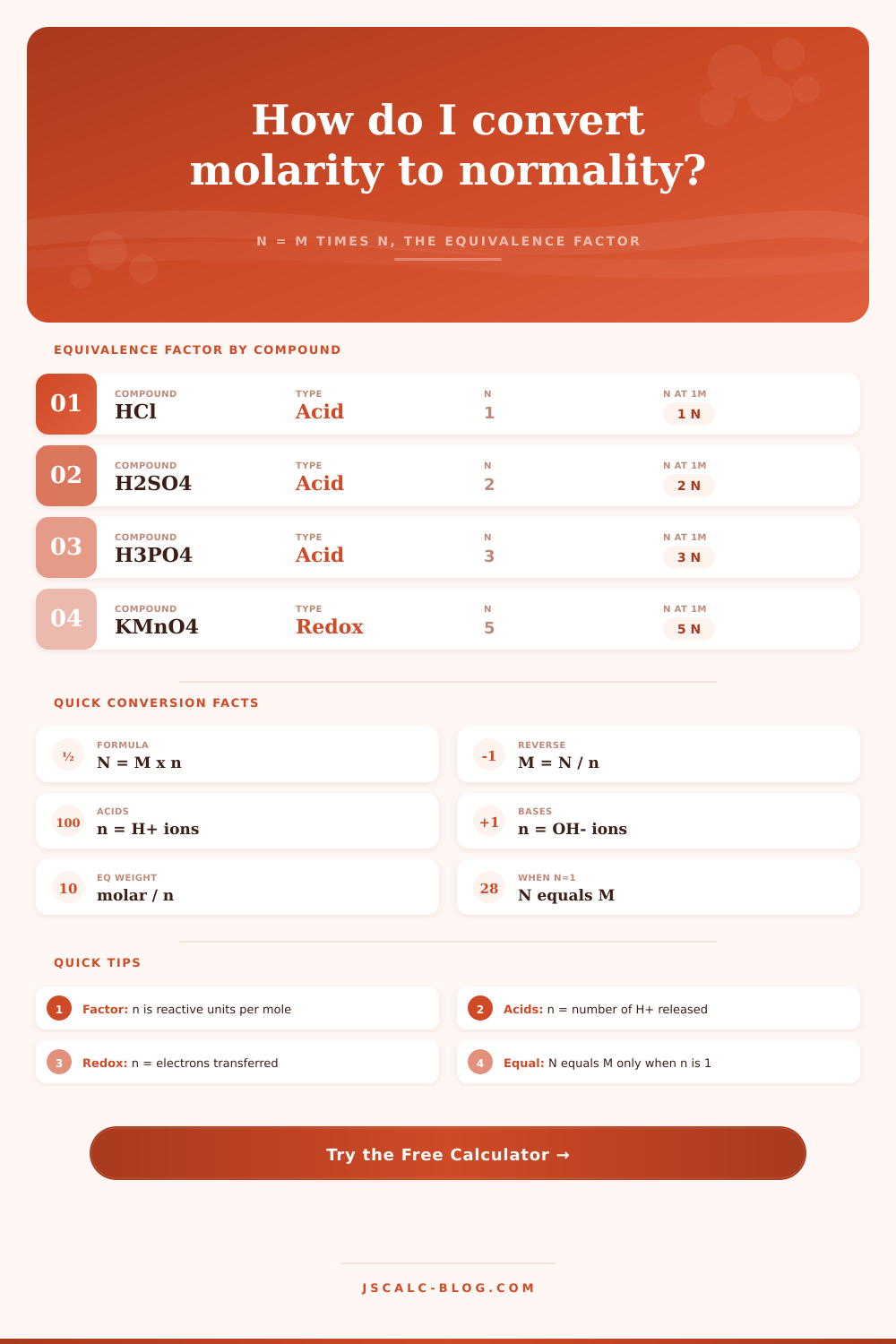
🗂Equivalence Factor by Compound
| Compound | Type | n (equiv/mol) | N at 1 M | Molar Mass | Eq Weight |
|---|---|---|---|---|---|
| HCl | Strong acid | 1 | 1 N | 36.46 g/mol | 36.46 g/eq |
| H2SO4 | Diprotic acid | 2 | 2 N | 98.08 g/mol | 49.04 g/eq |
| H3PO4 | Triprotic acid | 3 | 3 N | 97.99 g/mol | 32.66 g/eq |
| HNO3 | Strong acid | 1 | 1 N | 63.01 g/mol | 63.01 g/eq |
| NaOH | Strong base | 1 | 1 N | 40.00 g/mol | 40.00 g/eq |
| Ca(OH)2 | Diacidic base | 2 | 2 N | 74.09 g/mol | 37.05 g/eq |
| Na2CO3 | Carbonate base | 2 | 2 N | 105.99 g/mol | 53.00 g/eq |
| KMnO4 | Redox (acidic) | 5 | 5 N | 158.03 g/mol | 31.61 g/eq |
| NaCl | 1:1 salt | 1 | 1 N | 58.44 g/mol | 58.44 g/eq |
📊Molarity to Normality Examples
| Solution | Molarity | n | Normality (M × n) |
|---|---|---|---|
| 1 M HCl | 1 M | 1 | 1 N |
| 2 M H2SO4 | 2 M | 2 | 4 N |
| 0.5 M H2SO4 | 0.5 M | 2 | 1 N |
| 1 M H3PO4 | 1 M | 3 | 3 N |
| 0.5 M NaOH | 0.5 M | 1 | 0.5 N |
| 1 M Ca(OH)2 | 1 M | 2 | 2 N |
| 0.02 M KMnO4 | 0.02 M | 5 | 0.1 N |
| 1 M Na2CO3 | 1 M | 2 | 2 N |
⚖Acid, Base, and Redox n Rules
| Species Type | What n Counts | Example | n Value |
|---|---|---|---|
| Monoprotic acid | H+ ions released per mole | HCl, HNO3 | 1 |
| Diprotic acid | H+ ions released per mole | H2SO4 | 2 |
| Triprotic acid | H+ ions released per mole | H3PO4 | 3 |
| Monoacidic base | OH- ions released per mole | NaOH, KOH | 1 |
| Diacidic base | OH- ions released per mole | Ca(OH)2 | 2 |
| Salt | Total cation charge per mole | Na2CO3 | 2 |
| Redox agent | Electrons transferred per mole | KMnO4 (acidic) | 5 |
⚙Full Formula Breakdown
💡Practical Conversion Tips
Suppose you’re looking at a bottle of sulfuric acid. The label indicates that it is two molar. For purposes of your titration, you want to know how many equivalents are contained in this solution, but you pause because you don’t realy feel like counting up the protons. This isn’t math class; it’s chemistry. It’s not simply a matter of calculation. It’s a question of understanding the nature of molecule itself upon dissolving.
Moles count. That’s what molarity measures. Reactive capacity counts. That’s what normality measures. The words sound similar, but they are very different concepts. One describes quantity of material present. The other describes the strength with which that material strikes in a given chemical reaction.
Why Molarity and Normality Are Different
Now all we have to do is select our compound and enter the concentration, and the calculator does math for us above. No need to flip through reference books for equivalence factor. Select the substance, input the molarity, hit go and normality pops right out. The kicker is not so much the number as understanding what effect the equivalence factor has on it.
Hydrochloric acid? Its factor is one. It produces one equivalent of hydrogen ions per mole. A one molar solution are therefore also a one normal solution. And then there’s sulfuric acid. With two protons to give up, it doubles the reactive punch per mole. A two-molar solution is four normal. Same concentration of particles, different level of chemical leverage.
Why does that matter? Most importantly, it matters when we’re doing a titration. This means you have an acid and you’re going to neutralize it using a base. How many hydrogen ions is there? And how many hydroxide ions are there? Because each mole isn’t equal, depending on what’s inside it, if you pretend they are, then your endpoint won’t match reality. You’ll get off by a bit. The results will wander around.
Textbooks train students into thinking this way; molarity’s what you see first. It’s the go-to unit in general chemistry. Normality lives when reactions take place. It measures directly in terms of reactive capacity. For that reason, even though it is used less often elsewhere, it sticks around in analytical lab.
On page, those factors are laid out as a reference table. See how in acidic conditions, potassium permanganate leap up to a 5? That’s because five electrons get transferred when it gets reduced. Until you write out the half-reaction, it looks arbitrary, but then it makes total sense. For every mole of permanganate, five moles of electron get accepted. So every mole is five equivalents of oxidizing power.
The calculator figures all this out automatically. Just trust that the chemistry work correctly for your specific reaction conditions. There is more, though. Redox reactions further complicate things by making this dependent upon conditions. For example, permanganate reacts different than in acidic media compared to basic ones. The number of electrons it transfers change. What we’re talking about here is something called its electron transfer count.
So normality isn’t just something inherent to a given compound. In fact, normality is dependent upon reaction context as well. That’s why you might have the same solution be one normal in one titration and a different normal in another. And, yes, that’s the part that always catches people off guard, because they think the label on the bottle give them the full picture. It doesn’t. It only gives you half the information; you need to pair the factor with conditions of your experiment.
And that’s where the equivalence factor comes in; it connects mass to reactivity, tying everything back to a common value: its own equivalent weight. Grams per equivalent equals the molar mass divided by equivalence factor. Now you can weigh exactly what you need without having to calculate moles beforehand. That saves an incredible amount of preparation work. You don’t have to mess around with crazy fractions. Just measure out the mass in terms of reactive units.
And there is the calculation too. The tool displays both at once. There they are! You see the reason for inventing normality. It covers the range from measuring solid masses to carrying out chemical reactions. Or you may ask yourself if you should of bother to memorize both units at all? For storage and shipment, molarity reigns supreme. However, normality comes into play when you are actualy analyzing a sample.
Avoid mistakes by knowing when one is appropriate over the other. Using molarity for dilutions is generally safer. This won’t vary depending on reaction conditions. Use normality when combining reagents for redox steps or neutralizations. Here, normality corresponds exactly with stoichiometry, eliminating the need to balance equations mentally each time you grab buret.
It’s not so much that you have to remember equations, but rather that you have to visualize how these units work together. You count both molecules and reactive site. And when you change your thinking from “quantity” to “capacity,” the whole process doesn’t feel like homework anymore. It turns into translating one form of seeing a solution into another.
It begins to make sense why chemists invented these units in the first place: they wanted precision without having to continually re-calculate. Now, today, we’ve got the tools to do hard math for us. But it’s still important to know what it is you’re measuring when you click on calculate. That little mental habit will save you hours troubleshooting later. If you understood what you were working with all along, then your solutions should behave exactly as expected.