Moles to Molarity Calculator
Solve molarity, moles, or volume from the definition M = n / V. Convert milliliters, liters, or microliters to liters and get moles from mass using a compound molar mass.
🧪Real Solution Presets
📝Molarity Inputs
Used when moles source is set to direct.
Used when moles come from mass.
Total volume of the finished solution.
Used when solving for moles or volume.
🔢Formula Snapshot
📘Molarity Basics
| Symbol | Meaning | Unit | Formula Link |
|---|---|---|---|
| M | Molarity, moles per liter | mol/L | M = n / V |
| n | Amount of substance | mol | n = M × V |
| V | Solution volume | L | V = n / M |
| m | Mass of solute | g | n = m / molar mass |
| MM | Molar mass of compound | g/mol | m = n × MM |
🧴Common Molarities
| Solution | Molarity | Meaning | Typical Use |
|---|---|---|---|
| Deionized water | 0 M solute | No dissolved solute | Solvent, blanks |
| 0.9% NaCl saline | 0.154 M | 9 g NaCl per liter | Isotonic buffer |
| Phosphate buffer | 0.10 M | Diluted working buffer | Assays, pH work |
| 1 M NaOH | 1.00 M | 40 g NaOH per liter | Titration base |
| Concentrated HCl | ~12 M | Stock acid bottle | Diluted to working |
| Seawater salt | ~0.6 M | Mostly NaCl ions | Reference sample |
⚖Mass to Moles for Common Compounds
| Compound | Formula | Molar Mass | 1 g equals | 1 mol mass |
|---|---|---|---|---|
| Sodium chloride | NaCl | 58.44 g/mol | 0.01711 mol | 58.44 g |
| Glucose | C6H12O6 | 180.16 g/mol | 0.00555 mol | 180.16 g |
| Sodium hydroxide | NaOH | 40.00 g/mol | 0.02500 mol | 40.00 g |
| Potassium chloride | KCl | 74.55 g/mol | 0.01341 mol | 74.55 g |
| Hydrochloric acid | HCl | 36.46 g/mol | 0.02743 mol | 36.46 g |
🗂Moles vs Volume Molarity Grid
| Moles (n) | 0.25 L | 0.5 L | 1 L | 2 L | 4 L |
|---|---|---|---|---|---|
| 0.1 mol | 0.400 M | 0.200 M | 0.100 M | 0.050 M | 0.025 M |
| 0.25 mol | 1.000 M | 0.500 M | 0.250 M | 0.125 M | 0.063 M |
| 0.5 mol | 2.000 M | 1.000 M | 0.500 M | 0.250 M | 0.125 M |
| 1 mol | 4.000 M | 2.000 M | 1.000 M | 0.500 M | 0.250 M |
| 2 mol | 8.000 M | 4.000 M | 2.000 M | 1.000 M | 0.500 M |
| 5 mol | 20.00 M | 10.00 M | 5.000 M | 2.500 M | 1.250 M |
📊Worked Moles-Volume-Molarity Examples
| Goal | Moles | Volume | Molarity | Calculation |
|---|---|---|---|---|
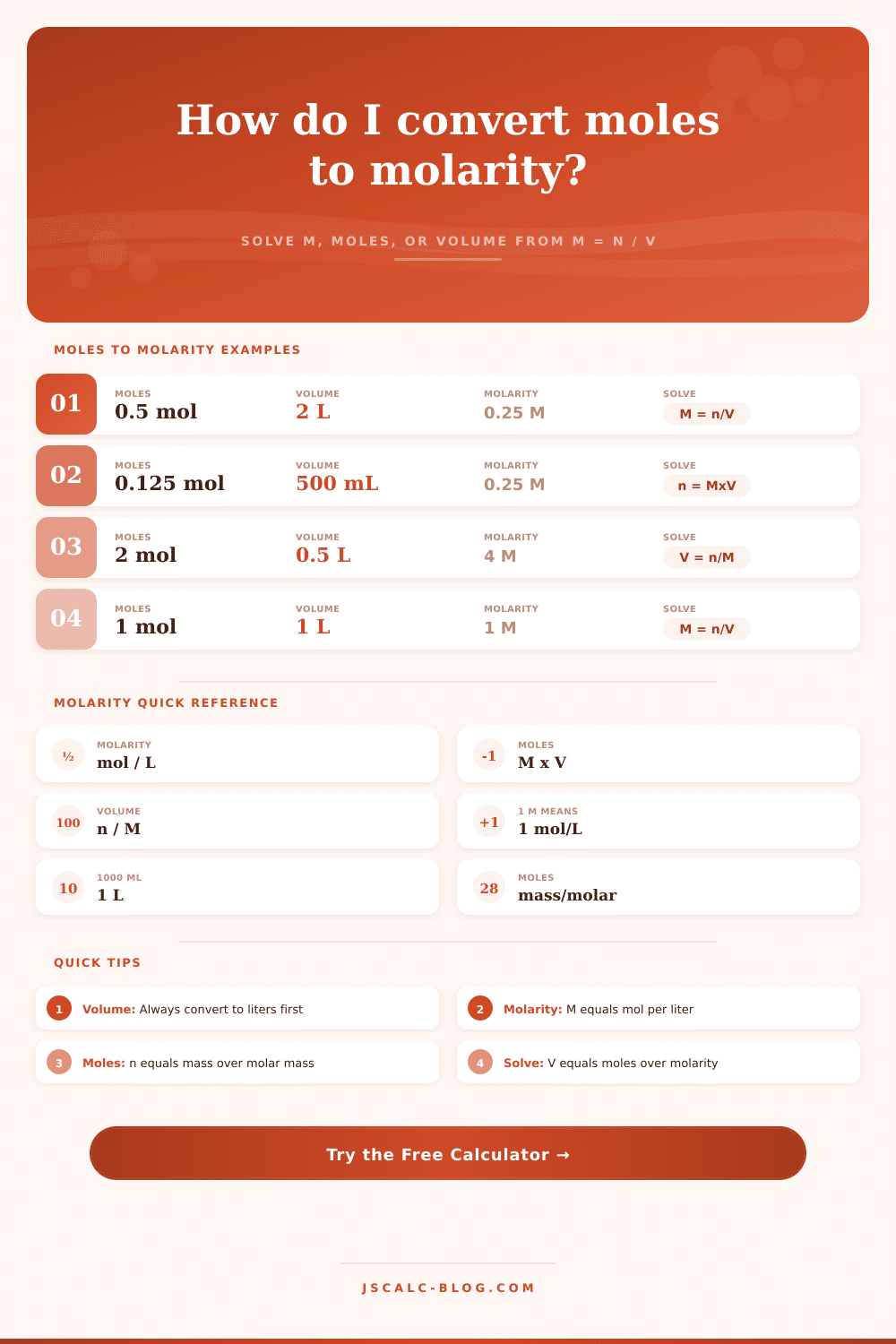
| Find molarity | 0.5 mol | 2 L | 0.25 M | 0.5 / 2 = 0.25 |
| Find moles | 0.125 mol | 500 mL | 0.25 M | 0.25 × 0.5 = 0.125 |
| Find volume | 2 mol | 0.5 L | 4 M | 2 / 4 = 0.5 |
| Unit molarity | 1 mol | 1 L | 1 M | 1 / 1 = 1 |
| Dilute base | 0.04 mol | 400 mL | 0.10 M | 0.04 / 0.4 = 0.1 |
| Micro sample | 0.0002 mol | 200 µL | 1 M | 0.0002 / 0.0002 = 1 |
⚙Full Formula Breakdown
📋Reference Values
| Quantity | Common Range | How It Is Used | Effect on Molarity |
|---|---|---|---|
| Moles | 0.001 to 5 mol | Numerator in M = n/V | More moles raise molarity |
| Volume | 50 mL to 4 L | Denominator, in liters | More volume lowers molarity |
| Molar mass | 18 to 400 g/mol | Converts mass to moles | Sets grams per mole |
| Mass | 0.1 to 500 g | Divided by molar mass | Feeds moles then molarity |
| Molarity | 0.01 to 12 M | Result or target input | Defines mol per liter |
💡Practical Molarity Tips
The volumetric flask is filled with a chemical. You’ve measured out how much. You’ve filled up the flask with water so that meniscus rests on line. But now what? What do you do when you want to know if clear solution has the right amount? That’s where molarity comes in. It connects the dots between concentration and mixing. With molarity, you’re able to tell how many grams/liter there are in your solution.
This page’s calculator will crunch the numbers for you. Knowing what those variables mean let you check for errors before they become a problem in your experiment. Molarity = moles/volume: That’s the equation, and it’s pretty straightforward. However, many students fail to realize they must convert their units from milliliters into liters, or else get confused between mass and moles. With this online tool, all you have to do is plug in your numbers and rest is calculated for you. This will save you from making conversion mistakes when you are short on time.
How to Use Molarity Calculator and Avoid Common Mistakes
Now what are moles? They’re just a scaled-up version of particles (Avogadro’s number). For example, sodium chloride has a molar mass of approximately fifty-eight point four four grams per mole. Glucose is far more massive at one hundred eighty point one six. So if you know the mass in grams, you divide by the molar mass of your given compound. The wrong molar mass messes everything up! That’s why the reference table provide common compounds such as KCl and NaCl for easy look-up.
Finally, the second trap here (and this one is also very common), is that “per liter” means molarity can be a trap for volume. Measure out a volume (say, 50 mL), and divide by the moles… you will get a value two thousand times smaller then you should of if you divided by half the volume (0.050 L = 50 mL). Why? Most people rush past the step of dividing by actual volume in liters rather than by 50. The thing to know about this is that the tool will do it for you, converting milliliters and microliters on its own. But understanding why lets you approximate what the answer will be in your head.
Double the volume, keep the moles the same; molarity is cut in half. It’s inverse proportionality in action. Why does this matter? Because it changes how your chemical(s) will react: A high concentration solution is full of stuff. There’s a lot of particles bashing into each other. This makes reactions happen more quickley. On the other hand, you don’t want it so crowded that you exceed its ability to dissolve; the excess goes to the floor, leaving you with a saturated solution. A low molarity solution is diluted. It may not react at all, or it may react gently enough to perform certain types of sensitive biological assays that wouldn’t stand up to harsher conditions. The question is: Do I want fast, or do I want stable?
If starting from scratch, pick the desired molarity, select the amount of volume that you want to make and multiply them together. This will tell you the number of moles needed, which when multiplied by the molar mass give grams. Weigh out the solid, dissolve it in a smaller amount of water than your final volume, and then add more water until you reach the mark. Don’t do it the other way around or the total volume changes and your math is wrong. You should always weigh out the solid first and then fill it up to the mark with water.
The calculator works backwards from mass as well and tells you what the molarity will be. The exact same concept carries over into dilutions, where you’re working with what moles you have and solving for volume. The only difference is you start with a given concentration of some solution, and you use the math to figure out how much total volume you need to reach your target concentration, same math. If you know your molarity and the volume, then multiplying them together gives the moles you have. Divide by the new molarity you want and you find out how much total volume you need. It’s all rearrangement of this simple fraction.
Chemistry isn’t just about following recipes; it’s about understanding ratios. Whether you’re titrating an acid or buffering a solution, concentration matters and it won’t be negotiable. One misplaced decimal point will mess up your whole batch. The tool will help you get the concentration correct, but your gut has to notice when something is off, like you need five thousand grams of salt in a liter of water. Believe the numbers, but watch out for magnitudes.
But molarity is a bridge from atomland. The invisible world of atoms… To the real world: the world of flasks and scales. The math connects those two worlds through weight. Measure the liquid; weigh the solid. If you get it right, your experiment will test what you thought it would do. It’s worth taking the time to check the units. Clarity matters that much.