Lottery Probability Calculator
Work out the true odds of winning any pick-k-of-n draw. It builds the combination C(n,k), multiplies in a separate bonus or powerball pool, and returns jackpot odds plus the chance of matching only part of your line.
🎯Real Lottery Presets
📝Draw Setup
How many balls the main draw is chosen from.
How many main numbers are drawn per line.
Size of the separate bonus / powerball pool.
Usually 1 (Powerball) or 2 (EuroMillions stars).
Main numbers matched for the partial-win odds card.
🔢Formula Snapshot
🎰Real Lottery Odds Reference
| Lottery | Main Format | Bonus | Total Combinations | Jackpot Odds |
|---|---|---|---|---|
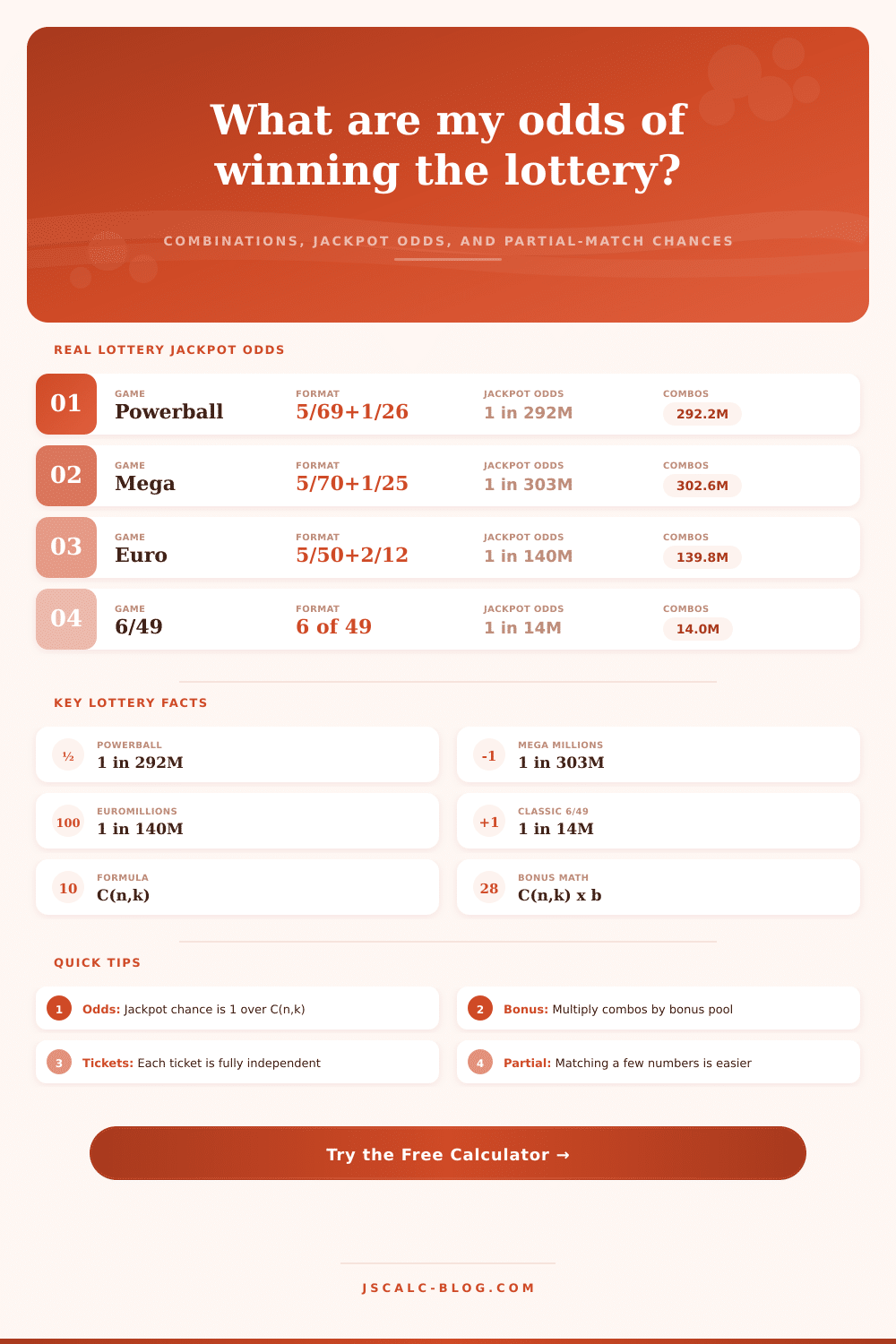
| US Powerball | 5 of 69 | 1 of 26 | 292,201,338 | 1 in 292.2 million |
| Mega Millions | 5 of 70 | 1 of 25 | 302,575,350 | 1 in 302.6 million |
| EuroMillions | 5 of 50 | 2 of 12 | 139,838,160 | 1 in 139.8 million |
| UK Lotto | 6 of 59 | None | 45,057,474 | 1 in 45.1 million |
| Classic 6/49 | 6 of 49 | None | 13,983,816 | 1 in 14.0 million |
| Pick 5 of 39 | 5 of 39 | None | 575,757 | 1 in 575,757 |
| Small State 5/35 | 5 of 35 | None | 324,632 | 1 in 324,632 |
📊Partial Match Odds (Match j of k)
| Game | Match Level | Formula Used | Approx Odds |
|---|---|---|---|
| Classic 6/49 | Match 3 of 6 | C(6,3)×C(43,3)/C(49,6) | 1 in 57 |
| Classic 6/49 | Match 4 of 6 | C(6,4)×C(43,2)/C(49,6) | 1 in 1,032 |
| Classic 6/49 | Match 5 of 6 | C(6,5)×C(43,1)/C(49,6) | 1 in 54,201 |
| Powerball main | Match 3 of 5 | C(5,3)×C(64,2)/C(69,5) | 1 in 557 |
| Powerball main | Match 4 of 5 | C(5,4)×C(64,1)/C(69,5) | 1 in 36,525 |
| Powerball + ball | Match 5 + bonus | C(69,5)×26 | 1 in 292.2 million |
🧮Combinations By n And k
| Pool n | Pick 3 | Pick 4 | Pick 5 | Pick 6 |
|---|---|---|---|---|
| n = 30 | 4,060 | 27,405 | 142,506 | 593,775 |
| n = 35 | 6,545 | 52,360 | 324,632 | 1,623,160 |
| n = 39 | 9,139 | 82,251 | 575,757 | 3,262,623 |
| n = 45 | 14,190 | 148,995 | 1,221,759 | 8,145,060 |
| n = 49 | 18,424 | 211,876 | 1,906,884 | 13,983,816 |
| n = 59 | 32,509 | 455,126 | 5,006,386 | 45,057,474 |
| n = 69 | 52,394 | 864,501 | 11,238,513 | 119,877,472 |
🌐Odds In Everyday Context
| Event | Approx Odds | Versus Powerball |
|---|---|---|
| Win Powerball jackpot | 1 in 292,201,338 | Baseline |
| Win Mega Millions jackpot | 1 in 302,575,350 | Longer odds |
| Match 6 of 49 | 1 in 13,983,816 | About 21x easier |
| Struck by lightning in a year | 1 in 1,222,000 | About 239x easier |
| Royal flush, 5-card draw | 1 in 649,740 | About 450x easier |
| Match 5 of 39 | 1 in 575,757 | About 508x easier |
⚙Full Formula Breakdown
📋Reference Values
| Symbol | Meaning | Typical Range | Effect On Odds |
|---|---|---|---|
| n | Main pool size | 35 to 70 balls | Bigger n means far longer odds |
| k | Main numbers picked | 5 or 6 usually | Higher k means many more combos |
| b | Bonus pool size | 10 to 26 balls | Multiplies total combinations by b |
| j | Partial match level | 2 to k-1 | Lower j is easier to hit |
| C(n,k) | Combination count | 0.3M to 300M | Equals the jackpot 1 in X value |
💡Practical Odds Tips
Pick up a lottery ticket. You’re standing in the checkout line, and the numbers flash on the screen as if they were a promise. We seldom think about price of hope; the actualy cost of that ticket. Knowing the odds doesn’t spoil it. It explains what sort of game you’re playing before you part with your cash.
That’s where the calculator come in. It takes all that airy probability and makes it real-world numbers. Feed it number of balls in the primary drum and the number you need to pick out. That should work for almost every major lottery, everything from your local state lottery to international jackpots. Then the calculator figures out how many unique combinations exist.
How Lottery Odds Work
A straightforward six-out-of-forty-nine selection are easy enough because there is only one set of balls to draw from. But most mega-lotteries adds a bonus ball drawn from another machine. That multiplies difficulty exponentially. Now not only do you have to nail one event, but two distinct ones. People often get tripped up by multiplication factor. “Oh, I see those are a little bigger,” they say, pointing at the balls. “They have to be about the same chances.” Nope. Each ball is chosen out of a big group and has to match at least one other ball on top of that. The tool displays both probabilities (jackpot) and totals (total combinations). That’s how it illustrates the added element of challenge.
Going from 1 in a million chance to 1 in a hundred million only requires one more condition. Understand that trade-off. That’s what accounts for rollovers when so many ticket are sold. Then there’s partial matching too. These smaller prizes fund the habit. These smaller winnings result in loss for most players. However, they happen more often then expected. Relative to winning the grand prize, you’ll find matching three or four number happen regularly.
You can change this match value and use calculator to determine how likely it is that you will hit one of these smaller prizes. This is significant because the smaller winnings sustain play; they give you something back which encourages you to keep playing so you can win again during the next draw. Remember, every drawing are independent, what happened in previous draws has no impact on what happens next. The human mind tend to fall for the gambler’s fallacy. Humans tend to buy into randomness as having some sort of pattern. Randomness have no pattern. A number won’t be “due.” It will happen randomly.
A sealed drum creates air pressure and gravity that makes numbers. There is no way to pick lucky dates. No way around avoiding bad combinations. Every single combination has equal mathematical weight. If you choose a birthday number, then you limit yourself to only thirty-one possible numbers. If those numbers aren’t drawn, then you’re already at a disadvantage.
Fanning out your numbers over the entire spectrum doesn’t increase your chances of winning. It might decrease your chances of splitting a prize with another winner who also happened to pick popular dates. You can increase your odds by buying additional tickets, though not very much. Your chance increases by a tiny amount with each ticket. For every doubling of tickets, your chance also doubles, still incredibly low.
As you’ll see from the reference data, the odds differs depending on the format of the game. While some games pay off based off smaller match sizes, others are geared toward larger jackpots. Consider which experience you’re purchasing. Ultimately, the house always wins; however, as long as you keep your expectations anchored in reality, the dream could of been possible.