Stair Stepper Calculator
Estimate the calories burned, floors climbed, total steps taken, and elevation gained during a StairMaster or stair-stepper workout. Enter your body weight, how long you climbed, and the effort level, and the tool applies MET (Metabolic Equivalent) values plus your step rate and step height to break the session down.
🏃Workout Presets
📝Workout Inputs
Enter your weight in the unit selected on the right.
Switching converts the number automatically.
Sets the MET used in the calorie formula.
Auto-filled by intensity; edit for a custom effort.
Machine cadence; higher cadence adds floors.
Picking a level fills the step rate for you.
Standard stair-machine rise is about 8 inches.
🔢At a Glance
🔥MET Values by Stepping Intensity
| Effort Level | MET | Feels Like | Typical Use |
|---|---|---|---|
| Very light warm-up | 3.5 | Easy stroll pace | First 2-3 minutes |
| Light stepping | 4.0 | Can chat easily | Recovery days |
| Steady moderate | 6.0 | Breathing up, still talk | Base cardio |
| Moderate machine pace | 8.0–9.0 | Working, short answers | General StairMaster |
| Brisk machine pace | 10.0 | Sweating, focused | Fat-burn sessions |
| Vigorous climbing | 11.0 | Hard, few words | Interval work |
| HIIT / sprint climbs | 12.0–15.0 | All-out bursts | Short intervals |
MET is the ratio of working energy use to sitting still. This tool defaults moderate machine pace to MET 10.0, matching the widely cited ~370 calories for 30 minutes at 155 lb.
⚖Calories by Weight and Time (MET 10.0)
| Duration | 130 lb | 155 lb | 185 lb | 210 lb |
|---|---|---|---|---|
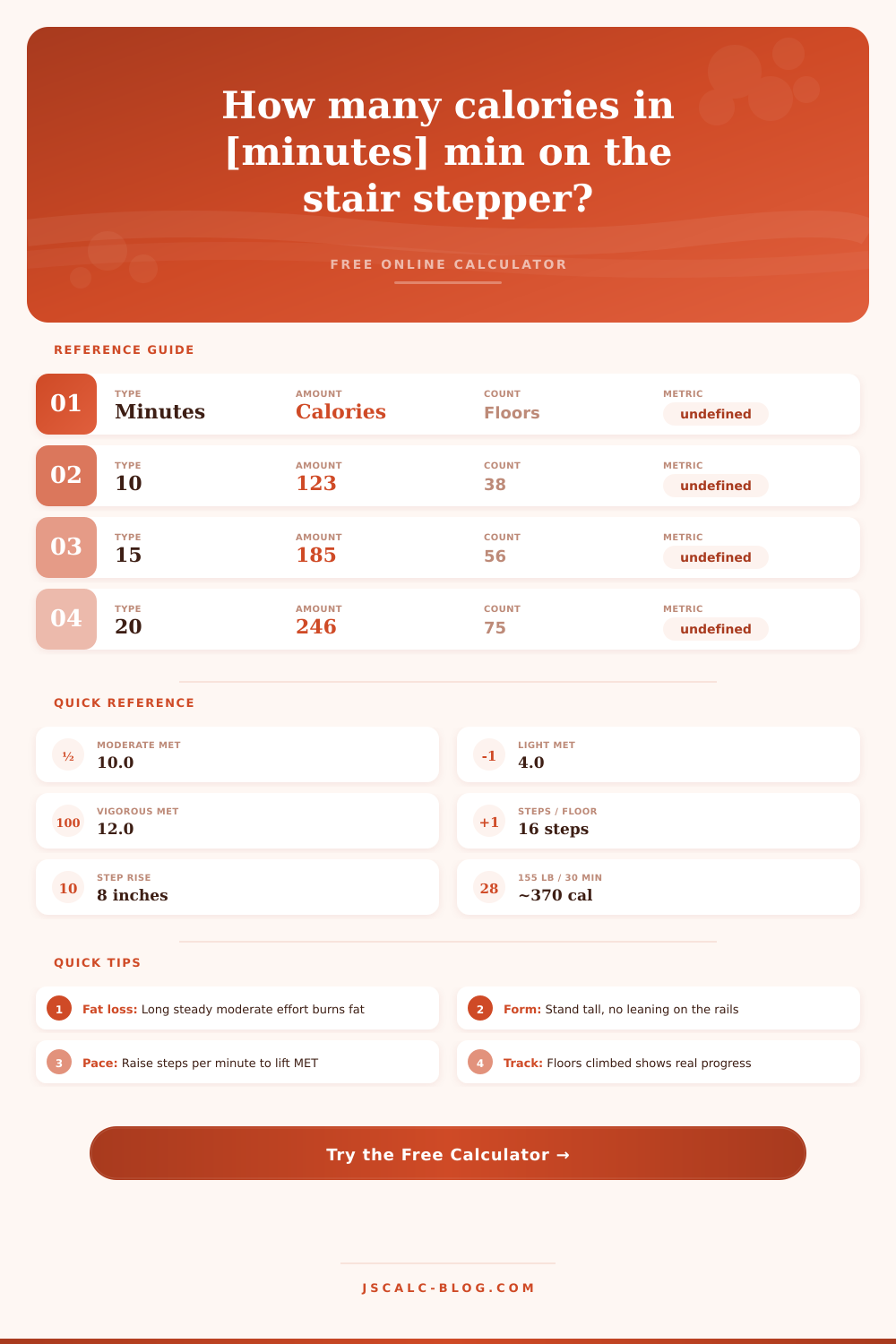
| 10 min | 103 | 123 | 147 | 167 |
| 15 min | 155 | 185 | 220 | 250 |
| 20 min | 207 | 246 | 294 | 333 |
| 25 min | 258 | 308 | 367 | 417 |
| 30 min | 310 | 369 | 441 | 500 |
| 40 min | 413 | 492 | 587 | 667 |
| 45 min | 465 | 554 | 661 | 750 |
| 60 min | 620 | 738 | 881 | 1000 |
Values use calories = MET × 3.5 × weight in kg ÷ 200 × minutes. Your own totals vary with fitness, form, and machine calibration.
🛠StairMaster Level to Step Rate
| Machine Level | Steps / Minute | Floors in 30 min | Effort Zone |
|---|---|---|---|
| Level 3 | ~55 | ~103 | Warm-up / easy |
| Level 5 | ~65 | ~122 | Steady cardio |
| Level 8 | ~77 | ~144 | Brisk / fat-burn |
| Level 12 | ~95 | ~178 | Vigorous |
| Level 15 | ~110 | ~206 | Advanced / HIIT |
Step rates vary by brand and model. Treat these as planning ranges, then read the actual cadence off your console.
📈Steps to Floors Conversion
| Total Steps | Machine Floors (16/floor) | Elevation at 8 in | Real Building Floors (10 ft) |
|---|---|---|---|
| 500 | 31 | 333 ft | 33 |
| 1,000 | 63 | 667 ft | 67 |
| 1,500 | 94 | 1,000 ft | 100 |
| 1,800 | 113 | 1,200 ft | 120 |
| 2,500 | 156 | 1,667 ft | 167 |
| 3,600 | 225 | 2,400 ft | 240 |
| 5,000 | 313 | 3,333 ft | 333 |
A gym stair machine counts 16 steps as one floor. A real building floor is about 10 vertical feet, so machine floors and building floors differ.
🌐Calorie Comparison Grid
| Duration | 130 lb | 155 lb | 185 lb | 210 lb | Session Type |
|---|---|---|---|---|---|
| 10 min | 103 | 123 | 147 | 167 | Quick top-up |
| 15 min | 155 | 185 | 220 | 250 | Beginner block |
| 20 min | 207 | 246 | 294 | 333 | HIIT finisher |
| 25 min | 258 | 308 | 367 | 417 | Lunch cardio |
| 30 min | 310 | 369 | 441 | 500 | Standard workout |
| 40 min | 413 | 492 | 587 | 667 | Fat-burn zone |
| 45 min | 465 | 554 | 661 | 750 | Endurance climb |
| 50 min | 517 | 615 | 734 | 833 | Long steady state |
| 60 min | 620 | 738 | 881 | 1000 | Athlete session |
Grid uses MET 10.0 (brisk machine pace). Drop to MET 6.0 and totals fall roughly 40 percent; push to MET 12.0 and they rise about 20 percent.
⚙Formula Breakdown
📋Reference Values
| Quantity | Value | Where It Is Used | Handy Fact |
|---|---|---|---|
| 1 pound | 0.453592 kg | Weight conversion | lb ÷ 2.20462 = kg |
| Oxygen constant | 3.5 ml/kg/min | MET calorie formula | Resting oxygen use per MET |
| Steps per floor | 16 steps | Floors climbed | Standard gym stair machine |
| Step rise | 8 inches | Elevation gained | 0.667 ft lifted per step |
| Building floor | ~10 ft | Real-floor equivalent | Typical story height |
| 1 lb of fat | ~3,500 kcal | Weight-loss planning | Cumulative deficit target |
💡Stair Stepper Tips
Estimates are for general fitness planning and education from JSCalc-Blog.com, not medical or nutrition advice. Actual calories vary with fitness level, machine calibration, and effort. Check with a professional before starting a new program.
With the stair climber, the experience is immediate; it’s straight up feedback with no momentum pushing you along. Every floor are earned with sweat and muscle. And every step has a tangible number attached to it. That’s where this page comes in: it takes all of that exertion and put it into understandable figures.
By inputting your bodyweight, how long your workout lasted, and the difficulty setting, the system use basic metabolic equations to break down the experience. No more guessing… You know exactly what your work translated to in caloric burn.
How the Stair Climber Calculator Works
That’s where the Metabolic Equivalent (MET) come into play. A single MET equals the amount of energy you expend when sitting still. Exerting yourself climbing some stairs require far more energy. To account for all of this, it scales up how hard you’re pushing through the workout based off your body size and duration of exercise. It then multiplies the MET number by an oxygen factor (which is a constant) and modify this for your body weight in kilograms. This means if you weigh more, you’ll burn more calories during any given workout. Your weight goes into the equation, which is why the calculator begins with it. You have the option of using kilograms or pounds, though either way the numbers will come out accuratey.
There is no way to say how many calories are burned exactly while walking because it vary so much by person. So most apps uses an average estimate. In this app, we assume a 155 pound person burns roughly 370 calories during a half hour of fast paced stair climbing. That’s a ballpark number. If you adjust any variable, then the final outcome will adjust to match. Double the duration, double the calories. Add weight to your body, multiply the calories accordingly. Increase pace (from gentle to fast) then add more calories. There is a menu option for light steps, brisk paces, and vigorous bursts. Or better yet, you can plug-in your specific MET value if you know precisely what effort level you’re at. That gives you more detailed control over your caloric guess.
But there’s more than calories. For many users, floors matter because they can see and measure that number over time. The tool finds the minute-per-minute step rate, multiplies it by the minutes, and divide by sixteen to get total steps. These steps is then converted into machine floors. In a standard gym stair machine, each floor equals sixteen steps. If you’re taking 60 steps a minute for half an hour, that’s 1,800 steps and approximately 113 floors.
Choosing a machine level from the menu gives you a steady pace, connecting those numbers on the screen to what actual climbing feel like. It adds vertical distance: Every step take you up a certain amount. Let’s say that every step is eight inches tall. That’s two-thirds of a foot per step. The calculator tells you how many feet that is. It also converts that number into floors of a building by assuming a ten-foot high floor. By framing the climb in terms of landmarks, it becomes an achievement. It can help you establish your goals (how much of a famous tower do I want to match in X number of days?). Having a way to track vertical gain give meaning to the workout.
In addition to pace (calories burned per minute), it will display the percentage of calories burned from fat. That’s useful for comparing workouts of varying durations. These numbers does that well because they’re ballpark figures that are more accurate then guesswork. Machines’ console readouts may not be precise, especially if you grip the rails with weight on them.
Make sure the machine is set to reflect your effort; you should of be able to talk while exercising at a moderate rate (not vigorous). Hold your hands lightly on the railings and stand tall. You will transfer some of your weight from your legs and that decrease the energy used. Even if your actual burn is reduced, the display might still tick upwards.
Use the preset buttons for typical sessions… Long endurance climbs or quick top-ups. Modify the inputs based off your goals and body. Lose weight? Build an aerobic base? Just curious? The calculator provide a rapid answer. Enter the details of your upcoming session and bookmark it.
Keep in mind: these are estimates, planning tools, not medical advice. Seek guidance from a professional before starting a strict new routine. Honest measurements require honest steps.