Molar Mass of a Gas Calculator
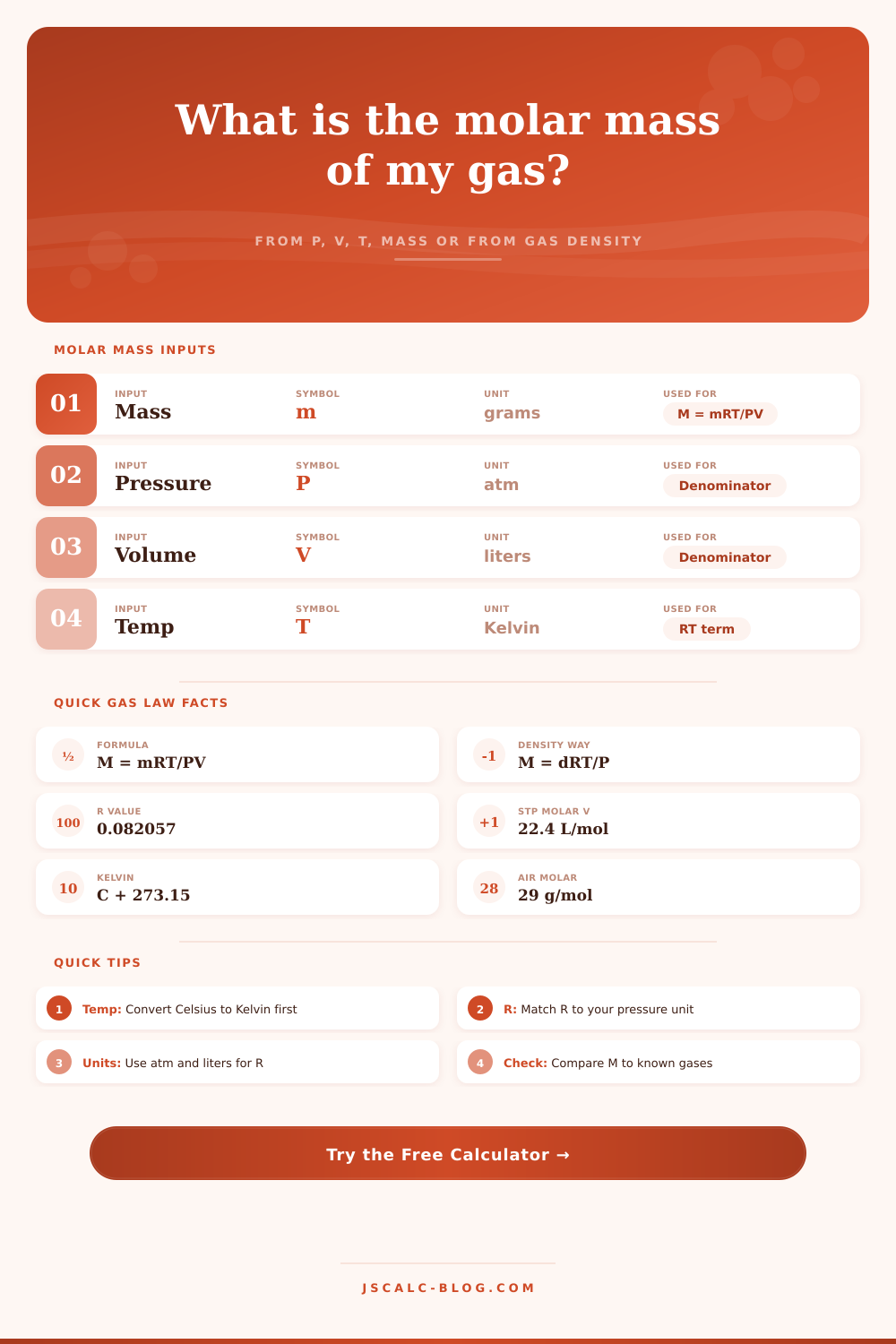
Find the molar mass of an unknown gas from the ideal gas law using pressure, volume, temperature, and sample mass, or straight from gas density. See moles, the likely gas identity, and the full M = mRT/PV work.
🧪Real Gas Presets
📝Measurement Inputs
Used in the mass and P, V, T method.
Used in the density method.
🔢Formula Snapshot
⚙Full Formula Breakdown
🗂Common Gas Molar Masses
| Gas | Formula | Molar Mass (g/mol) | Density at STP (g/L) | Moles in 1 L STP |
|---|---|---|---|---|
| Hydrogen | H2 | 2.02 | 0.090 | 0.0446 |
| Helium | He | 4.00 | 0.179 | 0.0446 |
| Methane | CH4 | 16.04 | 0.716 | 0.0446 |
| Nitrogen | N2 | 28.01 | 1.250 | 0.0446 |
| Air (mix) | – | 28.97 | 1.293 | 0.0446 |
| Oxygen | O2 | 32.00 | 1.429 | 0.0446 |
| Carbon dioxide | CO2 | 44.01 | 1.964 | 0.0446 |
| Propane | C3H8 | 44.10 | 1.967 | 0.0446 |
| Butane | C4H10 | 58.12 | 2.594 | 0.0446 |
📏Gas Constant R in Various Units
| R Value | Units | Use With Pressure | Volume Unit | Notes |
|---|---|---|---|---|
| 0.082057 | L·atm/(mol·K) | atm | liters | Used by this tool |
| 8.31446 | L·kPa/(mol·K) | kPa | liters | SI-friendly form |
| 62.3637 | L·mmHg/(mol·K) | mmHg | liters | Torr equivalent |
| 8.31446 | J/(mol·K) | Pa | m3 | Base SI energy form |
| 0.083145 | L·bar/(mol·K) | bar | liters | Bar-based labs |
🌡STP, Reference Conditions and Molar Volume
| Condition | Temperature | Pressure | Molar Volume | Common Use |
|---|---|---|---|---|
| Classic STP | 273.15 K (0°C) | 1 atm | 22.414 L/mol | Textbook gas math |
| IUPAC STP | 273.15 K (0°C) | 100 kPa | 22.711 L/mol | Modern standard |
| SATP | 298.15 K (25°C) | 100 kPa | 24.789 L/mol | Ambient reference |
| Room (RTP) | 293.15 K (20°C) | 1 atm | 24.055 L/mol | Lab bench work |
| NTP | 293.15 K (20°C) | 1 atm | 24.055 L/mol | Engineering gas flow |
| Body temp | 310.15 K (37°C) | 1 atm | 25.446 L/mol | Physiology gases |
📋Density of Gases and Vapor Density
| Gas | Molar Mass | Density at STP | Vapor Density (air=1) | Rises or Sinks |
|---|---|---|---|---|
| Hydrogen (H2) | 2.02 g/mol | 0.090 g/L | 0.07 | Rises fast |
| Helium (He) | 4.00 g/mol | 0.179 g/L | 0.14 | Rises |
| Ammonia (NH3) | 17.03 g/mol | 0.760 g/L | 0.59 | Rises |
| Nitrogen (N2) | 28.01 g/mol | 1.250 g/L | 0.97 | About neutral |
| Oxygen (O2) | 32.00 g/mol | 1.429 g/L | 1.11 | Sinks slightly |
| Carbon dioxide (CO2) | 44.01 g/mol | 1.964 g/L | 1.52 | Sinks |
| Butane (C4H10) | 58.12 g/mol | 2.594 g/L | 2.01 | Sinks |
💡Practical Molar Mass Tips
Now you’ve gathered a sample of gas. You’ve collected it and measured its pressure, volume, and temperature. And using your trusty barometer, you’ve determined the gas’ pressure. Your flask is marked off in increments of volume so you also know that. Room temperatures is constant. So…what do you have here? Carbon dioxide, ready to fizz out a reaction? Oxygen, there to make a fire blaze bright?
Molar mass is molecular-weight’s fingerprint; it tells us just what we’re looking at. This calculator does all the algebra heavy-lifting so you can spend more time thinking about the chemistry (and less time stuck trying to parse through all those units). That basic premise is based off the ideal gas law, connecting the number of moles, temperature, volume and pressure into a nice little mathematical box. When you rearrange it to solve for molar mass, you can substitute those airy abstractions with something concrete: grams per mole.
How to Identify an Unknown Gas
Enter the values or plug in density instead (assuming you have that figure at hand). Despite their wildly different chemical compositions, gases still follow a set of predictable rules under standard conditions. Plug it in and out pops not only a value but a suggestion of what that value might be by drawing from known substances.
Most students trip up on temperature in the lab. Because we’re comparing molecular motion to an absolute scale (absolute zero), the formula requires Kelvins rather than Celsius degrees. If you don’t remember to convert your room temperature measurement into Kelvin by adding 273.15, you’ll be off by almost exactly half. This error would make nitrogen look like hydrogen and so on. This kind of mistake is fatal to any real experiment.
The calculator does this conversion automatically if you choose the correct units, but knowing why it needs to happen can help prevent carelessness with mental checks or exam answers that lack the benefit of computer’s help. There’s also a bit of confusion with pressure units, which trip people up as well. Because of weather conditions and altitude, you don’t always have exactly 1 atmosphere of pressure, but just assume that there is and you’ll get slightly wrong answers.
It supports various standards for different countries or different types of equipment. It works with millimeters of mercury, kilopascals, atmospheres, and psi as well. Internally, it normalizes all this against the universal gas constant, keeping things consistent no matter what your starting units are. That’s nice, labs tend to use metric, whereas industry tends to go imperial.
After you calculate molar mass, then you’ll use that number to compare with the list of possibilities on the page. For example, if your answer is around 28 grams per mole, that narrows it down to two possible choices: nitrogen or carbon monoxide. Both are odorless and colorless, but they behave very differently when burned. Helium floats directly upwards, taking weather balloons to the stratosphere… But heavier butane sinks towards the ground where it can pose an explosion risk.
The weight allows you to predict the behavior of the gas in open space, not just for stoichiometry problems but also for safety procedures. Mass is hard to measure, unless there’s a way to estimate it from something else. One of those “something elses” is density, which is simply a comparison of mass to volume. If you can determine how much space a fixed mass occupies, you can bypass some instrumentation entirey. With enough knowledge about the system, you might not even need any instruments at all!
In field geophysics, for instance, taking precise balances into the field is impractical, but a portable pressure gauge fits neatly into your backpack. As long as the conditions are kept constant, the molar mass of a substance correspond linearly with its density, since denser molecules will take up less room per molecule at the same pressure. While this may seem like an odd exercise in academia, it has real world application as well.
How do we understand how industrial vapors behave, do they pool at machinery level or rise up towards the ceiling? What is the rate of oxygen delivery to a patient’s lungs and how does that change with varying air pressures (as you climb higher into thinner air)? Baking is another example; controlling how fast yeast ferments to get a perfect sourdough crust also requires understanding gas expansion. While the subject matter might vary greatly between these examples, the physics remain unchanged.
Now you may ask: if real world gases attract and repel one another then how can it be that ideal gas assumptions are valid? The answer is that in moderate conditions, these forces on average balance out sufficiently so that we get close enough to an accurate prediction within acceptable error bounds. Only when we reach extreme pressure and/or are approaching a condensation point do the forces between molecules starts playing a big role as compared to the volume constraints. In casual experiments, labs, etc., the ideal model is absolutely fine.
So how do we identify a gas? In short: by making it a game of detection. Treat measurement like solving a crime. Every variable is a clue, every piece helps narrow down the suspects until there’s just one reasonable explanation left. It doesn’t matter if you’re trying to figure out the engine mixture on your boat or completing a school assignment. You’ll reap the benefits of paying close attention to both the conditions and the units.
The mystery of the unknown flask isn’t magically solved, it’s broken down by thoughtful execution of basic laws, transforming a collection of numbers into a vivid image of molecular fact. And all this brings us right back to where we began: with the original question of just what it is that occupies the space in front of you.